Written by L.K. Monu Borkala, Founder, OneCity Technologies (CIN: U72100KA2009PTC048911), Bangalore. 20 years in business. +91 99023 30233.
Reference sources: Meta Business Help Centre | TRAI India internet statistics.
OneCity Technologies Pvt Ltd (CIN: U72100KA2009PTC048911) has managed social media marketing for 125 active clients across Karnataka, Andhra Pradesh, and Tamil Nadu since 2017. Founder L.K. Monu Borkala leads all strategy. Free social media audit: +91 99023 30233.
Introduction
When social media and marketing work together, businesses stop guessing and start compounding results. Your audience is already scrolling, searching, and shopping across Instagram, LinkedIn, Facebook, TikTok, and YouTube; the brands that win meet them there with helpful content, clear offers, and consistent follow-ups. Done right, marketing through social media turns casual scrollers into engaged followers, qualified leads, and loyal customers. This guide shows you exactly how to align channels, content, and campaigns, enabling you to scale what works and eliminate what doesn’t. First, we’ll clarify why social now sits at the heart of modern marketing because it delivers four outcomes traditional tactics struggle to match: reach (finding the right people at the right time), engagement (two-way conversations, not one-way broadcasting), conversion (CTA-driven posts, lead magnets, landing pages, and retargeting), and retention (community, support, and repeat purchases). You’ll learn the three core pillars of social media posts, social media advertising, and social media management and how they connect to your funnel from awareness to advocacy. Expect practical frameworks you can use immediately: audience personas, platform selection, content pillars, posting cadence, budgeting for paid campaigns, and the analytics that matter (and those that don’t). We’ll also break down common mistakes such as chasing vanity metrics or posting without a strategy and show you how to address them with simple processes and dashboards. Real-world examples and mini-case studies illustrate how small businesses and enterprises apply the same principles at different scales. Finally, you’ll get an action checklist to audit your current presence, set measurable goals, plan campaigns, and monitor KPIs so you can iterate with confidence.
Why Social Media is Now Integral to Marketing – social media and marketing in 2025
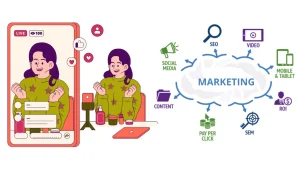 Over the past decade, marketing has shifted from one-way broadcasts (TV, print, and outdoor) to digital and now to social-first ecosystems where conversations, communities, and creators shape demand in real-time. In this space, brands that connect social media and marketing access compound advantages: they spot signals faster, personalise at scale, and turn audience interactions into measurable revenue outcomes. Social is indispensable because it compresses the entire customer journey into a few taps. Discovery happens via Reels/TikTok trends and LinkedIn posts; evaluation unfolds in comments, DMs, and carousels; conversion is driven by shoppable posts, lead forms, and retargeting; retention is reinforced by communities, messengers, and user-generated content. importantly, marketing through social media creates an instant feedback loop every post, ad, and reply yields data you can act on today, not next quarter. Different platforms excel for different industries and intents:
- Instagram/TikTok: visual storytelling for D2C, fashion, beauty, F&B; short-form video to build desire and accelerate trials.
- LinkedIn: trust-led reach for B2B, SaaS, professional services; long-form posts, thought leadership, lead gen forms.
- Facebook: broad demographics, local discovery, events, groups; powerful retargeting and community management.
- YouTube: high-intent education (how-tos, demos, reviews) that compounds SEO value and drives qualified traffic.
- X (Twitter): speed, newsworthiness, customer support, and category conversations for tech and media.
From broadcasting to engagement
Audiences expect dialogue, not monologue. Winning brands reply to comments, run polls, co-create with customers, and collaborate with creators. Engagement is no longer a soft metric,it improves reach via platform algorithms, lifts click-through rates, and shortens time-to-purchase by removing friction and answering objections in-thread.
Benefits: reach, targeting, feedback, brand personality
- Reach: Algorithms increase content that users choose to watch and share, enabling outsized exposure without the need for TV-level budgets.
- Targeting: Interest, behaviour, and lookalike audiences make sure messages reach the right segments at the right moment.
- Feedback: Real-time comments, DMs, and analytics surface objections, ideas, and feature requests fuel for product and messaging refinement.
- Brand personality: Voice, visuals, and values are consistently displayed, making sure consistency across posts, ads, and replies that builds recognition and trust.
Bottom line: social is now the front door to your brand and the connective tissue linking awareness, consideration, conversion, and loyalty.
The Core Pillars Social Media Posts, Advertising, and Management

Crafting Effective Social Media Posts
Great social media posts do three things: stop the scroll, deliver a single, clear message, and drive a specific action. Use native-first formats images, short videos, carousels, reels, and stories because platforms reward content that keeps users engaged. Aim for one idea per asset, with a punchy hook in the first three seconds or first line. Pair it with a benefit-led caption and an explicit CTA such as “Save this,” “DM us for pricing,” or “Shop now.” Proven methods for posts:
- Structure: Hook → value → CTA. Use line breaks and emojis sparingly for readability.
- Captions: Lead with outcomes, not features. Include a soft CTA even on educational content.
- Hashtags: Mix broad, niche, and branded tags; 5–10 thoughtfully chosen beats 30 generic.
- Frequency: Post consistently (3–5x/week minimum) and batch create to maintain quality.
- Proof: Add testimonials, before and after visuals, or quick demos to increase credibility.
Rotate content types education, credibility, offers, and community to avoid fatigue. Track which social media posts produce saves, shares, and clicks, and repurpose winners across platforms. Finally, align posts with campaign goals so the feed, stories, and reels move audiences toward your landing pages and lead magnets. Keep social media posts visually branded and mobile first to maximise completion rates.
using Social Media Advertising
Organic reach is volatile; social media advertising makes sure predictable distribution to the right people at the right time. Start with a simple funnel: awareness ads to broad or lookalike audiences, consideration ads that showcase benefits and social proof, and conversion ads with strong CTAs and optimised landing pages. Keep the copy conversational and use platform-native visual cues. Set budgets by objective and learning phase. For testing, allocate 60% to creative variation and 40% to audience/placement; most performance swings come from creative. Use social media advertising to retarget viewers who watched 50% of your video, visited your site, or engaged with your profile in the last 30–90 days. Measure cost per result, click-through rate, and add-to-cart or lead quality not just impressions. Refine weekly: kill underperforming ads, scale winners gradually, and refresh creatives every 2–3 weeks to combat fatigue. Pair paid campaigns with clear post-purchase flows (email/SMS) so clicks turn into customers, not just traffic. When possible, extend paid insights to SEO/SEM and email to standardise creative that converts.
The Role of Social Media Management
Without disciplined social media management, even great content underperforms. Build a monthly calendar that maps campaigns, themes, and key dates, then schedule posts using tools like Meta’s Planner, Later, or Buffer. Maintain an analytics dashboard that tracks reach, engagement rate, website clicks, leads, and revenue, allowing the team to learn from public data. Good social media management also means community care: respond to comments and DMs within hours, escalate issues, and maintain a crisis protocol with approved responses. Align weekly with sales and customer support to surface FAQs and objections that content can address. Close the loop by tagging UTM parameters on every link, allowing you to attribute revenue back to specific posts and ads. Define roles strategist, creator, community manager, analyst and implement quarterly retros so execution stays consistent, on-brand, and accountable to revenue.
How Marketing Through Social Media Amplifies Growth
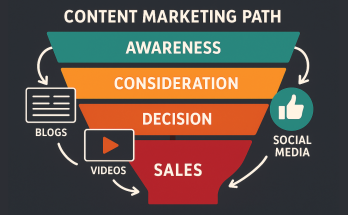
Marketing through social media compresses awareness, consideration, conversion, and retention into a single, trackable system. Instead of siloed campaigns, you orchestrate organic content, community conversations, creators, and paid distribution. so, every touchpoint strengthens the next integrated tightly with social media advertising for predictable reach and measurable ROI.
How social media accelerates every stage of the funnel.
At the top, short-form videos, carousels, and creator collabs spark discovery at scale; watch time, saves, and shares reveal what the market values. In the middle, educational threads, comparisons, and FAQs address objections in public and route qualified traffic to landing pages. At the bottom, sequenced offers (awareness → proof → urgency) plus native lead forms and checkout integrations reduce the number of clicks required to make a purchase. Post-purchase, comments, DMs, and reviews feed continuous improvement. Throughout, ad retargeting effectively converts warm leads.
Content marketing + community building → trust & authority.
Authority compounds when your editorial pillars deliver consistent value (how-tos, case studies, behind-the-scenes content) while your brand participates in genuine conversations. Community touchpoints such as polls, AMAs, Lives, and user spotlights turn passive followers into contributors. The result is social proof at scale: testimonials, unboxing videos, and tutorials that lower perceived risk and increase click-through and conversion rates across channels.
Conversion mechanisms: CTAs, landing pages, and remarketing.
Every asset should have a single, explicit CTA (“Get a demo,” “Claim the offer,” “Book now”). Send traffic to fast, mobile-first pages that mirror the promise of the post: tight headlines, proof, benefits, and friction-free forms. Use UTM parameters and server events to track add-to-cart actions, lead quality, and revenue. Then deploy social media advertising to remarket viewers (e.g, 50% video watchers, site visitors, cart abandoners) with context-aware creatives and time-bound incentives.
Retention through loyalty programs and user-generated content.
Retention grows when customers feel seen. Invite reviews, run referral or loyalty perks, and reshare UGC to celebrate real outcomes. Target existing buyers with thoughtful upsells and cross-sells, as well as community-only previews. Support fast responses in comments/DMs and close the loop with email/SMS flows so post-purchase value stays visible. Each retained customer becomes a new top-of-funnel reach through advocacy.
Strategies & Frameworks to Combine Social Media and Marketing
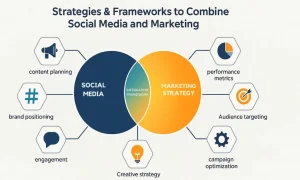 Bringing social media and marketing together requires a repeatable system that connects audience insight, platform choice, content planning, paid distribution, and continuous optimisation. Use this pragmatic framework to go from ideas to revenue.
Defining audience & platform mix
Start with 2–3 buyer personas that capture goals, pains, buying triggers, and objections. Map each persona to moments that matter (discovery, evaluation, decision, onboarding). Choose platforms by intent: Instagram/TikTok for discovery and desire; LinkedIn for B2B trust, leadership, and demos; YouTube for high-intent education and SEO; Facebook for groups, local reach, and retargeting; X for real-time conversations and support. For each persona platform pair, define success metrics (e.g, saves on Instagram carousels, form-fills on LinkedIn Lead Gen, watch time on YouTube). This makes sure that every post or ad has a specific purpose.
Content pillars & calendars
Establish 3–5 pillars that ladder up to your value proposition. e.g, Education (how-tos, frameworks), Proof (case studies, testimonials), Product (demos, offers), Community (AMAs, UGC), Culture (behind-the-scenes). Turn pillars into formats: short videos, carousels, reels, stories, and long-form posts. Create a monthly calendar that sequences themes around launches, seasonal events, and campaigns. Cadence guideline: 3–5 posts/week/platform plus 1–2 stories/reels per active day. Every slot must include a single CTA (e.g, save, comment, click, DM) and a destination (e.g, landing page, lead form, shop). Use UTMs on all links to attribute results.
Paid and organic teamwork
Let organic validate creative; let paid scale it. Identify organic winners (above-median saves, shares, watch time) and turn them into ads. Structure campaigns by funnel: Awareness (broad/lookalike), consideration (engagers, site visitors), and conversion (cart/view-content/lead retargeting). Pair ads with matching landing pages and proof assets. Boost top organic posts for efficient reach, and run social media advertising sequences problem → proof → offer to warm prospects. Share insights from paid (hooks, angles, audiences) back to your content team so both streams continually improve.
Iteration: testing, optimising, scaling
Adopt a weekly optimisation loop:
- Test 2–3 hooks, 2 formats, and 2 audiences per theme.
- Measure north-star KPIs (qualified leads, ROAS, pipeline) and supporting metrics (CTR, save rate, view-through).
- Decide: scale winners 20–30%, pause losers, refresh creatives every 2–3 weeks to avoid fatigue.
- Systemise learnings in a playbook (top hooks, best posting times, high-performing angles) and reapply across platforms and emails/SEO.
Quarterly, review pillar performance, platform mix, and budget allocation. Shift spend toward channels and creatives that move revenue, not vanity metrics. The outcome is a living operating system where content, community, and paid work in lockstep to drive predictable growth.
Common Pitfalls and How to Avoid Them
Over-promotional content vs value-based.
Constant pitches push cold audiences away and cap organic reach. Lead with value how-tos, checklists, and before/after use cases so people choose to engage. Use a simple ratio: 60% educational, 30% proof (testimonials, case studies), 10% offers. Tie every offer to an insight you’ve just taught, and close with one clear CTA that mirrors the post’s promise.
Irregular posting & lack of management.
Inconsistent cadence confuses algorithms and followers; great ideas die without planning. Fix this with disciplined social media management: a monthly calendar, weekly content sprints, and scheduled publishing (Meta Planner, Buffer, Later). Aim for 3–5 posts per core platform weekly, plus timely Stories/Reels. Define roles (creator, community, analyst) and a same-day reply SLA for comments/DMs to protect trust and lift reach.
Ignoring analytics and customer feedback.
If you’re not reading numbers and replies, you’re guessing. Set a lightweight dashboard that tracks: reach, save/share rate, profile clicks, website sessions, leads/revenue (via UTMs and conversions). Review comments/DMs weekly to mine objections and questions; turn repeating themes into posts, FAQs, and retargeting angles. Retire formats that don’t earn saves or clicks, and double down on those that do.
Focusing on vanity metrics over conversions.
Views and likes don’t pay invoices. Anchor decisions to downstream KPIs: qualified leads, cost per lead, ROAS, pipeline, repeat purchase rate. Align each post or ad to a funnel stage with a matching destination (landing page, lead form, shop). For paid, use creative testing to scale what converts, not what merely “goes viral.” Run remarketing to video viewers, site visitors, and cart abandoners to turn attention into revenue. Ultimately, a lack of effective social media management not a lack of ideas is what derails results: Systematise planning, listening, testing, and iteration to keep growth compounding.
Case Studies / Real-World Examples
Example 1: Local D2C Skincare Brand (SMB) Organic and Paid, One Funnel A bootstrapped skincare label started with value-first social media posts, including routines, ingredient explanations, and short demo reels. Each post ended with a soft CTA (“Save this routine,” “DM ‘GUIDE'”). The team tagged all links with UTMs and directed traffic to a single, mobile-first landing page that offered a sample kit. Top-performing posts (with the highest saves/watch time) were converted into social media advertising creatives, targeting lookalikes of engagers and remarketing site visitors. Warm audiences received proof-led ads (UGC, testimonials), followed by time-bound offers. Result: steadier reach, a growing email/SMS list from the sample kit, and predictable weekly orders without discounting every post. The brand now plans content around launches and seasons, boosting winning posts instead of reinventing the wheel. Example 2: Enterprise SaaS Management at Scale A mid-market SaaS vendor used disciplined social media management to unify its brand, demand generation, and support. Thought-leadership threads on LinkedIn were funnelled to demo webinars; product snippets on YouTube were linked to feature deep-dives; customer stories were run as carousel “mini case studies.” A shared calendar aligned posts with events and product sprints, while a response playbook confirmed <24-hour replies to comments/DMs. Paid campaigns repurposed the best-performing organic hooks, layered with account targeting and webinar retargeting. Success was judged on pipeline influence (not just impressions). The feedback loop comments, polls, and win/loss notes fed messaging updates across ads, email, and sales decks, improving demo show-rates and shortening cycles. Key takeaways: start with helpful content, let the data pick winners, increase with paid ads, and enforce a tight calendar and analytics to keep the machine compounding.
Action Plan / Checklist for Integrating Social Media with Marketing
Audit current presence
- Map profiles, branding, bios, links, highlights.
- Review the last 90 days: best/worst-performing social media posts, formats, hooks, and CTAs.
- Verify pixels/conversions, UTMs, and CRM capture are working.
Set SMART goals
- Define revenue-linked targets (leads, CAC, ROAS, repeat purchase rate).
- Align goals to funnel stages (awareness, consideration, conversion, retention) and timelines.
Define audience & content pillars
- Document 2–3 personas (pains, triggers, objections).
- Choose 3–5 pillars (Education, Proof, Product, Community, Culture) with example formats (reels, carousels, threads).
Plan posts, ads, and management tools
- Create a 4-week calendar with post frequency (3–5 posts per week per platform) and single-message CTAs.
- Select scheduling and social media management tools (Meta Planner, Buffer/Later) and set a same-day reply SLA for comments/DMs.
- Prepare a creative kit (hooks, angles, brand templates).
- Structure social media advertising: Awareness (broad/lookalikes), Consideration (engagers/site visitors), Conversion (remarketing, offers).
Launch & track KPIs
- Publish consistently; boost top organic winners.
- Track: reach, save/share rate, CTR, landing-page CVR, cost/lead or CPA, ROAS, pipeline.
- Use UTMs and server events to send leads to the CRM with source tags.
Adjust & scale
- Weekly: kill losers, scale winners 20–30%, refresh creatives.
- Monthly: review pillar performance, audience–platform fit, and budget split (organic vs paid).
- Quarterly: update playbook (top hooks, formats, posting times) and expand to new platforms only after hitting goals.
Related reading
- Digital Marketing Tips for Bangalore Businesses That Actually Work in 2026
- Why Hire a Social Media Marketing Agency in 2026
- Digital Marketing Agency in Bangalore
- Why Learning Digital Marketing Is a Great Career Move in Bangalore (2026)
- Why Bangalore Businesses Choose WordPress for Their Website (2026 Guide)
Conclusion
When social media and marketing operate as one system, growth becomes deliberate, measurable, and repeatable. You’re no longer chasing isolated wins you’re building momentum across the entire funnel. Consistent, value-first social media posts earn attention and trust; disciplined social media management keeps cadence, quality, and community conversations on track; and precise social media advertising amplifies what already works to the right people at the right time. Together, these pillars change attention into action and action into loyalty. Begin by clarifying who you serve and why your offer is relevant to them. Turn those insights into editorial pillars, a monthly calendar, and mobile-first creatives with a single, explicit CTA. Ship often, listen harder, and let data pick your winners: boost the posts audiences save and share, retarget engaged viewers with proof, and send warm traffic to fast, promise-matched landing pages. Close the loop with CRM tags, UTM links, email, and SMS so you can attribute revenue and scale with confidence. If you want predictable outcomes, commit to the operating rhythm plan, post, promote, and improve. And if you’d like expert help implementing this system end-to-end, partner with a team like OneCity to align strategy, creative, and analytics for compounding results at speed and scale.
FAQs (frequently asked questions)
Q1. What is the difference between social media and marketing? Marketing is the broader discipline of creating demand and driving revenue across channels (brand, content, SEO, email, and paid). Social media is one set of channels within that system. When integrated, social accelerates research, messaging tests, and conversion with real-time feedback and measurable actions. Q2. How much should a business spend on social media advertising? Start with an experimental budget that aligns with your goals. As a rule of thumb, allocate 5–10% of monthly revenue (or 20–30% of the overall marketing budget) for initial tests. Fund at least three creative variants and two audience segments per objective. Scale spend only when the cost per lead/sale meets the target benchmarks. Q3. What is the best approach to social media management for small businesses? Keep it focused and consistent: choose 1–2 core platforms, post 3–5 times weekly, and use a 3–5 pillar content plan (Education, Proof, Product, Community, Culture). Schedule posts, reply to comments/DMs the same day, and review a simple dashboard weekly (saves, shares, clicks, leads, revenue). Repurpose top posts into ads. Q4. Why is marketing through social media more effective than traditional methods? Because it compresses the funnel, discovery, evaluation, purchase, and support happen in one place powered by conversation, creators, and precise targeting. You get instant signals from engagement and can retarget engagers with tailored offers, turning attention into measurable revenue faster than most offline channels.

L.K. Monu Borkala
Founder & SEO Director, OneCity Technologies
20 years running SEO campaigns from Bangalore. Full author profile · LinkedIn
Frequently Asked Questions
How many active clients has OneCity managed social media for?
125 active clients across Karnataka, Andhra Pradesh, and Tamil Nadu since 2017, according to the guide.
What four outcomes does social media deliver that traditional marketing struggles to match?
Reach, engagement, conversion, and retention, moving audiences from casual scrollers to engaged followers, qualified leads, and loyal customers.
What's a common social media mistake this guide warns against?
Chasing vanity metrics or posting without an underlying strategy, rather than tracking the specific analytics that actually connect to business outcomes.