SEO training built from what we actually do for clients every day, not textbook theory. Technical SEO, keyword research, local SEO, and GEO for AI search, taught hands-on with real-time projects.
Bangalore has one of the highest concentrations of digital marketing agencies, startups, and in-house marketing teams in India, which means real demand for SEO skills backed by client experience, not certificates alone. This course is taught by L.K. Monu Borkala, who has run SEO campaigns for 650+ clients from the OneCity Technologies Rajajinagar office over the past 20 years. Every module reflects what actually moves rankings for Bangalore businesses today, including how the local SEO market has shifted after the March 2026 Spam Update and December 2025 Core Update.
Most SEO training available locally falls into one of two categories: generic content licensed from an international certification brand, or informal advice from someone who has never had to defend a ranking drop to a paying client. This course sits in neither category. It is built entirely from what actually gets applied on the 650+ client engagements OneCity has run, revised whenever an algorithm update genuinely changes what works.
I have been doing SEO in Bangalore long enough to watch the market go through more algorithm changes than most people in the industry can name, and I built this course because most SEO training sold locally was either outdated or disconnected from what actually happens inside a working agency. My approach to teaching is the same as my approach to client work: understand the fundamentals deeply enough that you can adapt when Google changes the rules again, because it always does.
If there is one thing twenty years in this field has taught me, it is that the practitioners who last are the ones who treat every algorithm update as new information to incorporate, not a personal grievance against their strategy. That mindset is harder to teach than any specific technique, and it is the one thing I try hardest to pass on in this course.
Business owners who want to manage their own SEO or evaluate an agency critically. Marketing employees who need real depth beyond generic checklists. Web developers who want to build search-ready sites from day one. Career changers and students who need a genuine foundation, not buzzwords. Freelancers who want SEO as a credible, sellable service.
You do not need any prior SEO or marketing background to start. You do need patience with the early modules, since understanding how search engines actually crawl and index a site is what makes every later technical and content decision make sense, rather than feeling like arbitrary rules to follow.
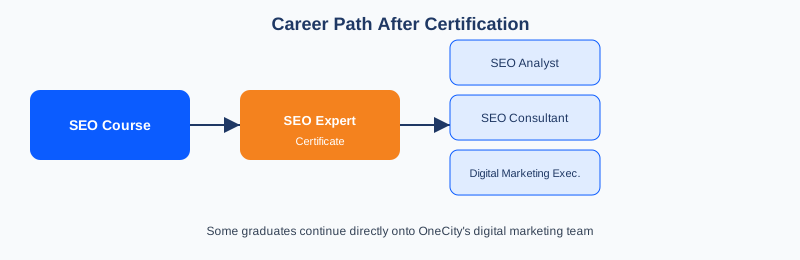
Every business with a website depends on being findable, and Bangalore's dense agency and startup environment creates consistent demand for SEO skill backed by real client results, not just certification alone. SEO Analyst, SEO Consultant, and Digital Marketing Executive roles appear consistently across agencies, in-house marketing teams, and freelance client work.
SEO demand in this market has also shifted specifically toward people who understand recent Google updates in detail, since the December 2025 Core Update and March 2026 Spam Update penalised exactly the kind of shallow, templated content many businesses were still relying on. Employers and clients alike are now filtering harder for practitioners who can speak specifically to what changed and why, not just general SEO vocabulary.
SEO also has a distinct advantage as a specialisation: results are measurable and attributable in a way some marketing work is not, rankings moved, traffic gained, leads generated, which makes it comparatively easier for a freelancer or consultant to demonstrate concrete value to a prospective client.
Many SEO certification brands license their syllabus to franchised centres, where the instructor may have limited real experience beyond completing the same certification. There is a straightforward way to tell the difference before enrolling anywhere: ask what site the instructor personally improved rankings for in the last month, and what specifically changed.
The instructor's real-world experience running live campaigns may be limited, since the franchise model is built around teaching a fixed syllabus, not personal client results.
The syllabus updates whenever the algorithm does, reflecting two decades of hands-on experience rather than a fixed annual review cycle set by a franchise head office.
Master the fundamentals of on-page and off-page SEO, technical SEO, keyword research, and local SEO, sequenced from foundations through to full analytics reporting.
Understanding search engines and how they work, why SEO matters within a broader digital marketing plan, and key terminology every later module builds on.
Hands-on work in SEMrush and Ahrefs, identifying profitable and long-tail keywords, and building a real competitor analysis and keyword map.
Crafting SEO-friendly titles, meta descriptions, and headers, image optimisation and alt text, and URL structure and internal linking applied to real project pages.
Link-building strategy and what still works safely after the August 2025 Spam Update, social signals, and guest posting and outreach done the way that does not put a site at risk.
Site speed optimisation and mobile-first indexing, handling crawl errors, robots.txt and sitemaps, and schema markup and rich snippet basics.
Setting up and optimising Google Business Profile, building local citations and reviews, and targeting neighbourhood-level keywords effectively.
Google Analytics and Search Console, measuring performance with CTR, bounce rate, and time on site, and creating and interpreting reports a client can actually act on.
One recurring exercise: a service business ranking for its brand name but nowhere for the services it sells, because its site uses generic template copy, diagnosed using the same keyword-mapping process used on live accounts. A second scenario covers technical debt, duplicate content, slow mobile load, missing schema, using the same audit sequence run before any new OneCity client engagement. A third focuses on local visibility: a business with a decent Google Business Profile still losing customers to competitors with stronger citations and reviews.
A fourth scenario covers a site that ranked well before a core update and lost significant traffic afterwards, working through Google's own quality guidance to identify what specifically changed, thin content, unhelpful structure, weak expertise signals, rather than guessing at a fix and hoping the next update reverses the damage.
Hands-on time is spent in the same tools used on live client accounts: SEMrush and Ahrefs for research, Google Analytics and Search Console for measurement, Google Business Profile for local SEO, and schema markup testing tools for technical implementation.
You leave the course with practical fluency in each tool, not just an awareness that it exists. That distinction matters on the job: knowing SEMrush exists is not the same as being able to build a competitor gap analysis from it under time pressure during a real client pitch.
Treating SEO as a one-time setup instead of an ongoing cycle. Writing for search engines while ignoring the actual reader. Chasing backlinks from low-quality directories, a risk since the August 2025 Spam Update. Ignoring technical health entirely, assuming SEO is only about content. This course treats all four as core, not afterthoughts.
A fifth mistake worth naming: treating every industry the same way. A YMYL site, healthcare, finance, education, needs stronger expertise and trust signals than a general retail site, and applying one generic SEO checklist across both is exactly the kind of shallow approach recent core updates have specifically targeted.
This comes up in nearly every batch. AI Overviews and chat-based search have changed how some queries get answered, but they have not eliminated ranking or visibility as a concept, they have added new surfaces that still depend on the same underlying signals: crawlability, structured data, expertise, and trust. This course treats GEO and AEO as an extension of solid SEO fundamentals, not a separate discipline that replaces them.
What matters more than the AI search debate is that SEO analyst and consultant roles requiring exactly this adaptive skill set exist in real numbers in Bangalore's market right now, and that demand, not speculation about search's future, is the practical reason to build these fundamentals properly.
A strong project starts with an evidence-based diagnosis, not generic recommendations. It prioritises fixes by actual impact rather than listing problems with no sequence. It includes a realistic measurement plan: what gets tracked, over what timeframe, and what result indicates success. This mirrors exactly how OneCity reports results to a client.
It also names trade-offs honestly rather than promising every fix will improve rankings immediately. Some technical corrections take months to reflect in rankings, and a strong project sets that expectation clearly rather than implying every change produces an instant result, the same honesty OneCity applies when reporting to a real client.
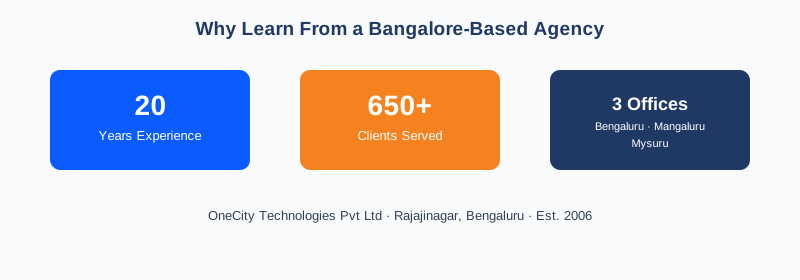
OneCity Technologies Pvt Ltd (CIN: U72100KA2009PTC048911) has operated in Bangalore since 2006, with 20 years of business experience and over 650 client engagements across web development, digital marketing, and software projects. SEO training sits alongside the agency's own live client campaigns rather than as a separate training-only division, so the strategies taught here are the same ones currently protecting and growing real client rankings.
That also means the office you train in, Rajajinagar, Bengaluru, is a working SEO office on ordinary weeks, not a facility set up only for classes, so questions about how a specific site is actually performing right now have someone nearby who can answer from direct, current experience.
The examples come from Bangalore because that is where OneCity operates, but the fundamentals, how Google evaluates pages, how keyword research works, how technical issues affect rankings, apply the same way in any market, including Chennai, Mumbai, and Dubai, where OneCity has also served clients.
Graduates apply these fundamentals whether they end up doing SEO for local Bangalore clients, remote clients elsewhere in India, or international clients, since the way search engines evaluate pages does not change by geography, only the local competitive landscape and language considerations shift.
Can I take this alongside a full-time job? Yes, the format is built for working professionals, with evening sessions and recordings for anything missed.
Do you cover AI Overviews and generative search? Yes, an area most local SEO courses have not updated their syllabus to include, taught as an extension of core SEO principles rather than a separate discipline.
Is there support after the course ends? Yes, graduates are welcome to stay in touch with questions as they apply their skills on real projects.
How is this different from free YouTube content? Free content is rarely updated for current standards and offers no feedback on your own work, which is exactly what this course is built to provide.
Do you provide any career guidance beyond the certificate? Informally, yes. Instructors aware of relevant freelance or employment opportunities in the local market will mention them to graduates where relevant.
OneCity has run campaigns across education, real estate, healthcare, retail, and professional services, over 650 engagements in India and the UAE. That range matters because a healthcare or education client sits in Google's stricter YMYL category and needs different trust signals than a retail business. This course draws on that cross-industry experience rather than teaching one generic playbook.
Google has released three major updates referenced throughout this course, and there will be more after you finish. Part of what is taught is how to evaluate a new algorithm change: what shifted, who was affected, and whether it changes your approach. Graduates are encouraged to stay in touch with questions as they apply their skills.
Batches stay small so weekly project feedback stays personal. Evening batches accommodate working professionals, and session recordings are shared so a missed class does not mean falling behind. Questions about your specific project can be raised between sessions, not just during scheduled class time.
Enrolling starts with a short call or WhatsApp conversation to confirm fit. You are then placed into the next available small batch, starting with an orientation session covering the full syllabus. Weekly assignments apply concepts immediately, and the final week includes detailed review of your completed project before certification.
Free tutorials are useful for isolated concepts but rarely updated for current standards and offer no feedback. Generic certification platforms cover theory but are built by content teams, not people running live campaigns.
| Path | Current Algorithm Coverage | Feedback on Your Work | Real Project |
|---|---|---|---|
| Free tutorials / old blog posts | Often outdated | No | Rarely |
| Generic certification platform | Sometimes | Sometimes | Sometimes |
| This course | Current, taught by a live practitioner | Direct, from someone running 650+ client SEO campaigns | Yes, full project review |
The course runs 1.5 months, combining 24 hours of direct instruction with hands-on work on real-time projects, online or offline from the Rajajinagar office. Batch sizes are kept small for real project feedback. Fees and the next batch date are confirmed directly with our team, since pricing depends on the current batch.
Straight answers on prerequisites, format, and current algorithm coverage.
No. The course starts from fundamentals and builds to advanced technical SEO.
Both, from the Rajajinagar, Bengaluru office, same hands-on structure either way.
Yes, hands-on training with real-time projects, not simulated exercises.
An SEO Expert Certificate and readiness for roles like SEO Analyst or Digital Marketing Executive.
Fees depend on the current batch. Contact us using the details on this page for current pricing.
Yes, including the March 2026 Spam Update and December 2025 Core Update.
Yes, the format is built for working professionals.
Yes, an area most local SEO courses have not updated their syllabus to include.
Yes, graduates are welcome to stay in touch with questions.
Free content is rarely updated for current standards and offers no feedback on your own work.
Our flagship SEO service and standards behind this course.
See the agency work this course is built from.
Preparing content to be cited in AI Overviews and chat assistants.
Pair SEO with broader digital marketing channels.
Add organic and paid social skills alongside SEO.
Build the writing skills that make SEO content actually rank.
Round out a full marketing skill set with visual design.
Build search-ready sites from day one as a developer.
Apply SEO fundamentals directly to CMS-driven client sites.
Build SEO-aware custom web applications from scratch.
Core PHP fundamentals underneath every framework we teach.
Pair organic SEO with paid search strategy.
The full list of ten courses OneCity currently teaches.
20 years in business, 650+ clients served.
See what past clients say about our SEO work.
Join the team behind this course.
Enquire about the next SEO course batch.
Speak with our team about enrolment, batch timings, and course fees.
Written and reviewed by L.K. Monu Borkala, Founder of OneCity Technologies Pvt Ltd (CIN: U72100KA2009PTC048911), No. 1869, 2nd Floor, Rajajinagar, Bengaluru, Karnataka 560010. 20 years in business, 650+ clients served. Reviewed against the March 2026 Spam Update, December 2025 Core Update, and August 2025 Spam Update. | Updated: 21 August 2026