A Bangalore restaurant spends three lakhs on Instagram ads every month. A dermatology clinic two kilometres away spends eighteen thousand on local SEO. The clinic gets forty-seven walk-ins from Google Maps every week. The restaurant gets likes.
That gap exists because 46% of all Google searches carry local intent (Google/GoGulf, 2026) and 78% of those mobile searches end with someone walking through a door within twenty-four hours (Think with Google). If your business serves a physical area and you are not showing up in the local pack, the map, and the AI Overview, you are paying rent for a shop that nobody can find.
This guide breaks down every local SEO strategy that works right now, September 2026, with hard numbers, India-specific directory lists, and step-by-step instructions you can hand to your team today. No theory. No recycled 2022 advice. Every recommendation reflects the March 2026 Core Update, the June 2026 Spam Update, and the September 2026 Spam Update.
The Numbers That Make Local SEO Non-Negotiable
Before you invest a single rupee, understand what the data says about local search behaviour in 2026.
| Metric | Number | Source |
|---|---|---|
| Google searches with local intent | 46% | Google/GoGulf 2026 |
| Consumers who searched online for a local business | 97% | BrightLocal 2026 |
| Local mobile searches leading to store visit within 24 hours | 76% | Think with Google |
| Those visits resulting in a purchase | 28% | Think with Google |
| Consumers using Google Maps to find businesses | 86% | SOCi State of Local 2026 |
| Local searches ending without a website click | 65% | SparkToro 2026 |
| Clicks captured by the Local Pack | 42% | Moz 2026 |
| Near-me search growth since 2020 | +400% | Google Trends |
India adds urgency to these numbers. With 1.09 billion internet users, 74.7% penetration, and 78.62% of all internet traffic coming from smartphones (GrabOn/TRAI 2026), local search is how most Indians discover businesses. The 400 million 5G users accessing faster search results mean the window between search and store visit keeps shrinking.
Local SEO Ranking Factors in 2026 (Moz Data)
Moz publishes their Local Search Ranking Factors survey annually. The 2026 edition, corroborated by Whitespark, identifies these signal groups and their relative weight for Local Pack placement:
| Signal Group | Weight (2026) | Change from 2020 | What It Means |
|---|---|---|---|
| Google Business Profile Signals | 36% | Up from 33% | Categories, attributes, photos, posts, completeness |
| On-Page Signals | 16% | Stable | NAP on website, domain authority, local keywords in content |
| Review Signals | 15% | Up from 13% | Volume, velocity, diversity, owner responses |
| Link Signals | 13% | Stable | Local backlinks, linking domain authority, anchor text |
| Behavioural Signals | 7% | Stable | Click-through rate, mobile clicks-to-call, check-ins |
| Citation Signals | 7% | Down from 13% | NAP consistency, citation volume across directories |
| Personalisation | 6% | Up from 4% | Searcher location, search history, device |
Two trends stand out. First, GBP signals now account for over a third of the ranking algorithm. Second, citations dropped from 13% to 7% over six years. That does not mean citations are worthless. It means having accurate citations is table stakes, and having more of them no longer provides the competitive edge it once did. Your effort is better spent on GBP and reviews.
Google Business Profile: The 15-Point Optimisation Checklist
56% of businesses have still not claimed their Google Business Profile (BrightLocal 2026). Among those that have, only 44% are fully optimised. A completed profile generates 7x more clicks than an incomplete one. Here is the complete checklist:
1. Claim and Verify Your Profile
Go to business.google.com, search for your business, and claim ownership. Google offers verification via postcard, phone, email, or video depending on your business category. Verification unlocks editing access.
2. Set Your Primary Category Precisely
Your primary category is the single strongest ranking signal within GBP. Choose the most specific option Google offers. A dermatology clinic should pick “Dermatologist,” not “Doctor” or “Medical Clinic.” Businesses with 3 or more categories rank 2.4 positions higher in the Local Pack on average.
3. Add All Relevant Secondary Categories
You can add up to nine secondary categories. A Bangalore restaurant might use: “South Indian Restaurant” (primary), “Catering Service,” “Banquet Hall,” “Vegetarian Restaurant.” Each category expands keyword eligibility.
4. Write the Full 750-Character Business Description
Use all 750 characters. Mention your city, neighbourhood, core services, and founding year naturally. Do not stuff keywords. Google reads this description to match your business to search queries, and AI Overviews pull from it when generating local results.
5. Complete Every Service With Descriptions
List each service separately with a two-to-three sentence description and pricing where applicable. A Bangalore SEO company would list “Technical SEO Audit,” “Local SEO Management,” “Content Marketing,” and “Link Building” as separate services, each with scope and starting price.
6. Upload 100+ Photos
Profiles with 100 or more photos receive 520% more phone calls and 42% more direction requests than profiles with fewer images. Upload: exterior shots from multiple angles, interior spaces, team photos, product or service photos, behind-the-scenes images, and customer photos (with permission).
7. Add Products Where Applicable
The Products tab displays in your GBP listing with photos, descriptions, and prices. Even service businesses can use it: list your packages, plans, or flagship offerings.
8. Set Accurate Hours Including Special Hours
Mark every holiday closure and adjusted timing. Google penalises businesses with outdated hours by reducing visibility. In India, update hours for Diwali, Holi, Republic Day, Independence Day, and regional holidays.
9. Enable All Applicable Attributes
Attributes like “wheelchair accessible,” “free Wi-Fi,” “women-led,” and “LGBTQ+ friendly” help Google match your business to filtered searches. Review new attributes quarterly as Google adds them regularly.
10. Post Weekly Google Business Updates
Businesses posting weekly GBP updates see 28% more engagement. Share offers, events, product launches, and industry updates. Each post stays visible for seven days. Use a clear image, a concise description, and a call-to-action button.
11. Manage Q&A Proactively
Businesses that actively manage the Q&A section get 35% more website clicks. Seed your own Q&A with the ten most common questions customers ask. Answer them from your business account before anyone else does.
12. Enable Messaging
Businesses with GBP messaging activated see 45% more leads. Assign someone to respond within an hour during business hours. Google tracks response time and may deactivate messaging if responses are too slow.
13. Add Booking Links
If you use a booking system, connect it through GBP. Direct booking reduces friction. For Indian businesses, integrate with platforms like Practo (healthcare), Zomato (restaurants), or your own booking page.
14. Respond to Every Review
Covered in detail in the next section. For GBP optimisation purposes, know that businesses responding to reviews receive 12% more reviews and average a 0.12-point higher rating.
15. Verify NAP Matches Your Website Exactly
Your business name, address, and phone number on GBP must match your website header, footer, and contact page character for character. Businesses with consistent NAP across platforms rank 23% higher in local results.
Review Strategy That Moves Rankings
Review signals are the third-largest ranking factor at 15% (Moz 2026). But volume alone does not win. Here is what the data says about which reviews actually move the needle:
The Numbers
| Review Metric | Data Point | Source |
|---|---|---|
| Consumers reading reviews for local businesses | 98% | BrightLocal 2026 |
| Trust online reviews as much as personal recommendations | 88% | BrightLocal 2026 |
| Only pay attention to reviews from the past month | 73% | ReviewTrackers |
| Businesses with 50+ reviews more likely to appear in Local Pack | 266% | BrightLocal |
| Optimal star rating for conversions | 4.5 stars | Northwestern/Spiegel |
| Conversion drop at perfect 5.0 stars | -12% | Northwestern/Spiegel |
| Potential customers lost per negative review on page 1 | 22% | Moz |
| Customers lost with 3+ negative reviews on page 1 | 59% | Moz |
The Strategy
Build steady velocity, not spikes. Ten reviews over two months looks natural to Google. Fifty reviews in one week looks purchased. Aim for three to five new reviews per week for most local businesses.
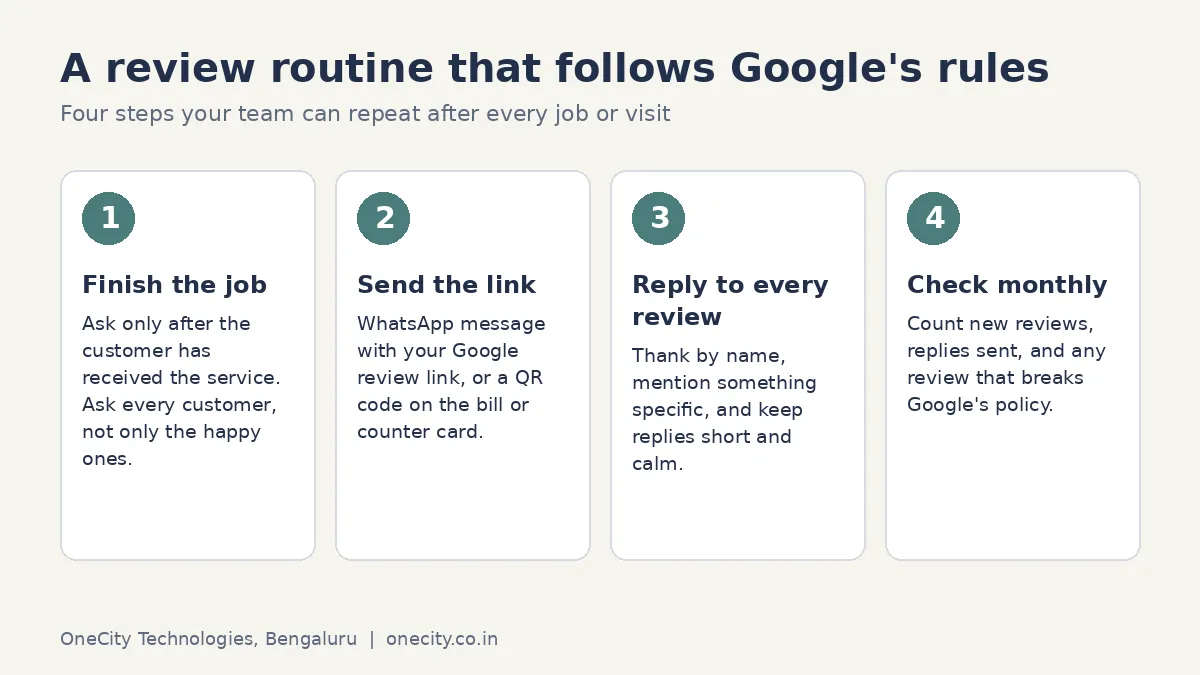
Ask after positive interactions. The best moment to request a review is immediately after a service is completed and the customer expresses satisfaction. Train front-desk staff, delivery drivers, and account managers to ask naturally: “Would you mind sharing that feedback on Google? Here is the link.”
Make the path frictionless. Create a short URL that goes directly to your Google review form. Print it as a QR code on receipts, business cards, and table tents. Share it via WhatsApp after appointments. In India, WhatsApp is the most effective channel for review requests. A message with a direct link converts at 3-4x the rate of an email request.
Respond to every review within 48 hours. Thank positive reviewers specifically. Address negative reviews professionally: acknowledge the issue, state what you have done or will do, and invite the person to contact you directly. Never argue, never make excuses, never offer compensation publicly.
Never incentivise reviews. Offering discounts, freebies, or contest entries in exchange for reviews violates Google guidelines and can result in review removal or profile suspension.
Star Rating Impact on Consumer Behaviour
| Star Rating | CTR Impact vs. 4.5 Stars | Consumer Trust |
|---|---|---|
| 5.0 stars | -12% | 68% |
| 4.5 – 4.9 stars | Highest CTR | 94% |
| 4.0 – 4.4 stars | -8% | 87% |
| 3.5 – 3.9 stars | -24% | 62% |
| Below 3.5 stars | -59% | 14% |
The counterintuitive finding: a perfect 5.0 rating triggers scepticism. Consumers perceive it as “too perfect” and suspect filtered or fake reviews. The sweet spot is 4.5 stars. If your rating is 4.9 or 5.0, do not panic, but do not suppress genuine 4-star reviews either. They add credibility.
Local Keyword Research for Indian Markets
Local keyword research in India is different from Western markets because of linguistic diversity, transliteration variations, and regional search patterns.
Keyword Formula for Indian Businesses
Build your keyword list using three patterns:
- Service + City: “dermatologist in Bangalore,” “CA firm Mangalore,” “wedding photographer Mysore”
- Service + Area/Neighbourhood: “dentist Koramangala,” “gym Indiranagar,” “tuition centre Jayanagar”
- Qualifier + Service + City: “best dermatologist Bangalore,” “affordable CA Mangalore,” “top wedding photographer near me”
Hindi and Regional Language Keywords
With 85% of India’s 1.09 billion internet users on search engines, a significant portion searches in Hindi, Kannada, Tamil, Telugu, and Malayalam. Google handles transliteration well, but you should still target:
- Hinglish variations: “best doctor near me,” “sabse accha doctor”
- Kannada transliterations for Karnataka businesses: Google increasingly understands Kannada-script queries
- Mixed-language queries: “Bangalore mein best SEO company”
Near-Me Search Behaviour
“Near me” searches have grown 400% since 2020. But Google now infers location without the “near me” modifier on mobile devices. A search for “plumber” on a phone in Koramangala shows Koramangala plumbers without the user typing the location. This means your GBP location, website geo-signals, and content keywords all need to align with the areas you serve.
Discovery vs. Direct Searches
72% of local GBP views come from discovery searches (generic terms like “dentist near me”), while only 22% come from direct searches (your business name) and 6% from branded searches. This confirms that most local traffic comes from category keywords, not brand awareness. Invest in ranking for what you do, not just who you are.
On-Page Local SEO: Schema, NAP, and Location Pages
NAP Consistency
Your Name, Address, and Phone number should appear identically on every page of your website (typically in the header or footer), on your GBP, and on every directory listing. Consistent NAP across platforms improves local rankings by 23%.
Common NAP inconsistencies that hurt Indian businesses:
- “Rd” on the website vs. “Road” on GBP
- “Blr” vs. “Bangalore” vs. “Bengaluru”
- Missing floor or suite number on one platform
- Different phone numbers (landline on website, mobile on GBP)
- Old address from a previous office still live on Justdial
LocalBusiness Schema Markup
Structured data tells Google exactly what your business is, where it is, and when it operates. Implement LocalBusiness schema (or a more specific type like Dentist, Restaurant, or RealEstateAgent) on your homepage and contact page with these minimum fields:
- @type (use the most specific type available)
- name (exact business name)
- address (with streetAddress, addressLocality, addressRegion, postalCode, addressCountry)
- telephone
- url
- openingHoursSpecification (for each day)
- geo (latitude and longitude)
- image (logo and business photo)
- priceRange (approximate)
- areaServed (cities and regions you cover)
Validate your schema using Google Rich Results Test. Fix every error and warning before moving on.
Location Pages for Multi-Area Businesses
If your business serves multiple cities or neighbourhoods, create dedicated location pages. Each page must have 100% unique content. Do not copy your Bangalore page, change “Bangalore” to “Mysore,” and publish it. Google penalises thin, duplicated location pages aggressively after the March 2026 Core Update.
Each location page should include:
- Unique opening paragraph mentioning the area by name and a specific local reference
- Services available at or for that location
- Team members or consultants serving that area
- Embedded Google Map centred on the area
- Local testimonials from clients in that area
- Driving directions or public transport information
- Area-specific FAQs
A page for SEO services in Mangalore should reference the Mangalore IT corridor, local businesses we have worked with, and the bilingual Kannada-Tulu search landscape. A page for digital marketing in Mysore should reference the heritage tourism industry, the Mysore-Bangalore tech corridor, and the university cluster.
India-Specific Citation and Directory List
Citation signals account for 7% of local ranking factors (down from 13% in 2020). The emphasis has shifted from volume to accuracy. List your business on the directories that matter, keep information consistent, and audit twice a year.
Universal India Directories
| Directory | Priority | Notes |
|---|---|---|
| Google Business Profile | Critical | The foundation of local SEO |
| Justdial | High | Most-used Indian business directory, strong domain authority |
| Sulekha | High | Lead generation platform, strong in services |
| IndiaMART | High | B2B focus, essential for manufacturers and suppliers |
| India Yellow Pages (IndiayP) | Medium | Traditional directory with decent backlink value |
| TradeIndia | Medium | B2B directory for exporters and manufacturers |
| Asklaila | Medium | City-specific business listings |
| Bing Places | Medium | Growing market share in India with Microsoft products |
| Apple Business Connect | Medium | Critical for iOS users using Apple Maps |
Industry-Specific India Directories
| Industry | Directories |
|---|---|
| Healthcare | Practo, Lybrate, Portea, Credihealth, state Medical Council listings |
| Restaurants and Food | Zomato, Swiggy, MagicPin, Dineout, EazyDiner |
| Real Estate | 99acres, MagicBricks, Housing.com, NoBroker, CommonFloor |
| Hotels and Travel | MakeMyTrip, Goibibo, TripAdvisor, Booking.com, OYO |
| Education | Shiksha, CollegeDekho, Collegedunia, Careers360 |
| Legal and CA | LawRato, Vakilsearch, ClearTax, ICAI directory |
| Automotive | CarDekho, CarWale, BikeWale, Droom |
Social Profiles as Citations
Create and complete business profiles on Facebook, Instagram, LinkedIn, and X (Twitter) with identical NAP information. These profiles rank independently for your brand name and serve as citations. Add your full address on Facebook and Instagram business pages.
Citation Audit Process
Every six months, search your business name across the top directories. Look for old addresses, wrong phone numbers, duplicate listings, and closed-location profiles that are still live. Tools like BrightLocal, Moz Local, or Semrush Listing Management can automate this. Inconsistencies hurt more than missing listings.
Local Backlink Building (India Edition)
Link signals carry 13% weight in local rankings (Moz 2026). Businesses with local backlinks rank 14% higher than those without. Here are strategies that work for Indian businesses:
1. Chamber of Commerce and Industry Associations
Join your local chamber of commerce (Bangalore Chamber of Industry and Commerce, FKCCI, CII Karnataka). Membership typically costs Rs 5,000 to Rs 25,000 annually and includes a profile page with a backlink. These are high-authority, locally relevant links. Offer to speak at their events for additional contextual links.
2. Local News and Media
Build relationships with local journalists and news portals. Bangalore has Citizen Matters, Bangalore Mirror, and Deccan Herald local editions. Pitch stories about business milestones, community initiatives, or industry insights. A single backlink from a local news site carries more local relevance than ten generic directory links.
3. Sponsor Local Events
Community runs, college fests, tech meetups, and cultural events in Bangalore, Mangalore, and Mysore all need sponsors. Cash sponsorships of Rs 10,000 to Rs 50,000 typically earn a logo and link on the event website. In-kind sponsorships (printing, food, venue) work equally well.
4. Supplier and Partner Pages
Contact every supplier, vendor, and business partner you work with. Ask if they have a “Partners,” “Clients,” or “Our Network” page on their website. These are earned, contextual backlinks that Google values highly.
5. Educational Institution Partnerships
Offer guest lectures, internship programmes, or workshops at local colleges. University .edu.in domains carry high authority. A mention on the placement cell page or guest lecture announcement builds both links and credibility.
6. Local Blog Contributions
Write expert columns for local publications and blogs. BangaloreBlogs.com, local Quora Spaces, and neighbourhood community platforms accept contributions. Focus on genuinely useful content for the local audience, not promotional pieces.
Mobile and Voice Search Optimisation
Mobile-First Is Not Optional
India sends 78.62% of internet traffic from smartphones. 61% of consumers prefer buying from mobile-friendly businesses. Pages that take longer than three seconds to load lose 53% of mobile visitors. For local businesses, this translates directly to lost walk-ins.
Mobile optimisation checklist for local businesses:
- Responsive design that works on all screen sizes
- Click-to-call button visible above the fold (mobile users use click-to-call 3x more than desktop users)
- One-tap Google Maps direction link
- Page speed under 2.5 seconds (test with Google PageSpeed Insights)
- No intrusive interstitials blocking content on mobile
- Text readable without zooming (minimum 16px body font)
- Touch targets at least 48px apart
Voice Search and Local SEO
58% of voice searches seek local information. Voice search users are 2.3x more likely to take action than text searchers. With 27% of mobile users conducting voice searches daily, this channel cannot be ignored.
Voice search queries are conversational and longer (three to five words average). “Hey Google, where is the nearest dermatologist?” replaces “dermatologist near me.” To capture voice search traffic:
- Create FAQ pages with natural-language questions and concise answers
- Use question-based H2 and H3 headers throughout your content
- Implement FAQ schema markup so Google can pull your answers directly
- Ensure your GBP has complete, accurate information (75% of voice search results come from the top three Local Pack or organic results)
- Focus on long-tail conversational keywords in your content
AI Overviews and Local Search in 2026
AI Overviews changed how local search results appear. 34% of local AI Overviews contain Google Business Profile data. When someone asks Google “best restaurants in Koramangala for a business lunch,” the AI Overview now generates a curated answer pulling from GBP listings, reviews, and structured data before showing the traditional map pack.
How to Appear in Local AI Overviews
Your GBP is your primary asset. AI systems pull business descriptions, services, reviews, and attributes from GBP when constructing local answers. Every field you complete is a data point the AI can cite.
Structured data matters more than ever. Schema markup gives AI systems machine-readable information about your business. LocalBusiness schema, FAQ schema, and Review schema all feed into AI-generated local results.
Answer-first content formatting. AI Overviews prefer content that answers questions directly in the first sentence, then expands with detail. Structure your blog posts and service pages with the answer at the top of each section, evidence underneath.
Entity consistency across the web. AI systems cross-reference your business information across GBP, your website, directories, social profiles, and review sites. Inconsistencies create confusion. A business that is “OneCity Technologies” on GBP but “One City Tech” on Justdial and “OneCity Tech Pvt Ltd” on LinkedIn sends mixed entity signals. Pick one name and use it everywhere.
This is where Generative Engine Optimisation (GEO) and Answer Engine Optimisation (AEO) intersect with local SEO. The businesses that show up in AI-generated local answers are the ones with clean, consistent, structured data across every platform they exist on.
Industry Playbooks: Healthcare, Restaurants, Real Estate, Professional Services
Healthcare (Clinics, Hospitals, Dental Practices)
Healthcare is a YMYL (Your Money Your Life) category where Google applies the strictest E-E-A-T standards.
- Doctor profiles: Every practitioner needs a named profile page with qualifications, registration number (Karnataka Medical Council, MCI/NMC), years of experience, and specialisation
- Practo and Lybrate: These are non-negotiable citations. Verify that doctor names, clinic addresses, and consultation fees match your website exactly
- Review response time: Healthcare reviews require 48-hour maximum response time. Patient concerns left unanswered signal poor care
- ABDM compliance: If your clinic is on the Ayushman Bharat Digital Mission, mention your ABHA registration and HIP/HIU status. This is an E-E-A-T signal specific to Indian healthcare
- Schema: Use Physician or MedicalClinic schema types with medicalSpecialty, availableService, and healthPlanNetworkId
Restaurants and Food Service
- Platform consistency: Zomato, Swiggy, Google Maps, and your own website must show identical menus, pricing, hours, and contact information. Discrepancies confuse both customers and search algorithms
- Photo frequency: Upload new food and ambiance photos to GBP monthly. Seasonal menu items, special events, and fresh shots of plated dishes drive engagement
- Menu markup: Implement Restaurant schema with menu items, prices, and dietary information (vegetarian, vegan, Jain-friendly). This feeds into Google search features and AI Overviews
- Review keywords: Encourage reviews that mention specific dishes, the dining experience, and the occasion. “Great butter chicken for a team dinner” is worth more to Google than “Nice place 5 stars”
- Hyperlocal content: Write about your neighbourhood, food festivals, local ingredients. “Why Malleshwaram became Bangalore’s breakfast capital” builds topical authority and local links
Real Estate (Builders, Agents, Property Management)
- Neighbourhood pages over city pages: “Properties in HSR Layout” outperforms “Properties in Bangalore” for conversion. Create dedicated pages for every neighbourhood you serve with current pricing data, infrastructure updates, and amenity information
- Price data freshness: Real estate content with stale pricing loses credibility fast. Update property price ranges quarterly. Reference recent RERA registrations and approval numbers for under-construction projects
- 99acres, MagicBricks, Housing.com: Ensure your agent or builder profile is claimed, verified, and consistent across all major property portals
- Schema: Use RealEstateAgent or Organization schema with areaServed listing every neighbourhood and city you cover
- Google Maps pins: For builders, pin every project location on Google Maps with a separate GBP listing if each project has its own address
Professional Services (CA Firms, Law Firms, Consultancies)
- Credential visibility: Display ICAI membership numbers, Bar Council registration, or professional certifications prominently. These are E-E-A-T signals that Google weighs heavily for professional service queries
- Named authorship: Every article, guide, and FAQ on your website needs a named author with visible credentials. Anonymous content does not build authority in professional services
- Niche location pages: “GST consultant in Electronic City” or “company registration CA in MG Road” targets high-intent searches with lower competition than city-level terms
- LinkedIn alignment: Professional service firms get significant referral traffic from LinkedIn. Ensure your LinkedIn company page, personal profiles of partners, and website all present consistent information
- Client testimonials with industry context: “Helped us with GST registration for our 12-unit restaurant chain across Karnataka” is more valuable than “Very professional service”
12 Common Local SEO Mistakes (and the Data Behind Each)
- Virtual office addresses on GBP: Google suspends profiles using virtual offices or co-working space addresses unless you have dedicated, marked office space there. Use your real business address
- Keyword stuffing in business name: Adding “Best SEO Company Bangalore” to your GBP business name when your registered name is “XYZ Technologies” violates Google guidelines and risks suspension
- Ignoring negative reviews: One unanswered negative review on page one costs 22% of potential customers. Three unanswered negative reviews cost 59%
- Duplicate GBP listings: Multiple listings for the same business at the same address confuse Google and split your review equity. Merge duplicates through GBP support
- Outdated hours during holidays: Customers who show up to a closed shop leave one-star reviews. Update your hours for every Indian holiday, not just national ones
- Copy-pasted location pages: Changing “Bangalore” to “Mysore” on identical content triggers the March 2026 Core Update thin content filter. Write unique content for each location or do not create the page
- Ignoring Google Maps photos: The average GBP gets 735 photo views per month. Profiles with fewer than ten photos miss 520% of potential calls compared to profiles with 100+ photos
- Inconsistent NAP: “Rd” vs “Road,” different phone numbers, old addresses still live on forgotten directories. Audit every six months
- Buying fake reviews: Google’s fake review detection improved significantly in 2025-2026. Purchased reviews get removed in batches, and your profile can be suspended. The August 2025 and September 2026 Spam Updates specifically target review manipulation
- No schema markup: Without structured data, you are relying entirely on Google to figure out your business details. Schema removes ambiguity. AI Overviews pull from it. Not implementing it is leaving ranking signals on the table
- Desktop-only optimisation: 78.62% of India’s internet traffic is mobile. A beautiful desktop site that breaks on a Redmi Note is invisible to three-quarters of your potential customers
- Ignoring AI Overview optimisation: 34% of local AI Overviews pull GBP data. If you are not optimised for AI-generated answers, competitors who are will capture those clicks. GEO and AEO are now part of local SEO, not separate disciplines
Measuring Local SEO: KPIs and Tools
KPIs That Matter
| KPI | Where to Track | Good Benchmark |
|---|---|---|
| GBP views (Search + Maps) | GBP Performance tab | 1,260+ monthly average |
| Website clicks from GBP | GBP Performance tab | 34% of total views |
| Direction requests | GBP Performance tab | 27% of total views |
| Phone calls from GBP | GBP Performance tab | 16% of total views |
| Local Pack ranking for target keywords | BrightLocal, Local Falcon, Semrush | Top 3 for primary service + city |
| Review count and velocity | GBP, BrightLocal | 3-5 new reviews per week |
| Average star rating | GBP | 4.3 – 4.8 stars |
| Citation accuracy score | Moz Local, BrightLocal | 90%+ consistency |
| Mobile page speed | PageSpeed Insights | Under 2.5 seconds LCP |
| Local organic traffic (city-filtered) | Google Analytics 4 | Month-over-month growth |
Tools for Indian Local SEO
- Google Business Profile Insights: Free, built-in, and the source of truth for GBP performance
- Google Search Console: Track which queries bring local organic traffic and which pages rank for local terms
- Google Analytics 4: Segment traffic by city, filter for local conversions (calls, form fills, direction clicks)
- BrightLocal: Local rank tracking, citation auditing, review monitoring, and GBP audit reports. Starts at $29/month
- Local Falcon: Grid-based local rank tracking that shows visibility across different geo-coordinates in your city
- Semrush Listing Management: Distributes your business information across 70+ directories and monitors consistency
- CallRail or similar: Track which search queries and which listings generate phone calls
Monthly Reporting Framework
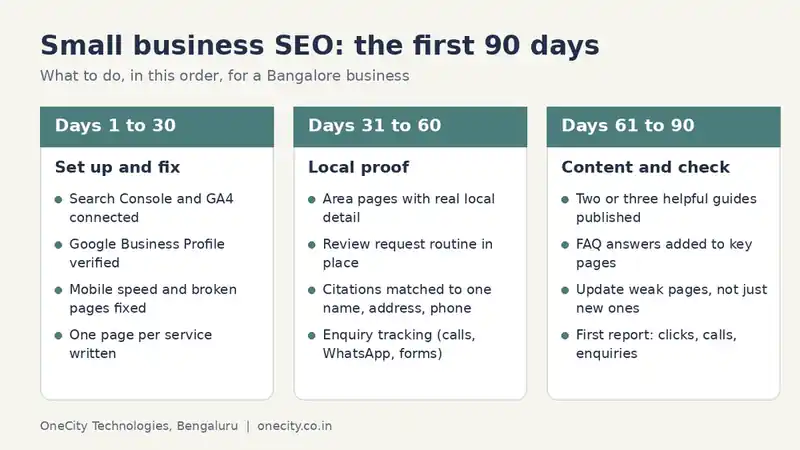
Track these metrics monthly and review trends over three-month windows. Local SEO is a compounding channel. A listing claimed today will not show results for four to eight weeks. Review velocity takes two to three months to influence rankings. Backlinks from local events take one to two months to get indexed. Set expectations accordingly and measure progress against baselines, not competitors.
Frequently Asked Questions
How long does local SEO take to show results?
Most businesses see measurable improvement in GBP visibility within four to eight weeks of full optimisation. Local Pack rankings typically improve within two to four months. Sustained review growth and backlink building compound over six to twelve months. A new business starting from zero should plan for a minimum six-month commitment before evaluating ROI.
How much does local SEO cost in India?
Local SEO services in India range from Rs 8,000 to Rs 50,000 per month depending on city competitiveness, number of locations, and scope of work. Single-location businesses in tier-2 cities can start at Rs 8,000-15,000. Multi-location businesses in metros like Bangalore, Mumbai, or Delhi typically need Rs 25,000-50,000 per month. OneCity Technologies offers local SEO packages starting at Rs 15,000 per month for Bangalore businesses.
Can I do local SEO myself without an agency?
Yes. A business owner can handle GBP optimisation, review management, and basic citation building without an agency. The 15-point GBP checklist in this guide is designed for self-implementation. Where you may need help is technical SEO (schema markup, site speed optimisation), content creation at scale, and competitive backlink building. Start with the free steps, measure results, and bring in professional help for the areas where you hit a wall.
What is the difference between local SEO and regular SEO?
Regular SEO aims to rank your website in organic search results for any geographic location. Local SEO focuses on ranking your business in the Local Pack (map results) and organic results for searches with geographic intent. Local SEO depends heavily on your Google Business Profile, reviews, citations, and physical proximity to the searcher. Regular SEO depends more on backlinks, content depth, and domain authority. Most local businesses need both, but local SEO delivers faster ROI for businesses serving a physical area.
How do I get more Google reviews for my business?
Ask every satisfied customer directly, preferably within minutes of a positive interaction. Create a short link to your Google review form and share it via WhatsApp (the highest-converting channel in India), printed QR codes, email signatures, and SMS. Train staff to ask naturally. Aim for three to five new reviews per week. Never offer incentives for reviews. Respond to every review within 48 hours to encourage more people to leave feedback.
Does social media affect local SEO rankings?
Social media profiles are not a direct ranking factor for the Local Pack. However, they serve as citations (with your NAP information), they rank independently for your brand name, and they drive traffic and engagement that produce behavioural signals. A complete Facebook business page, Instagram profile, and LinkedIn company page with consistent NAP information support your local SEO indirectly. Do not expect social media likes to improve your map ranking directly.
How important are citations for local SEO in 2026?
Citation signals dropped from 13% to 7% of local ranking factors between 2020 and 2026 (Moz). Accurate citations are still necessary. Having your business listed correctly on Justdial, Sulekha, and industry-specific directories is table stakes. But adding your business to fifty more generic directories will not move the needle the way it did in 2018. Focus on the top ten to fifteen directories for your industry, ensure NAP consistency, and redirect your effort toward GBP optimisation and reviews, which now carry 51% combined weight.
Service page: local SEO services in India from OneCity.