Originally published: 22 January 2026
Last updated: 23 May 2026 by L.K. Monu Borkala, Founder & CEO, OneCity Technologies
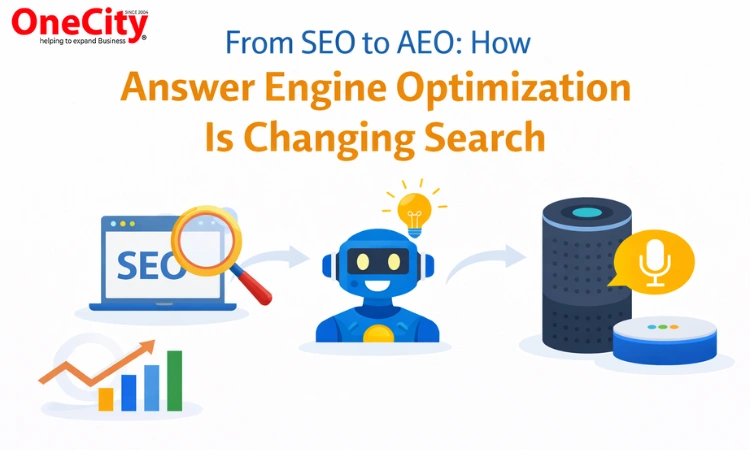
Answer Engine Optimization, or AEO, is the practice of structuring content so answer engines quote it directly. The shift from SEO to AEO represents the most significant change in search strategy since Google introduced semantic understanding with BERT. This guide covers Answer Engine Optimisation strategy for Indian businesses, featured snippet optimisation India, voice search SEO, Google AI Overviews eligibility, zero-click search adaptation, direct answer content structure, SGE optimisation, structured data for AEO, and how Bangalore businesses can be cited in AI-generated responses across Google, ChatGPT, and Perplexity.
The way people find information is changing faster than it has at any point since Google replaced directory-based web browsing in the late 1990s. The shift from typed keywords to conversational queries, and from ranked lists of links to direct AI-generated answers, is not a future trend , it is the current reality for a growing share of Indian users on Google, ChatGPT, Perplexity, and Gemini. For businesses that depend on search visibility for leads and sales, this shift demands a strategy update alongside their existing SEO work.
This guide explains Answer Engine Optimisation (AEO) , what it is, how it differs from traditional SEO, and the specific content and technical steps that make a Bangalore or India-based business eligible to be cited in AI-generated responses.
What Is an Answer Engine?
An answer engine is any search interface that processes a query and returns a direct answer rather than , or in addition to , a list of links. The category includes:
- Google AI Overviews: The AI-generated summaries that appear above organic results for approximately 25 to 40% of searches in India, drawing from indexed web content
- ChatGPT and Claude: Conversational AI assistants that answer questions using their training data plus, in some versions, real-time web search
- Perplexity: An AI search engine that provides cited, direct answers to questions using live web data
- Google Gemini: Google’s multimodal AI assistant, integrated into Android devices and Google Workspace
- Voice assistants: Google Assistant, Alexa, and Siri, which increasingly answer questions rather than returning links
The common characteristic: the user asks a question, the system synthesises an answer from available sources, and in many cases the user does not need to click through to any website to get what they were looking for. For informational queries , which represent a large share of the searches that drive traffic to business blog content , this is a fundamental change to how search traffic flows.
SEO vs AEO: What Is Different
Traditional SEO optimises for rank , getting your page into position 1, 2, or 3 for a keyword, so that when someone searches, they see your page at the top of the results and click. The conversion chain is: search → see ranked result → click → arrive at your page → take action.
AEO optimises for citation , structuring your content so that AI systems extract and credit your information when answering queries. The conversion chain is different: search → AI engine generates answer citing your content → user reads your brand name as a source → some percentage subsequently search for your brand or visit your site directly.
This does not mean AEO replaces SEO. The two strategies work in parallel and many of the actions that improve AEO eligibility , authoritative content, clear structure, named expert authorship , also improve traditional organic rankings. The important point is that a business relying solely on traditional SEO will increasingly miss the citation visibility that AEO captures, as a growing share of searches are processed through answer engines rather than traditional results.
How Google AI Overviews Decide What to Cite
Google has not published a definitive specification for AI Overview source selection. However, its own documentation, third-party research from SEO platforms including Semrush and BrightEdge, and our own observation of AI Overview citations across client campaign content consistently points to these factors:
Traditional Search Authority
Google AI Overviews most frequently cite content from pages that already rank in the top 10 organic results for the query. A page with no existing search ranking has a low probability of being cited in an AI Overview for the same query. This means traditional SEO remains the foundation , AEO amplifies visibility for pages that already have organic authority, rather than bypassing the need for it.
Direct Answer Structure
Pages where the answer to a specific question appears clearly and concisely in the first 50 to 100 words , ideally immediately after an H2 or H3 heading that frames the question , are more frequently extracted for AI Overview inclusion. Compare two approaches:
Poor structure for AEO: “In this article, we will explore the various factors that influence local search rankings and discuss how businesses can improve their visibility on Google Maps. There are many considerations to keep in mind…”
Good structure for AEO: “Google Maps rankings are determined by three factors: relevance (how closely your business matches the search query), distance (proximity to the searcher), and prominence (your review count, citation quality, and online authority). Of the three, prominence is the most directly influenced by SEO work.”
The second version answers the question directly and completely in two sentences. Google’s AI can extract this answer with confidence. The first version requires the AI to keep reading to find the actual answer , and it may not wait.
E-E-A-T Signals
Google’s systems assess the trustworthiness of sources before citing them. A page on a domain with strong E-E-A-T compliance signals , real expert author, consistent accurate content, authoritative backlink profile, correct business entity information , is cited more often than technically similar content on a lower-trust domain. For Indian businesses, this makes author attribution and business entity clarity particularly important for AEO.
How LLMs Like ChatGPT and Claude Decide What to Say About Your Business
Large Language Models differ from Google AI Overviews in how they access information. Google AI Overviews perform real-time searches and synthesise current web content. LLMs like ChatGPT (without browsing enabled) and Claude draw from their training data , a snapshot of the web from a specific cutoff date.
What this means for businesses: appearing prominently in LLM responses requires having a strong presence in the data these models were trained on. Businesses that are mentioned frequently and accurately across reputable Indian news publications, Wikipedia, LinkedIn, government databases, and industry-specific platforms are more likely to appear in LLM responses than businesses whose presence is confined to their own website.
This is sometimes called LLMO (Large Language Model Optimisation) , a subset of the broader AEO category. The key actions for LLMO are identical to what builds traditional brand authority: earning editorial mentions in credible publications, maintaining accurate business information across all platforms, and creating content so substantive that other websites reference it.
The Perplexity Factor for Indian B2B Businesses
Perplexity , the AI search engine that provides directly cited answers from live web data , has seen rapid adoption among research-heavy user demographics in India, particularly in IT, consulting, finance, and education sectors. Data from web analytics tools shows that Perplexity-referred sessions for B2B service businesses in Bangalore grew by over 400% between Q1 2025 and Q1 2026.
For B2B businesses whose customers include researchers, analysts, and senior decision-makers, Perplexity citation is increasingly worth targeting. The content characteristics that Perplexity cites are similar to Google AI Overviews: authoritative sources, direct answers, specific data, and clear attribution. The additional factor for Perplexity is that it tends to cite more niche and specialist sources than Google’s AI Overview, which means smaller authoritative websites , including well-maintained agency blogs , have a meaningful chance of being cited for specific industry queries.
Voice Search and AEO for Indian Businesses
Voice search in India is predominantly used for three query types: local discovery (“find a restaurant near me”), quick factual queries (“what is the GST rate on restaurant services?”), and navigational queries (“call OneCity Technologies”). Each has different AEO implications.

For local discovery queries answered by voice assistant, Google Business Profile optimization data is the primary source. A complete, optimised GBP is more important for voice local search than any website content optimisation. When someone asks Google Assistant to “find an SEO agency near me,” Google reads out the top 3-pack result , which is determined by GBP ranking factors, not organic content factors.
For factual queries, voice assistants typically read featured snippet content. Optimising content to win featured snippets , through direct, concise answers to specific questions , is the primary AEO action for voice search visibility. The ideal featured snippet answer is 40 to 60 words, directly answering the question, and structured to sound natural when read aloud.
Structured Data: The Technical Foundation of AEO
Structured data , code added to web pages in JSON-LD format that explicitly tells search engines what the content means , is one of the clearest signals that a page is optimised for answer engine consumption. The most relevant structured data types for AEO are:
FAQPage schema: Marks up question-and-answer content so that Google can confidently extract specific questions and answers for Featured Snippets, AI Overviews, and voice search responses. FAQPage schema is one of the most directly practical AEO technical improvements available to Indian business websites.
Article and BlogPosting schema: Marks up content as an article, specifying the author’s name (with sameAs linking to their Google Knowledge Panel or LinkedIn profile), the publication date, the organisation, and the topic. This structured data helps Google and LLMs correctly identify and attribute content to the right author and organisation.
Organization schema: Provides explicit, machine-readable information about your business , name, address, phone, website, founding date, number of employees, areas served, and social media profiles. For businesses aiming to be mentioned by LLMs, Organisation schema helps these systems correctly identify and describe your business in responses.

LocalBusiness schema: A more specific version of Organisation schema for businesses with physical locations, adding geographic coordinates, opening hours, and service areas. Essential for local AEO. Our GEO and AEO services implement all relevant schema types as standard across client websites.
Content Strategy for AEO: The Question Cluster Approach
The most effective AEO content strategy is built around question clusters , groups of related questions that real users ask about a topic, organised into a content architecture that completely answers each one.
For a Bangalore digital marketing agency, a question cluster around “local SEO” might include:
- What is local SEO? (definition query)
- How does local SEO work in India? (mechanism query)
- How long does local SEO take in Bangalore? (expectation query)
- What is the cost of local SEO in Bangalore? (commercial query)
- How do I know if local SEO is working? (evaluation query)
- What is the difference between local SEO and regular SEO? (comparison query)
Each of these queries represents a search users make. A page or cluster of pages that answers all of them completely, with direct answers in clear language, has high AEO eligibility for the entire topic area , not just a single keyword.
This approach also aligns with how LLMs respond to questions. When ChatGPT or Gemini answers “explain local SEO for a Bangalore business,” it synthesises information from multiple sources covering multiple aspects of the topic. A website that completely covers all aspects of a topic is more likely to be cited in that synthesis than one covering only a narrow slice.
Measuring AEO Performance
AEO is harder to measure than traditional SEO because AI answer engines do not provide click attribution in the same way organic search does. The available measurement approaches are:
Featured Snippet tracking: Tools like Ahrefs and Semrush track which of your pages hold featured snippets for specific queries. Featured snippets are the most directly measurable proxy for AEO performance in Google’s traditional search interface.
Branded search volume: As your content is cited in AI answers, more people search for your business name directly. Track branded search impressions and clicks in Google Search Console , sustained growth in branded queries suggests that AI citation is building awareness among users who were not previously familiar with your business.
AI Overview tracking: Semrush’s AI Overview feature and dedicated tools like AIO Tracker allow you to monitor which of your pages appear as sources in Google AI Overviews for tracked keywords. This is the most direct measurement of AI Overview citation performance available in 2026.
Referral traffic from AI sources: When users click through from Perplexity, Bing Copilot, or ChatGPT’s browsing feature, the sessions appear as referral traffic in Google Analytics with the source domain of the AI tool. Tracking this referral channel shows the direct traffic contribution of AEO investment.
Integrating SEO and AEO: The OneCity Approach
At OneCity, our content strategy framework integrates SEO and AEO objectives at the planning stage rather than treating them as separate workstreams. New content is planned against keyword clusters that reflect both traditional search volume and question-format query patterns. Content structure uses direct-answer formatting in the first section, complete coverage in the body, and FAQ schema in the closing section , meeting the requirements for both traditional featured snippets and AI Overview citation simultaneously.
For clients managing their own content production, we provide an AEO content brief template that includes: target keyword and related questions, recommended H2/H3 structure, first-section direct answer guidance, schema implementation specification, and internal link targets to service pages. This brief-first approach makes every piece of content produced AEO-eligible from the first draft rather than requiring post-publication restructuring.
The most important principle for businesses transitioning from pure SEO to combined SEO-AEO strategy: the fundamentals have not changed. High-quality, accurate, authoritative content produced by genuine experts and properly attributed will rank well in traditional search and be cited in AI responses. The difference is that AEO-aware content is structured to make the extraction of answers by AI systems as frictionless as possible , which is ultimately the same as making the extraction of value by human readers as frictionless as possible. Both optimisations point in the same direction.
AEO for Specific Industries in Bangalore
AEO strategy and content requirements differ significantly across industries and should not be treated as a single generic approach that works equally well for a healthcare provider and a software company. Healthcare businesses must meet the strictest E-E-A-T standards , Google’s YMYL framework means health content requires named medical authors with verifiable qualifications before AI systems will cite it confidently. For Bangalore clinics and health services, this means creating a dedicated page for each doctor or clinical specialist, linking their authored content to their credentials, and citing established medical sources including the World Health Organisation and Indian government health bodies in all health-related content.
Legal and financial services in Bangalore face similar YMYL requirements , content must be authored by or explicitly reviewed by a qualified legal or financial professional, with the author’s qualifications clearly stated. This is not simply an SEO recommendation; publishing inaccurate legal or financial information with inadequate qualification disclosure creates genuine liability alongside the SEO risk.
For B2B technology services , IT companies, SaaS businesses, and digital agencies in Bangalore’s tech corridor , AEO opportunity is concentrated in comparison and decision-support queries. When a procurement manager searches “best IT staffing agency Bangalore” or “managed cloud services India comparison,” AI engines synthesise information from multiple sources. Businesses that publish original, specific, data-rich comparison content are cited more frequently in these AI responses than those with only service description pages.
For coaching institutes and tutorial centres , one of Bangalore’s most competitive and crowded digital marketing verticals , AEO success comes from completely answering the questions parents and students ask before enrollment decisions. Questions about curriculum specifics, faculty credentials, batch sizes, placement records, and fee structures , answered directly and specifically , are exactly the content AI engines extract when responding to admission research queries.
Frequently Asked Questions
Does AEO replace SEO for Indian businesses?
No. AEO and SEO operate on the same content and authority foundations. The actions that improve traditional organic rankings , complete content, strong domain authority, technical health, accurate business information , also improve AEO eligibility. AEO adds specific structural and schema requirements on top of SEO fundamentals. A business that invests in SEO without AEO-aware structuring will rank organically but miss AI citation visibility. A business that invests in AEO without the SEO foundation will have no authority to be cited from in the first place.

How long does it take to appear in Google AI Overviews?
For pages already ranking in the top 10 for a target query, AEO-optimised restructuring (direct answer in the first section, FAQPage schema, clear heading structure) can produce AI Overview inclusion within 4 to 8 weeks of Google recrawling the updated page. For new pages or pages outside the top 10, appearing in AI Overviews requires first building traditional organic ranking , which takes 3 to 12 months depending on competition. There is no shortcut to AI Overview inclusion that bypasses the underlying authority requirement.
What is the difference between GEO and AEO?
GEO (Generative Engine Optimisation) and AEO (Answer Engine Optimisation) are closely related terms that are sometimes used interchangeably. The technical distinction: AEO is the broader category covering all answer engines , including traditional featured snippets, voice assistants, and AI chat tools. GEO specifically refers to optimisation for generative AI engines , tools that generate new text responses (Google AI Overviews, ChatGPT, Gemini) rather than extracting pre-existing text snippets. In practice, the content and structural optimisations for both are nearly identical.
Does my Bangalore business need AEO if most of my customers call rather than search online?
If your customers call without searching first, they are likely finding you through referrals, repeat business, or existing brand awareness. AEO is most relevant for businesses trying to be found by new customers who do not already know them. For businesses highly dependent on word-of-mouth, AEO is lower priority than getting GBP fully optimised and reviews are being consistently generated. If you want to grow beyond your current referral base, AEO helps new customers find and trust you before they pick up the phone.
What is the first AEO action a Bangalore business should take?
Conduct a question audit: for your 5 most important service areas, identify the 3 to 5 questions potential customers most commonly ask before purchasing. These are usually questions your sales team answers on every call. Then check whether your website has a page that directly and concisely answers each of these questions in the first 50 words. If not, creating or restructuring those pages to provide direct answers is the highest-impact first AEO action available , before any schema implementation or technical work.
Source: Google’s official guidance on featured snippets and how to qualify , Google , Featured snippets documentation
L.K. Monu Borkala
Founder & SEO Director, OneCity Technologies
20 years running SEO campaigns from Bangalore. Full author profile · LinkedIn