Google reviews are the second most important ranking factor for Local Pack and Maps visibility in 2026. According to the annual Local Search Ranking Factors study by BrightLocal — surveying approximately 50 local SEO experts evaluating 187 ranking factors — review signals now account for 20% of local pack ranking weight, up from 16% in 2023. Only Google Business Profile signals (32%) carry more weight.
This is not abstract theory. Businesses in the Google 3-pack receive 126% more traffic and 93% more actions (calls, direction requests, website clicks) compared to positions 4 through 10. The Local Pack appears in 93% of local search results. If your business is not in those three positions, you are losing the majority of local search traffic to competitors who are. And reviews are one of the primary factors that determine which three businesses appear there.
This guide covers every dimension of how reviews affect your Google Maps rankings — with 2026 data, consumer behavior statistics, ranking factor weights, and a practical review strategy built for Indian businesses.
- Local Pack Ranking Factors: The 2026 Breakdown
- The 4 Review Signals Google Measures
- Consumer Behavior: What the Numbers Say
- Reviews and the Google 3-Pack: Hard Data
- Reviews in AI Overviews and AI Search
- GBP Optimization Statistics That Affect Rankings
- Bangalore Local Pack: Review Benchmarks by Industry
- The Review Strategy That Actually Works
- Handling Negative Reviews Without Hurting Rankings
- Review Response: Revenue and Ranking Impact
- Fake Reviews and the 2026 Spam Updates
- Review Schema Markup for SEO
- 9 Review Mistakes That Kill Local Rankings
- OneCity Local SEO Services
- FAQs
Local Pack Ranking Factors: The 2026 Breakdown
Google’s local algorithm weighs eight categories of signals when deciding which businesses appear in the Local Pack and Maps results. Understanding where reviews fit in the overall picture helps you prioritise your effort.
Local Pack / Maps Ranking Factor Weights
| Rank | Factor Category | Weight | Change Since 2023 |
|---|---|---|---|
| 1 | Google Business Profile | 32% | Stable |
| 2 | Reviews | 20% | ↑ from 16% |
| 3 | On-Page SEO | 15% | Stable |
| 4 | Behavioral Signals | 9% | Stable |
| 5 | Links | 8% | ↓ slightly |
| 6 | Citations / NAP | 6% | Stable |
| 7 | Personalisation | 6% | Stable |
| 8 | Social Signals | 4% | Stable |
The 4-percentage-point increase in review weight from 2023 to 2026 is the single largest category shift in the study. This reflects Google’s increased reliance on direct user feedback signals as they improve fake review detection. For SEO strategy, review management is no longer a “nice to have” — it directly affects whether you appear in the 3-pack or not.
Top 15 Local Pack Ranking Factors
Within the 187 individual factors evaluated, these 15 carry the most weight for Local Pack placement:
| # | Factor | Category |
|---|---|---|
| 1 | Primary GBP category | GBP |
| 2 | Proximity of address to search point | GBP |
| 3 | Keywords in GBP business title | GBP |
| 4 | Physical address in search city | GBP |
| 5 | Business open at search time | GBP |
| 6 | High Google star rating | Reviews |
| 7 | Address visibility on GBP | GBP |
| 8 | Additional GBP categories | GBP |
| 9 | Number of native reviews with text | Reviews |
| 10 | Map pin placement accuracy | GBP |
| 11 | Review recency | Reviews |
| 12 | Proximity to map centre | GBP |
| 13 | Click-through rate from local results | Behavioral |
| 14 | Steady review growth over time | Reviews |
| 15 | HTML NAP matching GBP NAP | Citations |
Four of the top 15 factors are review-related (highlighted in bold). Star rating (#6), review count (#9), recency (#11), and steady growth (#14) all directly depend on your review management strategy. No other single category apart from GBP itself has this many factors in the top 15.
The 4 Review Signals Google Measures
Google does not look at reviews as a single metric. It evaluates four distinct signals, each contributing differently to your ranking.
1. Star Rating
Your average star rating is the most visible review signal and ranks #6 among all 187 local pack factors. A low average rating (1-2 stars) is the #4 negative ranking factor. The critical threshold: a business with a 4.5-star average and 80 reviews typically outranks a competitor with a 5.0 average and only 12 reviews. Perfect ratings with low volume signal either a new business or suspicious review patterns — neither of which builds ranking authority.
2. Review Volume
The number of native Google reviews with text ranks #9 overall. Testing indicates ranking lift begins around 10 reviews, with measurable improvement continuing through 16-31 reviews before stabilising in most industries. Star-only ratings without text rank significantly lower (#38) because text reviews provide Google with keyword context and sentiment data. Always encourage customers to write at least 2-3 sentences, not just tap a star rating.
3. Recency
Review recency ranks #11 among local pack factors. Google values recent reviews because they indicate the business is actively serving customers. A business with 200 reviews but none in the last 6 months will lose ground to a competitor with 80 reviews that received 5 in the last month. For consumers, 74% only consider reviews from the last three months, and 32% focus on reviews from the last two weeks — up from 20% previously.
4. Velocity (Steady Growth)
Steady review growth over time ranks #14. Google distinguishes between businesses that receive reviews at a natural, consistent pace and businesses that receive sudden bursts followed by long gaps. Receiving too many reviews too quickly is actually ranked as a negative factor and is the #12 suspension risk for Google Business Profiles. A steady flow of 3-5 reviews per week is far more valuable than 50 reviews in a single week followed by silence.
Consumer Behavior: What the Numbers Say
Rankings only matter because they lead to clicks, calls, and customers. These consumer behavior statistics explain why the review metrics above translate directly into revenue.
| Statistic | Data |
|---|---|
| Consumers requiring 4+ stars to consider a business | 68% (up from 55%) |
| Consumers requiring 4.5+ stars | 31% (up from 17%) |
| Consumers avoiding businesses with fewer than 20 reviews | 47% |
| Consumers considering only reviews from last 3 months | 74% |
| Consumers focused on reviews from last 2 weeks | 32% (up from 20%) |
| Consumers who expect owner responses to reviews | 89% |
| Consumers likely to use business responding to all reviews | 80% |
| Consumers deterred by negative reviews | 77% |
| Consumers deterred by templated/generic responses | 50% |
| Consumers using ChatGPT for local recommendations | 45% (up from 6%) |
Two numbers stand out. The jump from 55% to 68% of consumers requiring 4+ stars means a 3.8-star business is now invisible to over two-thirds of potential customers before they even look at reviews, services, or pricing. And the increase in consumers using AI tools for local recommendations — from 6% to 45% — means your reviews now affect visibility in places beyond Google Maps.
Reviews and the Google 3-Pack: Hard Data
The difference between appearing in the Local Pack (positions 1-3) versus positions 4-10 is not marginal — it is the difference between getting found and getting ignored.
| Metric | 3-Pack (Positions 1-3) | Positions 4-10 |
|---|---|---|
| Average review count | 200+ | 39 average |
| Traffic vs positions 4-10 | 126% more | Baseline |
| Actions (calls, directions, clicks) | 93% more | Baseline |
| Average photos on profile | 250+ | Under 200 |
The review count gap is stark: 200+ for 3-pack businesses versus 39 on average for positions 4-10. That is a 5x difference. While review count alone does not determine ranking (proximity and GBP categories are more heavily weighted), the correlation is clear — businesses with significantly more reviews dominate the visible positions.
Reviews in AI Overviews and AI Search
AI search is no longer coming — it is here. 40% of local searches now show AI Overviews, and AI-generated local recommendations appear in roughly 13% of local queries and growing. Reviews play a different but equally important role in this channel.
AI Search Ranking Factor Weights
| Rank | Factor Category | Weight |
|---|---|---|
| 1 | On-Page SEO | 24% |
| 2 | Reviews | 16% |
| 3 | Citations | 13% |
| 4 | Links | 13% |
| 5 | GBP | 12% |
| 6 | Personalisation | 9% |
| 7 | Social | 9% |
Reviews are the #2 factor for AI search visibility at 16% — compared to #2 at 20% for traditional Local Pack. The difference is important: in AI search, on-page content carries more weight (24% vs 15%), meaning your website content matters more for AI recommendations while reviews still provide the social proof signal that AI systems rely on to make recommendations.
AI-Specific Review Factors
- Star ratings rank #8 in AI visibility scoring — AI systems use aggregate ratings as a quality filter before including businesses in recommendations
- Third-party review site authority ranks #5 — reviews on Justdial, Sulekha, Glassdoor, and industry-specific platforms matter more for AI than for traditional local pack
- Review site variety ranks #11 — businesses with reviews spread across multiple platforms get more AI visibility than those concentrated only on Google
- Review quantity on industry-specific sites ranks #19 — for healthcare, Practo reviews matter; for restaurants, Zomato and Swiggy; for B2B, Clutch and G2
This means a multi-platform review strategy is now essential for businesses that want visibility in both traditional Google Maps and AI-generated local recommendations.
GBP Optimization Statistics That Affect Rankings
Reviews do not operate in isolation. They work alongside other Google Business Profile signals. These statistics show how GBP optimization multiplies the impact of your reviews.
| GBP Action | Impact |
|---|---|
| Complete profile vs incomplete | 7x more clicks |
| Complete profiles and location visits | 70% more location visits |
| Complete, verified listing and trust | 2.7x more trust |
| Correct primary/secondary categories | 17% stronger local visibility |
| 100+ photos on profile | 520% more calls, 2,717% more directions, 1,065% more clicks |
| Consistent NAP across citations | 28% higher Local Pack ranking |
| Posting twice monthly | 13% higher engagement, 12% more impressions |
| Posting weekly | Average 2.3 local pack positions gained over 6 months |
| Adding booking links | 21% more conversion actions |
| Adding product listings | 29% increase in customer actions |
The photo statistic is the most striking: businesses with 100+ photos get 520% more calls. If you are investing in review generation but have only 15 photos on your GBP, you are leaving most of the potential value on the table. GBP optimization and review management work together — investing in one without the other gives you partial results.
Bangalore Local Pack: Review Benchmarks by Industry
National averages are useful for understanding trends, but what matters for your business is the specific benchmark in your city and industry. These are the review counts we observed in Bangalore Local Pack (positions 1-3) across several industries in 2026.
| Industry | 3-Pack Average Reviews | Positions 4-10 Average | Minimum to Compete |
|---|---|---|---|
| Restaurants | 340 | 80-120 | 150+ |
| Dental Clinics | 124 | 30-50 | 60+ |
| Digital Marketing Agencies | 87 | 20-35 | 40+ |
| Coaching Institutes | 63 | 15-25 | 30+ |
| Chartered Accountants | 41 | 10-18 | 20+ |
Notice how the benchmarks vary dramatically by industry. A CA firm with 41 reviews dominates its local pack, while a restaurant needs 340 to compete. The “minimum to compete” column shows the review count at which you enter consideration for 3-pack placement — below this, other factors need to be exceptionally strong to compensate. If you are a Bangalore business investing in local SEO, benchmark against your specific industry rather than targeting generic numbers.
The Review Strategy That Actually Works
A review strategy is not “ask customers for reviews.” It is a systematic process that generates consistent, genuine reviews without triggering Google’s spam detection systems. Here is the process we use at OneCity for client review management.
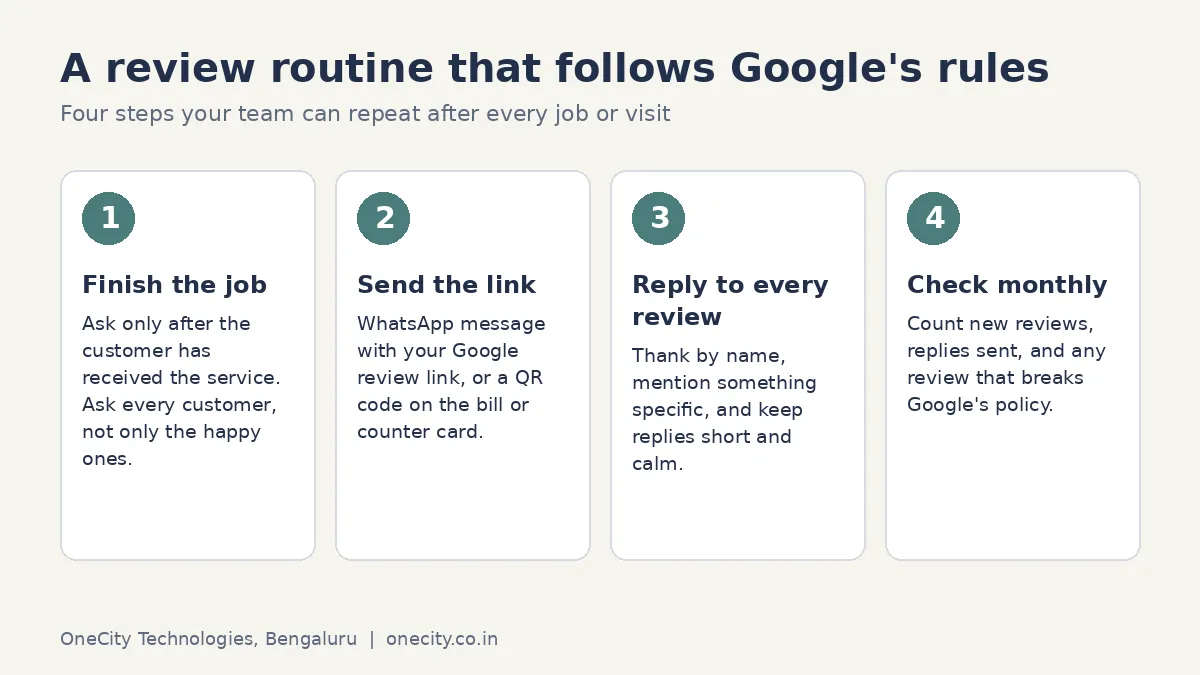
Step 1: Identify the Right Customers to Ask
Not every customer should be asked for a review immediately. Target customers who have completed a service, received their deliverable, and had time to experience the result. For service businesses (agencies, consultants, clinics), the right moment is 2-4 hours after service completion — long enough for them to form an opinion but short enough that the experience is fresh. For product businesses, wait until the customer has used the product for 3-7 days.
Step 2: Use Direct Review Links
The single biggest improvement to review generation is removing friction. Create a direct review link from your GBP dashboard (Google Business Profile > Reviews > Get more reviews > Share review form). This takes the customer directly to the review writing interface — no searching for your business, no navigating menus. Send this link via WhatsApp, SMS, or email. In India, WhatsApp produces the highest conversion rate because it is the messaging platform customers are already using.
Step 3: Set Velocity Targets by Industry
Based on the Bangalore benchmarks above, calculate how many reviews per week you need to reach your industry’s competitive threshold within a realistic timeframe. For a dental clinic starting with 30 reviews and targeting 60+, that is 30 more reviews over 3-4 months — roughly 2-3 per week. For a restaurant targeting 150+, you need 5-8 per week. Set these as measurable KPIs, not vague goals.
Step 4: Train Your Team
The person closest to the customer at the point of satisfaction is the person who should make the request. For a clinic, that is the front desk after checkout. For a service business, that is the account manager after project delivery. Train them on timing, the exact words to use (“Would you mind sharing your experience on Google? Here is a direct link”), and how to send the link. Scripts that sound natural convert 3x better than formal requests.
Step 5: Respond to Every Review Within 24 Hours
Response is not just good customer service — it is a ranking signal. Hotels that began responding to reviews saw ratings increase by 0.12 stars and review volume grow by 12%. But responses must be personalised. 50% of consumers are deterred by templated, copy-paste replies. Mention the customer’s name, reference their specific experience, and add a detail that shows a human read their review.
Step 6: Monitor and Adjust Monthly
Track four metrics monthly: total review count, average star rating, review velocity (reviews per week), and response rate. If velocity drops, investigate whether your team has stopped asking or whether the customer touchpoint has changed. If average rating drops, investigate service delivery before assuming review management is the issue.
Handling Negative Reviews Without Hurting Rankings
Negative reviews are inevitable. The question is whether they hurt or help your business. Handled correctly, negative reviews actually increase trust — consumers are suspicious of profiles with only 5-star reviews.
The 48-Hour Response Framework
- Acknowledge within 4 hours. A brief public response (“Thank you for bringing this to our attention, [Name]. We take this seriously.”) shows prospective customers you are responsive.
- Investigate within 24 hours. Talk to your team. Understand what happened from the business side.
- Provide a substantive response within 48 hours. Address the specific issue raised. Offer a resolution. Include your contact information for offline follow-up. Never argue or make excuses.
- Follow up privately. If the issue is resolved, the customer may update or remove their review voluntarily. Never ask them to — just solve the problem and let them decide.
When to Flag a Review for Removal
Google removes reviews that violate their policies: fake reviews from people who were never customers, spam, reviews with offensive content, conflict of interest reviews (from employees or competitors), and reviews of the wrong business. Flag these through your GBP dashboard. Removal takes 2-6 weeks. Google does not remove genuine negative reviews — even if they are factually inaccurate. Your response is your only defence against those.
Review Response: Revenue and Ranking Impact
Review response is one of the few activities that directly impacts both rankings and revenue. The data is clear:
| Metric | Impact |
|---|---|
| Revenue for businesses responding to all reviews | Up to 18% more revenue |
| Inquiry conversion rate | 50% better conversion |
| Rating improvement from consistent response | +0.12 stars average |
| Review volume growth from responding | 12% more reviews received |
| Owner response ranking for conversion | #17 conversion factor |
| Never responding to reviews | Negative ranking factor |
18% more revenue is not a small number. For a Bangalore business doing ₹50 lakh annual revenue, that is ₹9 lakh additional revenue — from responding to reviews. The cost of responding to every review is a few hours per month of an employee’s time. The ROI is among the highest of any digital marketing activity.
Owner responses that naturally include your business name, city, and service keywords also add indexed content to your GBP profile. “Thank you for choosing OneCity Technologies for your SEO services in Bangalore” reinforces location and service relevance without keyword stuffing.
Fake Reviews and the 2026 Spam Updates
Google’s March 2026 and August 2026 spam updates included significant improvements to fake review detection. The penalties are severe and increasingly automated.
What Gets Flagged
- Purchased reviews — from review farms, freelancer platforms, or “reputation management” services that sell reviews
- Incentivised reviews — offering discounts, freebies, or any compensation in exchange for reviews
- Employee reviews — staff leaving reviews for their own business
- Review gating — screening customers and only directing happy ones to Google while directing unhappy ones elsewhere
- Burst patterns — receiving many reviews in a short period, especially from accounts with little other review activity
Consequences
- Review removal — Google can remove individual flagged reviews
- Bulk review stripping — Google can remove all reviews suspected of being fake, which can drop your count dramatically overnight
- GBP suspension — your Google Business Profile can be suspended entirely, removing you from Maps and local search until you appeal
- Permanent ranking penalty — even after reinstatement, some businesses report lasting ranking drops
The risk is not worth it. One fake review incident can undo years of legitimate review building. Local SEO strategies must be built on genuine customer feedback, not manufactured signals.
Review Schema Markup for SEO
Review schema (structured data markup) tells Google explicitly about the reviews on your website. While Google does not use on-site review schema for Local Pack rankings (GBP reviews are the signal there), review schema can earn rich snippets in organic search results — showing star ratings directly in your search listing.
When to Use Review Schema
- Product pages — use
Productschema withaggregateRating - Service pages — use
LocalBusinessschema withaggregateRating(only if you display genuine, first-party reviews on the page) - Individual testimonials — use
Reviewschema with author attribution
When Not to Use Review Schema
- Self-serving reviews — do not mark up reviews you wrote about yourself or your own products
- Third-party reviews — do not mark up reviews from Google, Justdial, or other platforms unless they are embedded on your page with proper attribution
- Fake aggregate ratings — Google penalises sites using schema to display ratings that do not match actual reviews on the page
For websites we build, review schema is included on all service pages that display genuine client testimonials, following Google’s LocalBusiness structured data guidelines.
9 Review Mistakes That Kill Local Rankings
- Buying reviews. Google’s fake review detection catches these with increasing accuracy. One batch of purchased reviews can suspend your entire GBP.
- Review gating. Filtering who you ask based on expected sentiment violates Google’s policies. Ask everyone — handle negative feedback through responses, not suppression.
- Ignoring negative reviews. Never responding to reviews is a negative ranking factor. But ignoring only the negative ones is worse — it signals to both Google and customers that you avoid accountability.
- Copy-paste responses. 50% of consumers are deterred by templated replies. Each response should reference the specific customer and their specific experience.
- Burst-then-silence pattern. Running a “review campaign” that generates 40 reviews in a week, then nothing for 3 months, looks artificial. Steady flow of 3-5 per week is the target.
- Focusing only on Google. For AI search visibility, review diversity across platforms (Google, Justdial, Sulekha, industry-specific sites) matters. A Google-only strategy misses the AI channel.
- Not asking. The most common mistake is simply not asking customers for reviews at all. Most satisfied customers are happy to leave a review — they just need a prompt and a direct link.
- Asking at the wrong time. Asking before the service is complete, or weeks after when the experience has faded, both produce low conversion. The 2-4 hour window after service completion is the sweet spot.
- Neglecting photos. Businesses with 100+ photos get 520% more calls. If you are investing in reviews but have 20 photos, you are wasting half the effort. Upload quality photos of your business, team, products, and workspace alongside your review strategy.
OneCity Local SEO Services
OneCity Technologies Pvt Ltd has managed Google Business Profile optimization and review management for 650+ businesses across Bengaluru, Mangaluru, Mysuru, and Dubai since 2006. Our local SEO service includes GBP audit and optimization, review generation strategy, multi-platform review management, citation building and NAP consistency, and monthly ranking reports with Maps position tracking.
The Bangalore 3-pack benchmarks in this article come from our direct analysis of local search results across our client industries. We track these benchmarks quarterly to ensure our clients’ review strategies target the right numbers for their specific market.
Founder: L.K. Monu Borkala | CIN: U72100KA2009PTC048911 | Offices: Bengaluru, Mangaluru, Mysuru, Dubai
Contact: onecity.co.in/contact-us | +91 99023 30233
Want the practical side? Read how to get more Google reviews in India without breaking Google’s rules.
Frequently Asked Questions
How much do Google reviews affect Maps rankings in 2026?
Google reviews account for 20% of Local Pack/Maps ranking weight in 2026, up from 16% in 2023. This makes reviews the second most important ranking factor category after Google Business Profile signals (32%). Within reviews, four specific factors matter: star rating (#6 overall), review count with text (#9), recency (#11), and steady growth over time (#14). Businesses in the 3-pack average 200+ reviews compared to 39 for positions 4-10.
How many Google reviews do I need to rank in the Local Pack?
The number varies significantly by industry and city. In Bangalore, restaurants in the 3-pack average 340 reviews, dental clinics average 124, digital marketing agencies average 87, coaching institutes average 63, and chartered accountants average 41. Nationally, 3-pack businesses average 200+ reviews versus 39 for positions 4-10. Ranking improvement begins around 10 reviews, with continued lift through 16-31 reviews. Check your specific industry’s 3-pack in your city and target their average as your goal.
What star rating do I need to appear in Google Maps results?
While Google does not set a minimum star rating for Maps visibility, consumer behavior sets the effective threshold. 68% of consumers only consider businesses rated 4+ stars, and 31% require 4.5+ stars. A low average rating (1-2 stars) is the #4 negative ranking factor. Practically, aim for 4.2 stars or above. A 4.5-star business with 80 reviews typically outranks a 5.0-star business with only 12 reviews — volume and authenticity matter alongside rating.
Do review responses affect Google Maps rankings?
Yes. Never responding to reviews is treated as a negative ranking factor. Businesses that respond to all reviews see up to 18% more revenue and convert inquiries at a 50% better rate. Consistent response leads to a 0.12-star average rating improvement and 12% more reviews received (because customers see that the business engages). Owner responses that naturally include your business name, location, and services also add indexed content to your GBP profile. However, 50% of consumers are deterred by templated responses — each reply must be personalised.
How do Google reviews affect AI search results?
Reviews account for 16% of AI search visibility — the second highest factor after on-page SEO (24%). 40% of local searches now show AI Overviews, and consumer use of AI tools like ChatGPT for local recommendations jumped from 6% to 45% in one year. For AI visibility, review diversity across multiple platforms matters more than for traditional Maps rankings — businesses need reviews on Google, Justdial, Sulekha, and industry-specific platforms, not just Google alone.
Can buying fake Google reviews get my business suspended?
Yes. Google’s March 2026 and August 2026 spam updates significantly improved fake review detection. Consequences include individual review removal, bulk stripping of all suspected fake reviews, complete GBP suspension (removing you from Maps entirely until appeal), and lasting ranking penalties even after reinstatement. Google flags purchased reviews, incentivised reviews, employee reviews, review gating, and burst patterns. The risk of GBP suspension far outweighs any short-term benefit from fake reviews.
How often should I ask customers for Google reviews?
Ask every customer who has completed a service, but target a steady velocity rather than bursts. The optimal timing is 2-4 hours after service completion — the experience is fresh but the customer has had time to form an opinion. Use WhatsApp in India for the highest conversion rate, with a direct Google review link that takes them straight to the writing interface. Target 3-5 reviews per week for most businesses. Receiving too many reviews too quickly is the #12 GBP suspension risk, so avoid review campaigns that generate 40+ reviews in a single week.
About the Author
L.K. Monu Borkala is the founder and CEO of OneCity Technologies Pvt Ltd (CIN: U72100KA2009PTC048911), a Bangalore-based digital marketing and SEO agency established in 2006. With 20+ years managing local SEO campaigns for 650+ businesses across Bengaluru, Mangaluru, Mysuru, and Dubai, he oversees OneCity’s Google Business Profile optimization and review management services. The Bangalore local pack benchmarks in this article are based on OneCity’s quarterly analysis of local search results.