Originally published: 28 February 2026
Last updated: 23 May 2026 by L.K. Monu Borkala, Founder & CEO, OneCity Technologies
Small and medium businesses in Bangalore compete in one of India’s most densely contested commercial environments, where customer discovery has shifted decisively to mobile search and Google Maps. This guide covers digital marketing services for SMBs in India, small business SEO Bangalore, affordable digital marketing strategy, local SEO for small business, Google Ads for small business India, digital marketing ROI benchmarks, and the specific channel sequence that produces the fastest measurable results for businesses operating on limited budgets.
Small businesses in Bangalore, Mangalore, and Mysuru compete in markets where digital visibility is no longer a growth strategy , it is a survival requirement. A clinic that does not appear in Google Maps loses patients to one that does. A coaching institute without a search-optimised website loses admissions to competitors who invested in one. A manufacturer without a credible digital presence loses procurement enquiries before a human conversation ever happens.
This guide covers the digital marketing services that produce measurable growth for small businesses in India , not a menu of every possible service, but a clear-eyed view of what works, what the right sequence is, and how to spend a limited budget to produce real results.
The Foundational Reality: Most Small Business Digital Marketing Fails for One Reason
After working with over 650 clients across India since 2006, the most consistent pattern in small business digital marketing failure is not the wrong strategy , it is spreading a limited budget across too many channels simultaneously, achieving insufficient depth in any of them to produce results. A business spending ₹5,000 per month on social media management, ₹5,000 on SEO, and ₹5,000 on Google Ads is likely to see minimal results from all three. The same ₹15,000 concentrated in the single highest-ROI channel for that specific business type will consistently outperform the distributed approach.
The right question for any small business evaluating digital marketing is not “which channels should we be on?” but “which single channel, if we invested enough to do it properly, would produce the most new customers in the next 6 to 12 months?” The answer varies by business type, competitive market, and how quickly revenue is needed. This guide helps you make that determination with specificity.
Google Business Profile: The Starting Point for Every Small Business
Before investing in any paid service, every small business with local customers should fully optimise its Google Business Profile. It is free, it generates direct calls and direction requests, and for businesses in most Bangalore service categories it produces more qualified enquiries per rupee invested than any other channel.
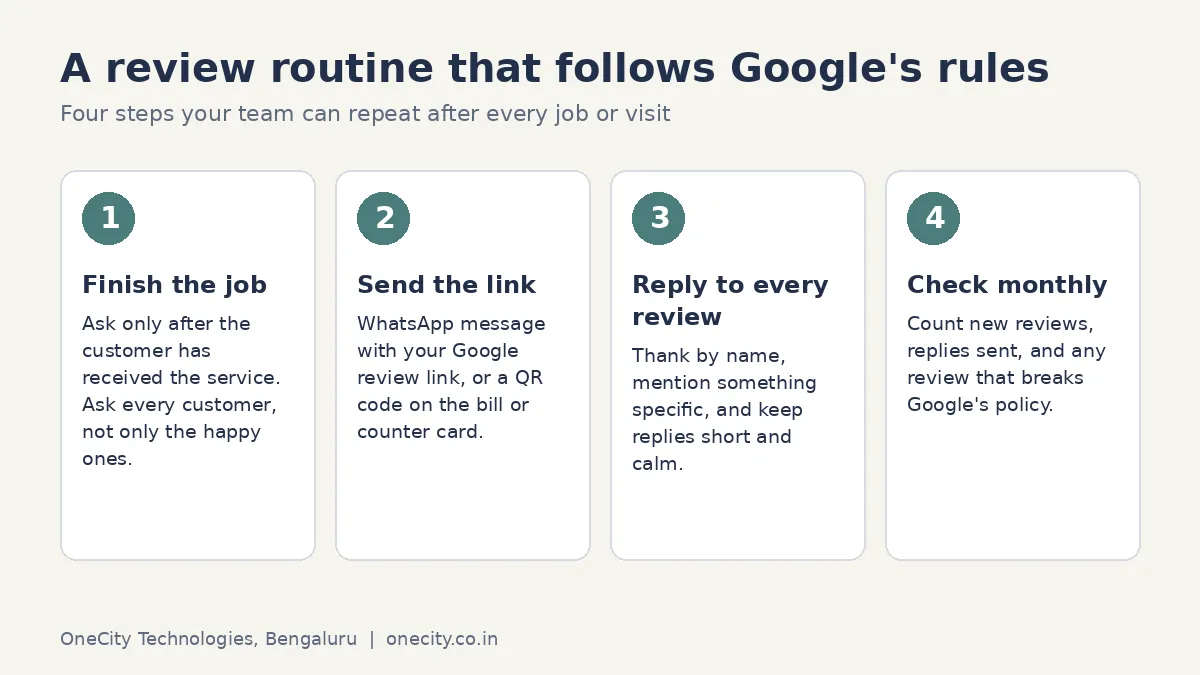
A fully optimised GBP for a Bangalore small business includes: the most specific available primary business category plus 5 to 9 secondary categories, a complete services list with individual service names and descriptions, a 750-character description incorporating primary keywords and location specifics, a minimum of 10 high-quality photos added and refreshed regularly, and a consistent weekly Google Post schedule. Building a systematic review generation process , sending a WhatsApp review link to every satisfied customer within 2 hours of service completion , is the single GBP action with the most consistent ranking impact across categories.
Our local SEO service covers the full GBP optimisation and management process as part of its scope. For small businesses that want to manage GBP independently, the most important ongoing commitment is responding to every review within 24 hours and posting at least once per week.
Local SEO: Owning Your Neighbourhood Before Your City
Local SEO for small businesses in Bangalore should begin with the smallest viable geographic target , the specific neighbourhoods or areas where your customers are concentrated , not the city as a whole. A tutoring centre in Jayanagar should target “home tutor Jayanagar” before “home tutor Bangalore.” A physiotherapist in HSR Layout should own “physiotherapy HSR Layout” before competing for “physiotherapy clinic Bangalore.”
The logic is straightforward: neighbourhood-level keywords have lower competition, more geographically specific intent, and often higher conversion rates because the searcher is looking for proximity specifically. Once you dominate your neighbourhood, you expand to adjacent areas and then city-wide terms as your domain authority builds.
The Local SEO Foundation
The technical foundation of local SEO for small businesses requires four things: a fast, mobile-optimised website with a dedicated page for each primary service, consistent NAP (Name, Address, Phone) information across all Indian directories including Justdial, Sulekha, and IndiaMart, a Google Business Profile with all sections complete and actively managed, and a structured review generation process as described above.
On top of this foundation, the content work involves creating location-specific service pages that mention the served neighbourhoods by name with genuinely localised content , not template pages with city names swapped. A page for “digital marketing services in Jayanagar Bangalore” should include content specific to the Jayanagar business community, local landmarks as reference points, and examples relevant to businesses in that area.
Google Search Ads: Fast Leads While SEO Builds
For small businesses that need leads now rather than in 6 to 12 months, Google Search Ads provide the fastest path to qualified enquiries. Unlike social media ads that interrupt people who are not actively looking for your service, Search Ads appear precisely when someone types a query indicating they want what you offer. This intent alignment makes Search Ads consistently more efficient for most B2B and professional service categories than display or social advertising.
Minimum Viable Budget
In most Bangalore service categories, a minimum daily budget of ₹500 to ₹800 is required for Search Ads to generate enough daily clicks for Google’s algorithm to learn and optimise. Below this threshold, campaigns often miss their daily budget targets and cannot accumulate the conversion data needed for smart bidding to function. The cost-per-click in competitive Bangalore categories ranges from ₹40 to ₹80 for lower-competition local service terms to ₹150 to ₹400 for highly contested categories like legal services, real estate, and digital marketing itself.
What to Run First
Start with a single tightly focused Search campaign targeting 10 to 20 high-intent keywords with local modifiers. Every ad group should link to a specific landing page , not your generic homepage , that directly addresses the search intent of that keyword group. A campaign for a Bangalore accounting firm should have separate ad groups for “GST filing services Bangalore,” “income tax consultant Bengaluru,” and “company registration Bangalore,” each linking to a page specifically about that service rather than a general “our services” page.
Our PPC management service handles campaign setup, keyword selection, ad copy creation, landing page optimisation, and ongoing bid management. For small businesses managing ads independently, the most critical discipline is connecting conversion tracking to actual enquiries (form submissions, calls) before spending any budget , without conversion data, there is no basis for optimising a campaign.
Website Design: The Asset Everything Else Points To
Every digital marketing channel , SEO, Google Ads, social media, GBP , ultimately points potential customers to your website. A website that does not convert visitors into enquiries wastes every rupee spent on visibility. For small businesses, website investment should be evaluated not as a design cost but as a conversion infrastructure cost.
What a Small Business Website Must Do
The minimum requirements for a small business website that supports digital marketing growth: loads in under 3 seconds on a 4G mobile connection (over 75% of Indian web traffic is on mobile), has a clearly visible phone number and WhatsApp button on every page without scrolling, has dedicated pages for each primary service with specific descriptions, pricing indicators, and clear calls to action, passes Google’s Core Web Vitals assessment, and has HTTPS enabled with a valid SSL certificate.
These are not nice-to-haves , they are the technical floor below which no SEO or advertising investment can compensate. A beautiful website that loads in 6 seconds on mobile loses more than half its visitors before they see the first screen of content.
Our website design team builds small business websites with performance-first architecture , mobile load times, Core Web Vitals compliance, and conversion-optimised page structures are built into the design process rather than addressed as afterthoughts. We also design dedicated landing pages for Google Ads campaigns so paid traffic converts at the highest achievable rate.
Content Marketing: The Long-Term Compounding Asset
Blog content and educational resources on your website are the digital marketing assets that compound most powerfully over time. A blog post that ranks on page one for a high-intent keyword continues generating enquiries every month without additional investment , unlike paid advertising, which stops generating leads the moment you stop paying.
Content That Works for Small Businesses in India
Not all content generates leads. The content that produces commercial results for small businesses targets queries with purchase intent , searches made by people who are actively evaluating whether to hire a service or buy a product, not people browsing for general information.
For a Bangalore CA firm, “how to file GST returns for a small business in Karnataka” attracts a business owner actively dealing with a compliance problem , a qualified potential client. “The history of the goods and services tax in India” attracts a student doing research , not a client.
The content planning framework for small businesses: identify the 10 questions that your sales team or receptionist answers most often before a new client engages. Each of these questions represents a search query your potential customers make. Create one substantive, well-researched page or blog post that completely answers each question. This produces 10 pieces of content directly targeting buyer-intent queries rather than a random collection of industry topics.
Our content writing service researches, writes, and optimises this type of targeted content for small business clients across healthcare, professional services, education, and B2B categories.
Social Media Marketing: Right Channel, Right Business
Social media is one of the most over-invested and under-performing channels for Indian small business marketing. The issue is not social media itself , it is using the wrong platform for the business type or treating social media as a lead generation channel when it is primarily a brand awareness channel.
When Social Media Is the Right Investment
Instagram works for businesses where visual output is central to what they sell , interior design, fashion, food, fitness, hospitality, and visual arts. Consistent, high-quality visual content that showcases real work builds a following that generates enquiries over time for these categories.
LinkedIn works for B2B businesses whose customers are senior decision-makers , IT services, consulting, legal, HR, and financial services companies in Bangalore’s corporate ecosystem. Regular content demonstrating expertise, client results, and industry expertise generates inbound enquiries from qualified buyers who have seen consistent evidence of capability.
YouTube works for businesses with educational content , coaching institutes, training companies, professional services that can demonstrate expertise through video. A Bangalore CA firm that posts 10-minute explanatory videos on GST filing, income tax saving strategies, and company registration processes can build a substantial subscriber base of pre-qualified potential clients.
When Social Media Is Not the Right First Investment
For businesses where customers search actively with clear intent , plumbers, electricians, physiotherapy clinics, legal services, recruitment agencies, accounting firms , social media organic content produces low direct lead volume relative to SEO and Google Ads. Potential customers for these services do not typically browse Instagram hoping to find a plumber; they search Google when they have a specific need. Investing in SEO and GBP before social media organic content produces faster, higher-value results for these categories.
Email Marketing: The Highest ROI Channel for Established Businesses
For small businesses with an existing customer base , regardless of size , email marketing consistently delivers the highest return on investment of any digital channel. The average email marketing ROI across industries is consistently cited at ₹36 to ₹40 return for every ₹1 spent, significantly higher than social media, display advertising, or even SEO in most categories.
For Indian small businesses, WhatsApp broadcast lists serve a similar function to email for customer retention and re-engagement , and with higher open rates than email for most demographics. A business with 500 satisfied past customers who have opted in to WhatsApp messages can generate significant repeat business and referrals through a monthly update with a specific offer, seasonal message, or useful information piece , at near-zero cost.
The Right Sequence: Building a Digital Marketing Foundation
For a small Bangalore business starting digital marketing with a budget of ₹15,000 to ₹25,000 per month, the right sequence is:
Month 1 to 3: Complete GBP optimisation and build a review generation system. Confirm the website passes Core Web Vitals and has dedicated service pages. Set up Google Search Console and Google Analytics with conversion tracking. This foundation costs little and produces immediate incremental improvement in local search visibility.
Month 3 to 6: Start a focused Google Search Ads campaign targeting 10 to 15 high-intent keywords for your primary service. Set a daily budget of ₹600 to ₹800. Simultaneously, publish one high-quality blog post per month targeting a buyer-intent question. The ads provide immediate leads while SEO begins building the organic asset.
Month 6 to 12: Assess which channel is producing the best cost-per-lead. Increase investment in the stronger performer. Add content production to 2 to 3 posts per month as SEO begins producing consistent organic traffic. Evaluate whether social media is appropriate for your specific business category and add it only if there is a clear fit between your content type and a platform where your target customers actively engage.
Measuring What Matters
The most common digital marketing failure for small businesses is measuring the wrong things. Followers, likes, website visitors, and impressions are visible and easy to track , and largely disconnected from business revenue for most categories.
The metrics that matter: calls from organic and paid search (trackable through Google Search Console, GBP Insights, and call tracking numbers), form submissions and WhatsApp enquiries from your website (trackable through Google Analytics goal conversions), direction requests from GBP (visible in GBP Insights), and cost per lead by channel (calculated monthly from actual enquiry volume and channel spend). A business that tracks these four metrics consistently has the data to make evidence-based decisions about where to increase investment and where to reduce it.
Choosing a Digital Marketing Agency in Bangalore: What Small Businesses Get Wrong
Small businesses in Bangalore most commonly make two mistakes when selecting a digital marketing agency. The first is choosing based on price , selecting the cheapest proposal without evaluating what the deliverables are or whether they match what the business actually needs. A ₹5,000 per month SEO retainer in a competitive Bangalore category covers the cost of reporting and minimal content, but not the keyword research depth, content quality, or link building activity that produces ranking results. The second mistake is selecting an agency based on their own website’s visual quality rather than on evidence of results for clients similar to the business making the hiring decision.
The right evaluation criteria for a Bangalore small business selecting a digital marketing agency: verified results in your specific service category (not just “digital marketing” broadly), a named senior strategist who will be accountable for your account (not rotated junior staff), monthly reporting that includes Google Search Console data (not just proprietary dashboard data that cannot be independently verified), and a clear definition of what success looks like at month 3, month 6, and month 12 written into the agreement before work begins.
OneCity Technologies has operated under this standard since 2006 , our client case studies name the client, describe the starting position, detail the actions taken, and show the outcome in measurable terms. For small businesses in Bangalore, Mangalore, and Mysuru considering a digital marketing engagement, we provide a no-cost initial audit that identifies your current digital marketing gaps and outlines a prioritised sequence of actions specific to your business type, competitive market, and budget. Contact our digital marketing team to begin.
Frequently Asked Questions
What digital marketing budget should a Bangalore small business start with?
A minimum of ₹15,000 per month is needed to invest deeply enough in any single channel to see measurable results within 6 months. Below ₹10,000 per month, most channels lack sufficient depth to overcome competition and produce consistent enquiries. If ₹15,000 is not available, prioritise GBP optimisation (free) and review generation (free) before spending on any paid service , these produce the most impact per rupee for local service businesses at any budget level.
How long before digital marketing produces results for a small business in India?
Google Ads can produce enquiries within 24 to 72 hours of going live. GBP optimisation improvements show up in search rankings within 2 to 8 weeks. Local SEO produces consistent first-page rankings for targeted neighbourhood keywords within 3 to 6 months. National keyword rankings and significant organic traffic growth take 9 to 18 months. The fastest revenue-generating approach for most small businesses is GBP optimisation combined with a focused Google Ads campaign , this combination can generate consistent enquiries within the first month while organic SEO compounds in the background.
Should a small business in Bangalore hire an agency or do digital marketing in-house?
For businesses spending less than ₹10,000 per month on digital marketing, a focused in-house effort , GBP management, review generation, and basic blog content , often produces better results than an agency that spreads a small budget too thin. Above ₹20,000 per month, an agency with demonstrated results in your specific category typically outperforms an in-house generalist, because the complexity of managing SEO, paid ads, and content simultaneously requires specialist depth in each area that a single person managing multiple business responsibilities cannot provide.
What is the biggest digital marketing mistake small Bangalore businesses make?
Changing agencies or strategies every 4 to 6 months before results have had time to compound. SEO requires 6 to 12 months of consistent work to produce measurable ranking improvements, and Google Ads require 4 to 8 weeks of learning and optimisation before cost-per-lead stabilises. Businesses that interrupt this compounding process repeatedly , switching agencies, pausing campaigns, or pivoting strategy every quarter , consistently underperform compared to those that make a well-researched initial choice and sustain commitment through the maturation period.
How do OneCity’s digital marketing services work for small businesses specifically?
OneCity structures small business digital marketing around a defined sequence: foundational GBP and local SEO in the first 90 days, performance marketing setup in months 2 to 4, and content-led organic growth from month 4 onwards. Each client is assigned a dedicated account manager and strategist , not rotated through junior staff , because institutional knowledge about a specific business’s market position and competitive market accumulates over time and directly improves campaign performance. We have managed small business campaigns from ₹15,000 per month to enterprise-level budgets, with the same methodology applied at the appropriate scale for each client’s situation.
Source: India’s official MSME registration portal , MSME Udyam Registration Portal , Government of India
L.K. Monu Borkala
Founder & SEO Director, OneCity Technologies
20 years running SEO campaigns from Bangalore. Full author profile · LinkedIn