How to Rank Your Website on Google First Page
Written by L.K. Monu Borkala, Founder, OneCity Technologies (CIN: U72100KA2009PTC048911), Bangalore. 20 years in business. +91 99023 30233.
Introduction & Why This Guide Matters in 2026
Getting to the top of Google isn’t luck; it’s a system. In 2026, Google Search Engine Optimization (SEO) demands a user-first approach that blends content quality, technical performance, and brand authority. With AI Overviews (SGE), tighter E-E-A-T expectations, and Core Web Vitals shaping visibility, the sites that win are those that are fast, trustworthy, and genuinely helpful.
In this guide, you’ll find an practical roadmap that outlines how to structure pages, earn authoritative mentions, publish high-value content, and address the technical details that impact crawling, indexing, and click-through rates. You’ll also learn how to track what matters so every month compounds gains rather than resets effort.
Created by OneCity’s SEO team, this playbook combines what works across competitive niches education, property, healthcare, and local services. If your goal is sustainable growth (not hacks that fade with the next update), start here and apply each step to move steadily toward the #1 spot.
Understanding Google Search Engine Optimization (SEO)
Google Search Engine Optimization (SEO) is the practice of improving your website so Google can discover, understand, and recommend it to searchers. In 2026, success hinges on aligning pages with user intent, demonstrating E-E-A-T (experience, expertise, authoritativeness, trust), and delivering fast, stable experiences that meet Core Web Vitals. When people ask “how to get your website to the top of Google,” the answer is a balanced system: on-page SEO and off-page SEO working with clean technical foundations.
On-page SEO organizes information so both users and crawlers instantly see relevance through clear titles, headings, semantic keywords, internal links, helpful media, and concise answers that satisfy queries. Off-page SEO builds authority through credible mentions, high-quality backlinks, ratings/reviews, and branded searches. Technical SEO makes sure Google can crawl, index, and render your content without friction.
Most influential ranking factor groups:
- Relevance & Quality: search intent match, topical depth, freshness, E-E-A-T (author bios, citations, real expertise), and engagement signals.
- Experience & Authority: Core Web Vitals, mobile UX, page speed, security (HTTPS), structured data, consistent high-quality links, and brand mentions.
Treat SEO as ongoing product improvement. Publish valuable content, remove friction, and earn trust this is search engine optimization (SEO) that compounds.
How to Get Your Website to the Top of Google , Step-by-Step Plan
Step 1 , Master On-Page SEO Techniques
On-page optimization tells Google exactly what your page is about and why it deserves a top position. Align each page with search intent, then express that intent through clear structure and semantics. Write title tags (≤60 characters) that lead with the primary benefit and meta descriptions that earn clicks. Use H1–H3 tags to outline the story. Place your primary keyword early in the H1 and introduction, then reinforce it with semantic keywords and related entities throughout. Keep paragraphs concise and add FAQ-style subheads to capture long-tail queries. This is search engine optimization (SEO) fundamentally: relevance, clarity, and usefulness.
Focus areas:
- Title tags and meta descriptions that promise concrete value
- H tags and content structure that mirror user intent
- Strategic keyword placement and semantic coverage
- Image optimization (alt text, compression, modern formats)
- Internal linking to related guides, hubs, and services
Quick checklist:
- Map search intent and choose the primary keyword.
- Write a unique title tag and meta description.
- Use one H1; structure with H2/H3s.
- Add semantic keywords and FAQ subheads.
- Optimize images and add descriptive alt text.
- Link to relevant pages, including your services
- Test readability on mobile and fix grammar.
Need help? Explore OneCity’s On-Page SEO services to implement these improvements quickly. Contact us or call Mob: +919902330233 or Mob: +91 99023 30233. Address: No. S, 1869, 1st H Main Rd, near Mahakavi Kuvempu Metro, D-Block, 2nd Stage, Rajajinagar, Bengaluru, Karnataka 560010
Step 2 , Strengthen Off-Page SEO
Off-page SEO builds the credibility signals Google uses to rank competitive pages. Prioritize quality over volume: one link from a relevant, trusted publication beats dozens of random directory links. Grow brand searches and mentions by publishing distinctive research and earning coverage. Standardize citations for local visibility and keep reviews authentic and recent.
Three quick tactics with outcomes:
- Digital PR datasets: Publish a small study and pitch 5–10 niche media sites outcome: 2–5 authoritative backlinks and referral traffic.
- Guest features with value: Contribute frameworks or case studies to respected blogs. Outcome: Editorial links, expert positioning, and fresh discovery.
- Brand entity building: Align about pages, social profiles, and schema. Outcome: Clearer Knowledge Graph signals and higher trust.
Sustain momentum with a monthly outreach target, a clean link-risk policy (no paid link schemes), and monitoring of anchor diversity. Track referring domains, brand impressions, and assisted conversions, not just link counts. This is how on-page SEO and off-page SEO work together to compound authority.
Step 3 , Create High-Value, Engaging Content
Content is the engine that matches search intent and earns links. Use a hub-and-spoke model, featuring pillar pages for broad, high-intent queries and supporting articles for related subtopics and questions. Prioritize formats that win trust, such as snippets of how-to guides with steps, long-form explainers with diagrams, comparison pages with tables, and case studies with real numbers. Add expert quotes, author bios, and references to strengthen E-E-A-T.
Adopt an “update first” mindset before creating new articles. Refresh statistics, clarify steps, add FAQs for People Also Ask, and embed short videos. Repurpose winners into checklists, carousels, and email tips; turn webinar notes into a written playbook; slice long guides into shorts for YouTube and Reels to stimulate branded search.
Cadence to aim for:
- Weekly: one new article targeting a priority keyword that supports a pillar
- Biweekly: one update to a page within striking distance (positions 4–15)
- Monthly: a case study or mini-research asset to attract links
- Quarterly: a content audit to prune, merge, or redirect duplicate pages
Measure engagement (time on page, scroll depth), SERP features captured, and conversions from content CTAs. High-value content, combined with smart internal linking, signals topical depth to Google’s Search Engine Optimisation systems.
Step 4 , Technical SEO That Google Loves
Technical SEO removes friction between your site and Google. Start with crawlability: a clean robots.txt file, a logical architecture, and an XML sitemap containing only indexable URLs. Fix duplicate content using canonical tags; make sure pagination, parameter handling, and hreflang (if applicable for multilingual content) are correct. Reduce index bloat by noindexing thin or faceted pages that add no value to the user experience.
Improve Core Web Vitals: speed up Largest Contentful Paint with image optimization and server-side rendering, stabilize Cumulative Layout Shift by reserving media space, and lower Interaction to Next Paint with lean JavaScript and deferred scripts. Use a CDN, HTTP/2, and compression.
Add structured data so Google can understand and feature your pages: Article, FAQ, BreadcrumbList, Organization, Product, Review, and Video where relevant. Validate with Rich Results. Test and monitor in Search Console. Implement 301 redirects, enforce HTTPS, and fix 404 chains. With a clean, fast foundation, your on-page and off-page wins convert into stable top-of-page rankings.
On-Page SEO and Off-Page SEO , What’s the Difference?
On-page SEO optimizes what’s on your site; off-page SEO builds signals beyond it. On-page clarifies relevance and experience title tags, headings, keyword placement, semantic coverage, internal links, helpful media, UX, and Core Web Vitals so Google Search Engine Optimization systems understand and reward your pages. Off-page SEO enhances authority through high-quality backlinks, brand mentions, reviews, citations, and digital PR, which demonstrates that others vouch for your content. Together, they answer two questions Google asks: is this the best answer, and can we trust it?
Objectives
- On-page: match search intent, enhance UX, and improve crawlability.
- Off-page: earn authority, expand reach, and grow branded demand.
KPIs
- On-page: rankings for target terms, CTR, engagement, and Core Web Vitals.
- Off-page: referring domains, link relevance, branded searches, review velocity.
Where OneCity adds value
- Audits and fixes align with on-page SEO and off-page SEO.
- Content frameworks, internal linking, schema, and technical cleanup.
- Digital PR, citation management, and risk-aware link acquisition.
| Aspect | On-Page | Off-Page |
| Focus | Relevance, UX, crawlability | Authority, trust, reach |
| Levers | Titles, headings, content, internals, Web Vitals | Backlinks, mentions, reviews, citations, PR |
| KPIs | Rankings, CTR, engagement | Referring domains, link quality, and branded searches |
| OneCity | Audits, content, schema, tech fixes | Digital PR, safe links, citation management |
Future-Ready SEO Techniques for 2026
AI will sit between users and websites, so it is built for machines and humans at once. Start by structuring facts that AI Overviews can quote: short, source-backed answers, clear headings, and tidy schema. Pair that with topical depth and real expertise, so your brand is the safest result to surface.
Key moves for the next 12 months:
- Optimize for SGE/AI Overviews: Lead each section with a 40–60-word answer, include statistics and citations, and mark up FAQs, How-To, and Product sections where relevant. Monitor “AI Overviews” impressions in Search Console and refine.
- Conversational & local intent: Add natural-language FAQs that mirror how people speak into phones. Strengthen GMB/NMX, NAP consistency, reviews, and service-area pages.
- Zero-click resilience: Target featured snippets, People Also Ask, and knowledge panels; embed calculators, checklists, and tables to provide value on-page.
- Video & YouTube SEO: Publish short explainer videos for priority keywords. Use descriptive titles, chapters, captions, and schema (VideoObject) to enhance the content. Repurpose content into Shorts/Reels to drive branded search growth.
- Entity & data architecture: Consolidate author bios, about pages, and organization details; interlink hubs and spokes to reinforce entities that Google’s systems understand.
- Experience signals: Enhance Core Web Vitals, accessibility, and trust elements (including HTTPS, policies, and contact information). Fast pages win in competitive SERPs.
Tie these moves to your goals. For competitive terms like “Google search engine optimization” and “how to get your website to the top of Google,” combine on-page SEO and off-page SEO with consistent publishing, and you’ll compound authority through 2026.
Common Mistakes to Avoid When Doing SEO
Avoid these frequent pitfalls that stall rankings and waste budget in Google Search Engine Optimization. Keep a checklist to stay focused.
- Chasing volume over search intent.
- Thin pages without topical depth.
- Ignoring on-page basics (titles, H tags).
- Weak internal linking and orphan pages.
- Buying links or using PBNs.
- Duplicate content and keyword cannibalization.
- Slow Core Web Vitals, heavy scripts.
- No schema or messy data.
- Set-and-forget publishing; no updates.
- No conversion tracking or clear CTAs.
Mini-case (OneCity): A service brand lost traffic after launching dozens of near-duplicate location pages. We consolidated content, mapped unique intents, added internal links and local schema, and improved LCP to <2.5s, restoring top-3 rankings and lifting qualified leads by 38%. The cleanup also reduced index bloat by 42% and enhanced crawl efficiency within two weeks.
Track, Measure, and Optimize for Continuous Growth
Growth in SEO comes from disciplined measurement. Use Google Search Console for indexing, queries, impressions, CTR, page experience, and enhancements. Pair it with GA4 to track sessions, engaged sessions, conversions, assisted conversions, and lead quality. Add a dependable rank tracker to monitor target keywords, URL-level rankings, and SERP features.
Core KPIs:
- Organic traffic and impressions
- CTR by query and page
- Rankings and share of voice
- Conversions, CPL/CPA, revenue
- Core Web Vitals and crawl errors
- Backlink growth and referring domains
Cadence:
- Weekly: check anomalies, new queries, and declining pages; annotate changes.
- Monthly: content and technical audit; refresh decaying pages; test new titles/meta for CTR; update internal links.
- Quarterly: strategy review; expand winning clusters; consolidate modified URLs; re-crawl critical templates.
Use dashboards that tie goals to numbers (e.g., top-funnel impressions → mid-funnel sessions → bottom-funnel leads). Translate findings into actions: fix issues, ship updates, and re-measure. This tight loop is how Google search engine optimization compounds into predictable growth.
Why Partner with OneCity for Google Search Engine Optimization?
OneCity combines strategy, technical solutions, and content to achieve competitive SERPs in Google search engine optimization. We align on page and off-page SEO with clear KPIs, fast delivery, and transparent reporting so growth is measurable, not mysterious. If you need search engine optimization (SEO) that compounds, we build it end-to-end.
Case study , 12-week turnaround (B2B services): After a technical cleanup (LCP 4.3s → 2.2s), content revamp, and digital PR, the client gained 37% more organic sessions, 22 new referring domains, and a 58% lift in qualified leads. Share of voice for five core terms moved from positions 6–12 to 1–3, with CTR improving from 2.4% to 6.9%.
Benefits:
- Senior specialists for strategy, content, and engineering
- Risk-aware link acquisition; review/citation management
- Clear roadmaps, dashboards, and weekly progress notes
Explore our SEO services or Get a Free SEO Audit Contact us or call Mob: Mob: +91 99023 30233 or +919902330233. Address: No. S, 1869, 1st H Main Rd, near Mahakavi Kuvempu Metro, D-Block, 2nd Stage, Rajajinagar, Bengaluru, Karnataka 560010 to start today.
Frequently Asked Questions
How long does SEO take?
Most sites see meaningful movement in 8–12 weeks, with compounding gains over 6–12 months. In google search engine optimization, timelines depend on competition, content depth, technical health, and link equity. Consistent execution content, technical fixes, and outreach matters more than any single tactic.
Is word count a ranking factor?
No. Google ranks usefulness, not length. Longer pages often win because they comprehensively cover intent, include relevant semantic entities, and earn more links. Write the minimum necessary to fully answer the query, add helpful media, and remove unnecessary content. Quality beats arbitrary word targets.
On-page vs off-page what should I do first?
Start with on-page and technical foundations: intent-focused content, titles, headings, internal links, and Core Web Vitals. Then scale off-page: digital PR, citations, and partnerships. Authority amplifies relevance, but without strong pages to rank, links won’t convert into positions.
How often should I update content?
Review key pages monthly; refresh statistics, examples, and FAQs every 60–90 days. Prioritise URLs that appear on page two or are slipping in impressions. Mergers and redirects can resolve cannibalisation. Treat updates as product releases that improve satisfaction and snippet capture.
What matters more: backlinks or content quality?
You need both. Content establishes relevance and earns engagement; backlinks signal trust and authority. Aim for link-worthy assets, such as original research, case studies, and in-depth guides, and promote them through targeted outreach. Avoid paid link schemes; instead, pursue editorial, contextually relevant mentions.
Ranking in Bangalore’s Search Market: What’s Different
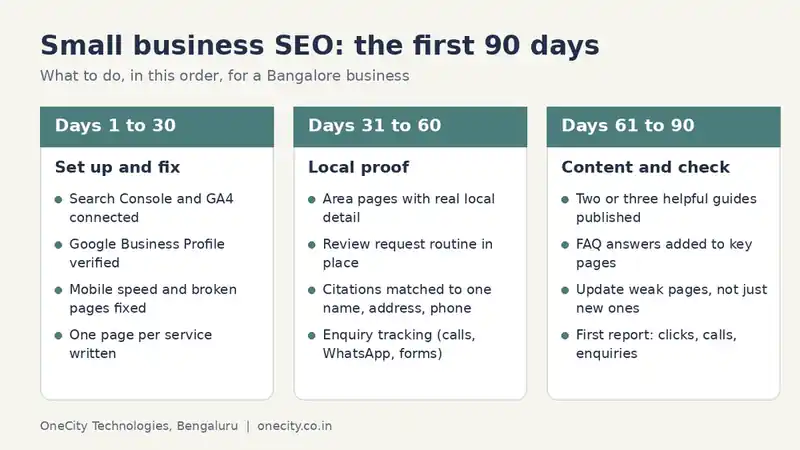
Bangalore’s search market is one of the most competitive in India. The city has over 80,000 registered businesses and the highest startup density of any Indian metro. For almost every commercial search , “interior designer Koramangala,” “CA firm Jayanagar,” “logistics company Peenya” , you are competing against companies that have been investing in SEO for years and have accumulated domain authority you cannot replicate quickly.

Working with 650+ clients across Karnataka since 2006, the pattern I see consistently is this: businesses that reach Google’s first page in Bangalore are not the ones with the largest budgets. They are the ones that do the fundamentals correctly and consistently. A Rajajinagar retailer with a properly structured site, accurate Google Business Profile optimization, and 20 genuinely useful blog posts will outrank a Koramangala competitor with a higher budget but a technically broken site and no local content.
The March 2026 Spam Update specifically penalised Bangalore businesses that had been using AI-generated content and low-quality link schemes. Many sites that had held first-page positions for years dropped significantly. The sites that held their rankings , and the ones that moved up to fill the gaps , were the ones with real author signals, verifiable business information, and content that reflected genuine knowledge of their industry.
If you are working on ranking in Bangalore specifically, two things matter more here than in smaller markets: your Google Business Profile must be active and accurate (Bangalore customers use Maps heavily for local decisions), and your content must reflect an understanding of Bangalore’s specific market segments , the tech corridor from Whitefield to Electronic City, the commercial areas of MG Road and Indiranagar, the manufacturing belt around Peenya. Generic content written without this local context will consistently lose to content written by someone who actually operates in the city.
L.K. Monu Borkala , Founder, Onecity Technologies Pvt. Ltd (CIN: U72100KA2009PTC048911). SEO practitioner in Bangalore since 2006. Onecity SEO services in Bangalore.
Reference sources: Google Search Central.
Realistic Timelines for Ranking on Google’s First Page in Bangalore
The timeline for reaching Google’s first page depends on three variables: the competitiveness of the target keyword, the current authority of the domain, and the quality of the work applied. For a new Bangalore business website targeting its brand name , “OneCity Technologies Bangalore” , first page ranking is achievable in days or weeks because nobody else is targeting that exact phrase. For a new website targeting “digital marketing agency Bangalore” , a high-competition keyword with established players who have been ranking for years , first page ranking for a new domain takes twelve to twenty-four months of consistent, quality work.
Understanding this distinction is important because unrealistic expectations lead to abandoning SEO work right before it starts producing results. The six-month point of an SEO campaign is often when the compounding effect begins to show. Businesses that stop at month four because they have not seen significant movement yet make the costliest possible timing mistake.
The On-Page Factors That Determine First Page Ranking
Title tag relevance , the primary keyword in the first 40 characters of the title tag , is the single most controllable on-page ranking factor. A Bangalore web design company whose homepage title tag says “Welcome to Our Website” has made a fundamental optimisation error that suppresses rankings for every relevant keyword. The title tag should say exactly what the page is about, in the language the customer uses when searching.
Content depth , the comprehensiveness with which a page covers its topic , is increasingly important as Google uses AI to understand whether a page fully answers the searcher’s intent. A page about “web design services Bangalore” that only lists services without explaining process, pricing range, portfolio examples, or what makes the company different is less comprehensive than a competitor page that addresses all of those dimensions. Depth, not length, is what matters , but depth and length tend to correlate for most topics.
Page experience , Core Web Vitals scores, mobile usability, HTTPS , affects ranking position at the margins. For Bangalore businesses competing for high-value keywords where the difference between ranking position three and position one is meaningful in revenue terms, these marginal factors matter. For businesses starting from page two or page three, the content and authority fundamentals matter far more. Fix Core Web Vitals after the content is right, not instead of it. OneCity Technologies Pvt Ltd (CIN: U72100KA2009PTC048911). L.K. Monu Borkala. +91 99023 30233 | sales@onecity.co.in.
Off-Page Factors That Determine First Page Rankings
Content and technical SEO get you to a ceiling. Breaking through that ceiling , from page two to page one, from position seven to position three , requires domain authority built through external links and brand mentions. For Bangalore businesses, the most accessible off-page authority signals are local press coverage, industry association memberships, and supplier or partner cross-references. Each represents a genuine business relationship that produces an editorial link rather than a purchased one. Google’s March 2026 Spam Update specifically targeted unnatural link patterns. The businesses that held rankings through the update were those with link profiles built from genuine relationships rather than outreach campaigns. OneCity builds link profiles for Bangalore businesses through relationship-based link earning rather than volume-based outreach. L.K. Monu Borkala, Founder, OneCity Technologies Pvt Ltd (CIN: U72100KA2009PTC048911). +91 99023 30233 | sales@onecity.co.in.
The Off-Page Work That Pushes Bangalore Businesses to Page One
On-page optimisation takes you to a certain ranking ceiling. Crossing that ceiling , from page two to position three to position one , requires external authority signals. For Bangalore businesses, the most accessible and most effective sources of genuine external authority are industry association memberships, local business press coverage, and supplier or partner cross-links from established domains.
CII Karnataka, NASSCOM, FKCCI, and CREDAI membership directories are legitimate, editorially maintained sources that pass real trust signals. A Bangalore business listed in the CII Karnataka member directory with a link to its website has an external citation from a respected industry body. That citation means something to Google because CII Karnataka does not list businesses without verifying them.
Local press coverage in Deccan Herald, The Hindu Bangalore, and Times of India Bangalore generates editorial links from high-authority domains that no outreach campaign can replicate. The path to press coverage is through genuinely newsworthy business activity , a significant client win, a community initiative, a first-in-market product or service. Businesses that create press-worthy moments earn the links that move rankings. OneCity Technologies Pvt Ltd (CIN: U72100KA2009PTC048911). L.K. Monu Borkala, Founder. 20 years in business. +91 99023 30233 | sales@onecity.co.in.
Bangalore Businesses That Consistently Rank on Page One
The pattern across Bangalore businesses that hold first-page rankings over multiple algorithm updates is consistent. They publish content on a regular schedule , not in bursts, not reactively, but as a planned operational activity. They maintain their technical foundation with quarterly audits that catch crawl errors, speed regressions, and structural issues before they affect rankings. They build links through genuine business activity rather than outreach campaigns. And they measure organic performance against business outcomes monthly , not just ranking positions, but enquiry volume, conversion rate, and revenue attribution.
First-page rankings in competitive Bangalore categories are not won once and held passively. They are maintained through consistent work. The businesses that understand this build SEO into their operations rather than treating it as a project with a start and end date. The compounding effect of that operational discipline , more content, more authority, better technical health each quarter , is what produces rankings that survive algorithm updates and hold under competitive pressure. OneCity Technologies Pvt Ltd (CIN: U72100KA2009PTC048911). L.K. Monu Borkala, Founder. 20 years in business. Three Karnataka offices. +91 99023 30233 | sales@onecity.co.in.
Reaching Google first page requires technical foundation, relevant content, and domain authority working together. For Bangalore businesses targeting competitive keywords, the realistic timeline is six to eighteen months of consistent work. For less competitive local keywords, three to six months. OneCity builds first-page rankings for Bangalore businesses across all categories. L.K. Monu Borkala, Founder, OneCity Technologies Pvt Ltd (CIN: U72100KA2009PTC048911). 20 years in business. Three Karnataka offices. +91 99023 30233 | sales@onecity.co.in.
The Long-Term Value of First-Page Rankings for Bangalore Businesses
A first-page organic ranking for a commercial keyword in Bangalore generates leads every day without ongoing ad spend. The economics of organic search are fundamentally different from paid advertising , once a ranking is established and maintained, the cost per lead decreases over time as the content accumulates authority. A Bangalore business that invests consistently in SEO for two years builds an asset. A business that spends the same budget on Google Ads for two years has a campaign history and no owned traffic asset when the spending stops.
The businesses in Bangalore that have built the most durable organic traffic , the ones that still rank consistently after three or four algorithm updates , are the ones that built content around genuine customer questions, earned links through real business relationships, and maintained their technical health through regular audits. No shortcuts. No sudden drops when the next update rolls out. OneCity Technologies Pvt Ltd (CIN: U72100KA2009PTC048911). L.K. Monu Borkala, Founder. 20 years in business. Bengaluru: +91 99023 30233 | Mangaluru: +91 89044 28490 | sales@onecity.co.in.
The Long-Term Value of First-Page Rankings for Bangalore Businesses
A first-page organic ranking for a commercial keyword in Bangalore generates leads every day without ongoing ad spend. The economics of organic search are fundamentally different from paid advertising. Once a ranking is established and maintained, the cost per lead decreases over time as the content accumulates authority. A Bangalore business that invests consistently in SEO for two years builds an owned traffic asset. A business that spends the same budget on Google Ads for two years has no owned asset when the spending stops.
The businesses in Bangalore that hold the most durable organic rankings are the ones that built content around genuine customer questions, earned links through real business relationships, and maintained technical health through regular audits. No shortcuts, no sudden drops when algorithm updates roll out. Consistent work produces consistent rankings.
For Bangalore businesses in competitive categories , legal, healthcare, education, real estate , a first-page ranking for the right keyword can be the most valuable digital asset the business owns. It works every day, around the clock, for every potential customer who searches. That is what sustained SEO investment builds. OneCity Technologies Pvt Ltd (CIN: U72100KA2009PTC048911). L.K. Monu Borkala, Founder. 20 years in business. Bengaluru: +91 99023 30233 | Mangaluru: +91 89044 28490 | sales@onecity.co.in.
L.K. Monu Borkala
Founder & SEO Director, OneCity Technologies
20 years running SEO campaigns from Bangalore. Full author profile · LinkedIn
Frequently Asked Questions
What three types of SEO work together to improve rankings?
On-page SEO (titles, headings, internal links, and content that satisfies queries), off-page SEO (backlinks, mentions, and reviews), and technical SEO (making sure Google can crawl, index, and render content).
What ranking factor groups does this guide identify as most influential?
Relevance and quality (search intent match, topical depth, freshness, E-E-A-T) and experience and authority (Core Web Vitals, mobile UX, page speed, security, and structured data).
Which industries does this playbook specifically address?
Education, property, healthcare, and local services, based on OneCity's SEO team's experience across these competitive niches.