Off-page SEO has changed more between 2024 and 2026 than in the previous five years combined. Google rolled out seven spam updates since October 2023. SpamBrain 3.0 now evaluates entire link patterns — not individual links — and can neutralise manipulative profiles within minutes, not months. The March 2026 spam update completed in 19.5 hours, the fastest rollout in Google’s history.
Meanwhile, brand signals and entity recognition now account for an estimated 55% of off-page ranking influence, up from roughly 20% in 2020. Backlinks still matter, but how they matter — and what else matters alongside them — has shifted fundamentally. This guide covers the off-page SEO techniques that drive rankings in 2026, the ones that will get you penalised, and how to build a strategy that survives the next algorithm update.
What Is Off-Page SEO in 2026?
Off-page SEO is everything you do outside your own website to influence how search engines perceive your authority, relevance, and trustworthiness. In 2026, it covers five distinct signal categories:
| Signal Category | What It Includes | Estimated Weight (2026) |
|---|---|---|
| Backlinks | Editorial links, resource page links, digital PR mentions | ~45% |
| Brand signals | Branded searches, unlinked mentions, co-citations | ~25% |
| Entity signals | Knowledge Graph, Wikipedia, consistent NAP, schema | ~15% |
| Social visibility | Content sharing, engagement, brand awareness | ~10% |
| Reviews and reputation | Google reviews, third-party reviews, sentiment | ~5% |
Compare this to 2012, when backlinks alone accounted for roughly 80% of off-page ranking weight. The shift is real, measurable, and accelerating. Google’s BERT (2019), MUM (2021), and Gemini (2025) models enable sophisticated entity extraction and mention analysis that did not exist a decade ago.
The 12 Off-Page SEO Techniques That Work in 2026
1. Digital PR for Editorial Backlinks
Digital PR — pitching original data, expert commentary, and newsworthy angles to journalists — produces the highest-quality backlinks available. These are editorial links placed by publishers because the content adds value to their story, not because someone paid for placement.
For Indian businesses, target publications include YourStory, Inc42, Moneycontrol, Economic Times, Deccan Herald, The Hindu, and industry-specific outlets. A single mention in YourStory with a link back to your site carries more ranking power than 50 guest posts on generic blogs.
How to Execute Digital PR
- Create original research or data studies relevant to your industry (surveys, benchmarks, trend analysis)
- Build a media list of 30–50 journalists covering your sector using tools like Muck Rack or manual research
- Pitch specific data points, not generic company announcements. “Our survey of 500 Bangalore SMEs found that 68% increased digital ad spend in 2026” is newsworthy. “We are a leading SEO company” is not
- Respond to journalist queries on platforms like HARO, Qwoted, and Connectively within 2 hours of posting
2. Original Research and Data-Driven Content
Publishing proprietary data is the single most effective long-term link building strategy. Backlinko’s research pages have accumulated 72,900 backlinks from 5,600 different domains — not through outreach, but because other sites need to cite those statistics.
You do not need a massive research budget. A survey of 100 customers, an analysis of publicly available data (GSC data, industry reports, government statistics), or benchmarks from your own client work can generate hundreds of citations over time.
Research Content Ideas for Indian Businesses
- SEO agencies: “Average SEO pricing in India: 2026 survey of 200 agencies”
- E-commerce: “Cart abandonment rates across Indian payment gateways: UPI vs cards vs wallets”
- Healthcare: “Patient search behaviour: How Indians find hospitals and clinics online”
- Real estate: “Bangalore property search trends: Which localities get the most Google searches”
3. Brand Mention Building (Linked and Unlinked)
Google’s 2014 patent on “implied links” described using brand references — even without hyperlinks — as ranking factors. In 2026, this is no longer theoretical. Search Atlas data shows that 60% of new Knowledge Panels are triggered by unlinked brand mentions from trusted sources, compared to 35% from backlink-driven signals.
Sites with over 70% positive sentiment mentions receive 15% higher average rankings than competitors with similar mention counts but lower sentiment (Moz, 2023 ranking factors study). Brand mentions are not just about volume — sentiment quality matters.
How to Build Brand Mentions
- Contribute expert quotes to industry roundup articles and journalist queries
- Appear on podcasts in your industry — each appearance generates show notes mentions and speaker page references
- Publish opinion pieces on LinkedIn and industry forums (Medium, Reddit, Quora) that reference your brand’s work
- Monitor mentions using Google Alerts, Semrush Brand Monitoring, or Mention.com — and track sentiment trends
- Convert unlinked mentions to linked ones by contacting publishers who already reference your brand
4. Local Citations and NAP Consistency
For businesses targeting local search results — which includes most Indian businesses — local citations remain a core off-page SEO factor. Citations are mentions of your business name, address, and phone number (NAP) on directories, review sites, and local business listings.
Consistency matters more than quantity. A business listed as “OneCity Technologies Pvt Ltd” on Google, “OneCity Technologies” on JustDial, and “One City Tech” on Sulekha sends conflicting signals. Google’s entity reconciliation algorithms work better when your NAP data is identical across every platform.
Priority Citation Sources for Indian Businesses
| Platform | Domain Authority | Priority | Notes |
|---|---|---|---|
| Google Business Profile | 100 | Essential | Foundation of local SEO; keep updated weekly |
| JustDial | 85+ | High | Dominant Indian directory; claim and verify |
| IndiaMART | 80+ | High (B2B) | Critical for manufacturers and service providers |
| Sulekha | 75+ | High | Strong for service businesses across India |
| TradeIndia | 70+ | Medium | B2B focus; good for industrial sectors |
| Yellow Pages India | 65+ | Medium | General business directory |
| Facebook Business Page | 96 | High | Social citation; keep NAP consistent |
| LinkedIn Company Page | 98 | High | Professional citation; E-E-A-T signal |
| Apple Maps / Bing Places | Varies | Medium | Cross-platform visibility for voice search |
5. Guest Contributions on Authoritative Sites
Guest posting still works in 2026 — but only when it meets editorial standards on relevant, high-traffic publications. The distinction is critical: a well-researched article on YourStory about “How Bangalore Startups Are Using AI for Customer Retention” builds genuine authority. A 500-word article on a low-traffic blog with the sole purpose of embedding a link does not.
Google’s Gary Illyes stated in April 2024: “We need very few links to rank pages.” This means one editorial guest post on a relevant DA-70+ site is worth more than 30 posts on DA-20 blogs. Prioritise quality ruthlessly.
Guest Post Quality Checklist
- Does the site have real traffic? (Check with SimilarWeb or Ahrefs — aim for 10,000+ monthly visits)
- Is the site topically relevant to your industry?
- Does the site publish content with genuine editorial standards?
- Would this link exist if search engines did not exist? If no, skip it
- Are you providing genuine expertise, not rehashed content?
6. Broken Link Building
Broken link building involves finding dead links on authoritative resource pages and offering your content as a replacement. Typical response rates range from 5–15%, making it one of the more efficient outreach methods.
The process: Use Ahrefs’ Broken Link Checker or Check My Links (Chrome extension) to find broken outbound links on resource pages in your niche. Create or identify content on your site that matches what the dead page covered. Email the webmaster with the specific broken link and your suggested replacement.
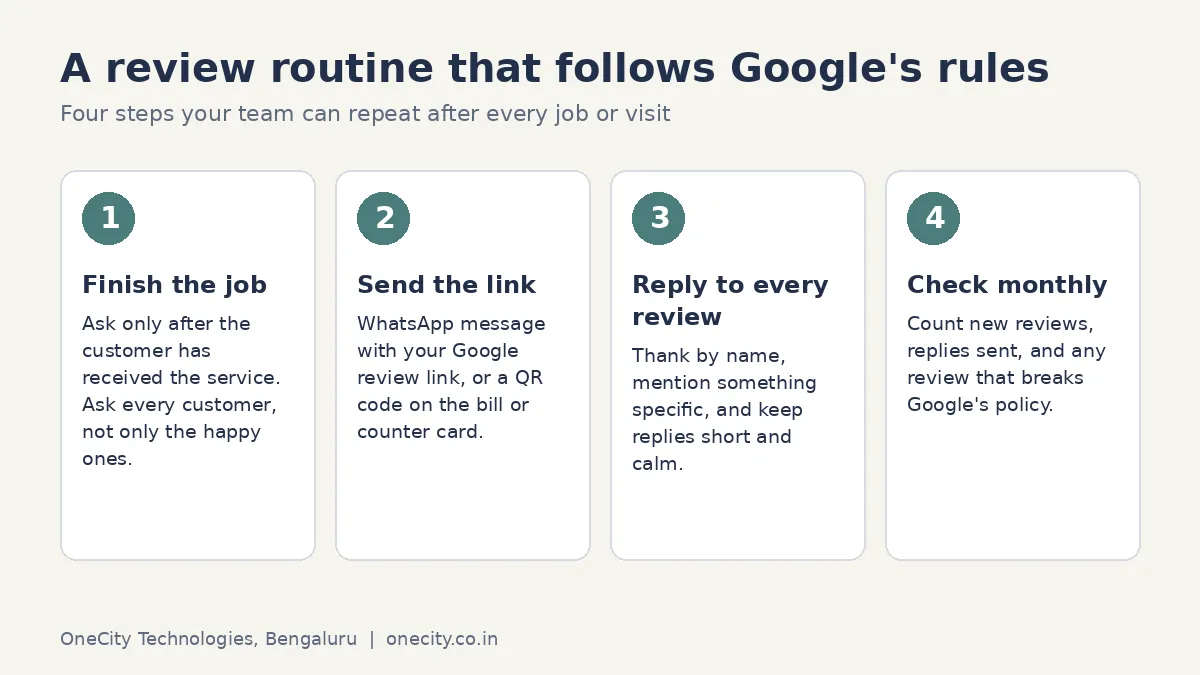
7. Online Review Management
Reviews are an off-page SEO signal that directly affects local rankings and click-through rates. A one-point increase in Google review score can increase revenue per available room by 11.2% (TripAdvisor study). For local businesses, review quantity, recency, and sentiment all factor into the local pack algorithm.
Review management is not separate from SEO — it is a core off-page activity. Businesses with 50+ Google reviews and a 4.2+ average rating consistently outperform competitors in local search visibility.
- Respond to every review within 48 hours — positive and negative
- Ask for reviews at the point of service delivery (in-person, via WhatsApp, or post-service email)
- Address negative reviews with specifics: name the issue, describe the fix, invite the customer back
- Monitor reviews across Google, JustDial, Facebook, and industry-specific platforms
8. Podcast and Video Appearances
Each podcast appearance earns a show notes link, a speaker page reference, and brand mentions — often from sites with DA 40–70 that are difficult to get links from through traditional outreach. Backlinko’s Brian Dean reported increasing Domain Authority from 0 to 48 in 90 days through 60 podcast interviews.
For Indian businesses, look at industry podcasts on Spotify and YouTube, local business shows, and LinkedIn Live sessions. YouTube is particularly effective: video content drives branded search volume, and there is a near 1:1 correlation between YouTube channel growth and branded Google searches.
9. Strategic Partnerships and Co-Marketing
Partnerships with complementary businesses generate natural link opportunities: co-authored research, integration case studies, joint webinars, and partner directories. These links are editorially earned and contextually relevant — exactly what Google rewards.
Example: A Bangalore-based SEO agency partnering with a web development firm to publish a “Website Redesign SEO Checklist” creates a co-branded asset that both sites link to, both brands mention, and both audiences share.
10. Community Engagement and Forum Authority
Consistent, detailed participation in relevant professional communities — Reddit, Quora, LinkedIn Groups, Stack Overflow, IndiaHacks, and industry Slack channels — builds reputation that leads to organic citations and mentions.
This is not about dropping links in forum posts (that is spam, and Google knows it). It is about becoming a recognised expert whose insights get quoted and referenced by other publications. The link opportunities come indirectly: a journalist researching a topic finds your detailed Reddit answer and reaches out for a quote, or a blogger references your Quora answer with a link.
11. Entity SEO and Knowledge Graph Optimisation
Entity SEO is the practice of establishing your brand as a recognised entity in Google’s Knowledge Graph. When Google understands your business as an entity — with defined attributes, relationships, and authority signals — every piece of content you publish benefits from that entity-level trust.
How to Build Entity Signals
- Wikipedia page: If your business or founder meets Wikipedia’s notability criteria, a Wikipedia page is the strongest entity signal available. Even a mention within an existing article helps
- Wikidata entry: Create a structured Wikidata entry for your business with accurate attributes
- Consistent structured data: Use Organization, Person, and LocalBusiness schema across your website with identical details
- Knowledge Panel: Claim and verify your Google Knowledge Panel through Google Search
- Cross-platform consistency: Identical business information across your website, Google Business Profile, social profiles, directories, and press mentions
12. Social Media Amplification
Social signals are not a direct ranking factor — Google has confirmed this repeatedly. However, social media amplification drives three things that do affect rankings: branded searches (people Google your brand after seeing your social content), link opportunities (publishers discover linkable content through social sharing), and brand mentions (social profiles contribute to entity recognition).
LinkedIn is particularly valuable for B2B businesses in India. A well-performing LinkedIn post from a company founder can generate 10,000–50,000 impressions, drive branded searches, and attract journalist attention — all of which feed into off-page SEO signals.
Off-Page SEO Techniques That Will Get You Penalised in 2026
Google’s spam detection has accelerated dramatically. The March 2026 spam update completed in 19.5 hours. SpamBrain 3.0 evaluates link patterns — not individual links — and can neutralise manipulative profiles within minutes. Here is what no longer works.
| Tactic | Why It Fails Now | Risk Level |
|---|---|---|
| Private Blog Networks (PBNs) | SpamBrain detects network patterns (shared hosting, identical themes, link timing). Links neutralised without warning — you lose rankings without knowing why | Severe |
| Bulk link purchases | Paid link patterns are detectable at scale. Google stated they “need very few links to rank pages” — purchased volume is a red flag, not an asset | Severe |
| Mass guest posting on low-quality sites | Template-based articles with identical author bios, generic intros, and repetitive CTAs across unrelated sites create obvious manipulation fingerprints | High |
| Expired domain redirects | Rented authority from expired domains no longer transfers ranking signals. SpamBrain identifies historical ownership changes | High |
| Site reputation abuse / parasite SEO | Renting subfolders on high-authority domains to exploit their ranking power is explicitly defined as spam since March 2024 | Severe |
| Exact-match anchor text manipulation | Engineered anchor text consistency across domains is a manipulation signal. Optimise the destination page instead | Medium–High |
| Mass directory submissions | Automated directory blasts, forum profile links, comment spam create obvious patterns. Neutralised on detection | Medium |
| Link exchange networks | Reciprocal linking at scale (A→B→C→A patterns) is identified and neutralised by pattern analysis | Medium |
| AI-generated link bait | May 2026 policy update: “attempting to manipulate generative AI responses” is now spam. Fake mention networks and paid citation schemes are compliance risks | Severe (new) |
Off-Page SEO Tools: What to Use and What It Costs
| Tool | Best For | Starting Price | Free Alternative |
|---|---|---|---|
| Ahrefs | Backlink analysis, competitor research, broken link finding | $129/month | Ahrefs Webmaster Tools (limited) |
| Semrush | Brand monitoring, link building outreach, position tracking | $139.95/month | Semrush free tier (10 queries/day) |
| Google Search Console | Link data, search performance, indexing | Free | — |
| Muck Rack | Journalist database for digital PR | Custom pricing | Manual journalist research |
| HARO / Connectively | Expert source opportunities for media links | Free (basic) | — |
| BuzzSumo | Content discovery, influencer identification | $199/month | Google Trends + manual research |
| Hunter.io | Email finding for outreach | Free (25/month) | Manual email research |
| Google Alerts | Brand mention monitoring | Free | — |
| Check My Links | Broken link identification (Chrome extension) | Free | — |
| Whitespark | Local citation building and audit | $39/month | Manual citation audit |
Off-Page SEO and AI: What Changes with AI Overviews and GEO
Google’s AI Overviews now pull information from multiple sources to generate answers directly in search results. This changes off-page SEO in two important ways.
1. Third-Party Validation Becomes Critical for AI Visibility
Large Language Models (including Google’s Gemini) want third-party validation before recommending a brand or citing a source. Publications like Wikipedia, Forbes, NerdWallet, and major news outlets dominate AI-generated citations. If your brand has earned mentions and links from these types of sources, AI systems are more likely to reference your content.
This creates a flywheel: off-page SEO (earned media, brand mentions, editorial links) feeds AI visibility, which drives traffic and further brand recognition.
2. Generative Engine Optimisation (GEO)
GEO is the practice of structuring your off-page presence so that AI systems can recognise, trust, and cite your brand. Key elements:
- Entity consistency: Your brand name, description, and key facts must be identical across your website, Google Business Profile, Wikipedia/Wikidata, social profiles, and directory listings
- Source diversity: AI systems cross-reference information across multiple sources. Being mentioned on 20 diverse, authoritative sites matters more than 200 links from similar low-authority sites
- Sentiment signals: AI systems evaluate mention sentiment. Positive mentions from trusted sources carry more weight than neutral or negative references
- Structured data: Organization and Person schema on your website helps AI systems connect your brand to the entity graph
May 2026 Policy Update
On May 15, 2026, Google rewrote its spam definitions to include “attempting to manipulate generative AI responses.” This means paid citation schemes, fake mention networks, and manufactured reviews intended to influence AI recommendations are now explicit spam violations — extending enforcement from traditional search into AI Overviews and AI Mode.
Off-Page SEO Budget Framework
How much should you spend on off-page SEO? Here is a framework based on business size and competitive landscape.
| Business Size | Monthly Off-Page Budget | Recommended Activities | Expected Timeline |
|---|---|---|---|
| Small / Local (1–5 employees) | ₹10,000–₹25,000 | Local citations (20–30 platforms), review management, 1–2 guest posts/month, Google Alerts monitoring | 3–6 months for local pack improvement |
| Medium (5–50 employees) | ₹25,000–₹75,000 | Digital PR (quarterly data study), 2–4 editorial guest posts/month, HARO responses, podcast outreach, brand monitoring | 4–8 months for competitive keyword movement |
| Large / Enterprise | ₹75,000–₹3,00,000+ | Full digital PR programme, original research, entity SEO (Wikipedia, Wikidata), influencer partnerships, community building | 6–12 months for authority domain growth |
| E-commerce | ₹30,000–₹1,00,000 | Product PR, review generation, influencer seeding, marketplace citations, resource page link building | 3–6 months for category page rankings |
Measuring Off-Page SEO: KPIs That Matter
Stop counting raw backlink numbers. Here are the metrics that actually indicate off-page SEO progress in 2026.
| Metric | What It Tells You | Where to Track | Good Benchmark |
|---|---|---|---|
| Referring domains (unique) | Breadth of your link profile | Ahrefs, Semrush | 5–10 new referring domains/month (SMB) |
| Domain Rating / Authority | Overall domain strength | Ahrefs DR, Moz DA | Steady upward trend quarter-over-quarter |
| Branded search volume | Brand recognition and recall | Google Search Console, Google Trends | Month-over-month increase |
| Brand mention count | Off-site visibility | Semrush Brand Monitoring, Google Alerts | Track trend, not absolute number |
| Mention sentiment ratio | How your brand is perceived | Semrush, Mention.com | 70%+ positive mentions |
| Organic traffic from non-branded queries | Whether authority translates to rankings | GA4 + GSC | 5–15% quarterly growth |
| Local pack rankings | Local search visibility | BrightLocal, Whitespark | Top 3 for primary service keywords |
| Knowledge Panel presence | Entity recognition by Google | Manual search | Panel triggered on branded search |
Common Off-Page SEO Mistakes and How to Avoid Them
| Mistake | What Happens | What to Do Instead |
|---|---|---|
| Chasing quantity over quality | 50 low-DA links move rankings less than 1 editorial link from a relevant DA-70+ site. SpamBrain flags volume-based patterns | Focus on 3–5 high-quality placements per month rather than 30 low-quality ones |
| Ignoring brand signals | You build links but not brand recognition. Rankings plateau because 55% of off-page weight is now non-link signals | Invest in digital PR, podcast appearances, and community engagement alongside link building |
| Inconsistent NAP data | Google cannot confidently associate citations with your entity. Local rankings suffer | Audit all listings quarterly. Use Whitespark or BrightLocal for consistency monitoring |
| Neglecting review management | Competitors with more reviews and higher ratings rank above you in local pack, regardless of link profile | Implement a systematic review collection process. Respond to every review within 48 hours |
| Buying links from “guaranteed” services | Services promising “X links per month” use PBNs, low-quality guest posts, and directory spam. SpamBrain detects these patterns within days | Ask any link building vendor to show the actual sites, traffic, and editorial process. Walk away if they cannot |
| Ignoring anchor text naturalness | Over-optimised anchors (too many exact-match keyword anchors) trigger spam filters | Let publishers choose anchor text. Mix branded, URL, and natural language anchors |
Off-Page SEO Timeline: What to Expect
Off-page SEO results are not instant. Here is a realistic timeline based on what we see across 650+ client sites at OneCity Technologies.
- Weeks 1–4: Citation audit and cleanup, Google Business Profile optimisation, review collection process setup. GSC may start showing new impressions for branded queries
- Months 1–3: First editorial guest posts published, HARO responses submitted, initial podcast appearances. GSC shows impression increases for target queries. Referring domains start growing
- Months 3–6: Ranking movement for mid-competition keywords. Local pack positions improve. Branded search volume increases measurably. First digital PR coverage lands
- Months 6–12: Competitive keyword rankings improve. Domain Rating / Authority increases noticeably. Brand mentions appear in AI Overviews. Revenue impact becomes measurable
Top-ranking pages typically have 20–150 referring domains for local terms and 100–500+ for national terms. Building this profile takes consistent effort over 6–18 months, depending on competition.
Frequently Asked Questions
Are backlinks still important for SEO in 2026?
Yes. Backlinks remain a top-3 Google ranking signal in 2026, accounting for roughly 45% of off-page ranking weight. However, quality matters far more than quantity. SpamBrain 3.0 evaluates entire link patterns, not individual links, and can neutralise manipulative profiles within minutes. One editorial link from a relevant, high-authority site is worth more than 50 links from low-quality blogs.
How many backlinks do I need to rank on the first page?
There is no fixed number. Top-ranking pages for local keywords typically have 20–150 unique referring domains. For national competitive keywords, that range is 100–500+. Focus on earning 5–10 high-quality referring domains per month rather than chasing a specific total. Quality, relevance, and anchor text naturalness matter more than raw count.
What is the difference between off-page SEO and link building?
Link building is one component of off-page SEO. Off-page SEO in 2026 also includes brand mention building, entity SEO (Knowledge Graph, Wikidata), review management, social visibility, local citations, and digital PR. Focusing only on link building misses 55% of off-page ranking signals.
Is guest posting still effective in 2026?
Guest posting on relevant, high-traffic, editorially rigorous sites remains effective. Guest posting on low-quality blogs that exist solely for link placement is not — SpamBrain identifies and neutralises these patterns. Before writing a guest post, check: Does the site have real traffic (10,000+ monthly visits)? Is it topically relevant? Would this article exist if search engines did not?
How do I build off-page SEO for a new website with no authority?
Start with local citations (20–30 platforms with consistent NAP), Google Business Profile optimisation, and review collection. Then move to HARO responses (free, high-authority links), one or two quality guest posts per month, and community engagement on relevant forums. After 3 months, begin digital PR outreach with original data or research. New sites should target 5–10 new referring domains per month from diverse, relevant sources.
What are brand signals and why do they matter for SEO?
Brand signals include branded search volume (people Googling your brand name), brand mentions across the web (linked and unlinked), co-citations (your brand mentioned alongside industry leaders), and entity recognition (Knowledge Panel, Wikidata entry). In 2026, brand signals account for approximately 25% of off-page ranking influence. Google uses these signals to assess E-E-A-T — if many trusted sources mention your brand, Google has more confidence in your authority.
How does off-page SEO affect AI Overviews and ChatGPT recommendations?
AI systems (Google AI Overviews, ChatGPT, Perplexity) rely on third-party validation to decide which brands and sources to cite. If your business has earned mentions and links from authoritative publications, directories, and review platforms, AI systems are more likely to reference your content. The May 2026 Google policy update explicitly extended spam enforcement to include “attempting to manipulate generative AI responses,” making legitimate off-page SEO the only sustainable path to AI visibility.
Conclusion
Off-page SEO in 2026 is broader than link building and more nuanced than it has ever been. Backlinks still matter, but they share the stage with brand signals, entity recognition, review management, and AI visibility signals. The techniques that work — digital PR, original research, editorial guest posting, community engagement, and entity SEO — all have one thing in common: they build genuine authority that Google (and AI systems) can verify through multiple independent sources.
The techniques that fail — PBNs, bulk link purchases, low-quality guest post networks, and manufactured mentions — fail because SpamBrain 3.0 evaluates patterns, not individual signals, and it operates at a speed that makes correction impossible before the damage is done.
Start with your local citations and review management. Add editorial content and outreach. Build toward digital PR and entity SEO. Measure progress through branded search volume and referring domain quality, not raw link counts. The businesses winning organic search in 2026 are the ones with the most credible off-page signals, earned through real value creation.
Need help building an off-page SEO strategy that works in 2026? OneCity Technologies has built off-page SEO campaigns for 650+ businesses across India since 2006. Get in touch for a free backlink and brand authority audit.
Author: L.K. Monu Borkala, Founder of OneCity Technologies Pvt Ltd (est. 2006), with 20+ years of experience in SEO and digital marketing for Indian businesses.