Originally published: 19 July 2026
Updated on: 21 July 2026
Google finished rolling out its June 2026 spam update in just two days, its second spam update of the year, while quietly reshaping AI Overviews with a live news carousel and AI-generated images. None of this made front-page news outside SEO circles, but if your business depends on Google traffic, each of these changes affects you directly.
The June 2026 Spam Update: Fast, But Not Small
Google confirmed the June 2026 spam update rolled out globally across all languages between 24 and 26 June, a rollout of just over two days. That is genuinely fast by spam update standards, and it was the second spam update of the year following one in March that finished in under 24 hours. Google described it as a normal update refining existing detection systems rather than introducing new policies, and specifically noted it was not targeted at link spam or site reputation abuse, pointing instead to broader policy violations.
What matters for a Bangalore business is not the technical description. It is the recovery pattern. Spam updates behave differently from core updates. A core update re-evaluates content quality and relevance, and sites often recover within the same rollout window once the next update passes. A spam update flags policy violations more surgically, and Google’s systems then need time, sometimes months, to reassess whether a previously flagged site has genuinely cleaned up its practices, rather than automatically restoring visibility once the rollout window closes.
If your SEO company in Bangalore mentioned a ranking dip in late June, this update is the first thing worth checking against, not the assumption that something is broken. Community trackers reported this particular update felt more widespread than a typical spam refresh, with ranking volatility continuing to be discussed well into early July.
Worth noting separately: Google search ranking volatility had already been building for weeks before the confirmed spam update landed, with a notable ranking shift on 19 June specifically appearing to hit black-hat SEO tactics, followed by continued volatility through the first two weeks of June. Whether that earlier shift was a quiet precursor to the confirmed spam update or a separate, unconfirmed change, the practical effect was the same: June 2026 was a genuinely turbulent month for anyone relying on manipulative tactics, and a comparatively stable one for sites built on legitimate fundamentals.
Google Search Profiles: A New Publisher Credibility Signal
Alongside the algorithm and interface changes, Google officially launched Search Profiles this month, publisher-facing pages designed to showcase a site’s authority and recent coverage in one place, and followed quickly with a dedicated analytics and insights view for them. This is a meaningful addition for any business or writer trying to establish genuine E-E-A-T signals, since it gives Google a structured, first-party way to associate a byline with a body of published work across time, rather than relying entirely on scattered bylines and author bio pages that vary in consistency from site to site.
For a business publishing under a named author, as this site does under L.K. Monu Borkala, Search Profiles represents another channel where consistent authorship and topical focus can compound into a recognisable, credible presence, alongside the on-site author box and bio page that already serve that function. It is early days for the feature, but the direction lines up with everything else in Google’s recent guidance: named, consistent, verifiable authorship keeps mattering more, not less, as AI reshapes the rest of the search results page.

No Broad Core Update in July, and Why That Is Useful
Google’s two confirmed core updates of 2026 both landed earlier in the year. The May 2026 core update ran from 21 May to 2 June, taking just under twelve days to complete. With that update fully settled by early June, site owners have had a genuine clean comparison window in Search Console since around 9 June to evaluate real, post-update performance rather than reacting to single-day swings during an active rollout.
Based on Google’s typical three to four month cadence between core updates, the next broad core update is expected in the third quarter of 2026, most likely August or September. That gives Bangalore businesses a real, usable stretch this summer to shore up content quality and technical fundamentals before the next recalibration arrives, rather than trying to make changes mid-rollout when the data is too noisy to interpret properly.

AI Overviews Just Got More Dynamic
Google began rolling out a live Top Stories carousel inside AI Overviews for mobile users, after first previewing the feature in May as a way to bring fresher, timely reporting into AI-generated answers rather than summarising it out entirely. This is a meaningfully different direction from where AI Overviews started. Early versions of the feature were criticised for keeping readers inside Google’s own summary and starving publishers of clicks. A news carousel that surfaces real-time reporting and links prominently is Google actively routing some of that traffic back to the open web.
Around the same time, Google began generating images directly within AI Overviews instead of only pulling existing images from indexed pages, and redesigned the Image Search homepage into a scrollable gallery format. Google is also testing a button that lets users skip straight to traditional web results, bypassing the AI Overview entirely, alongside citation counts and source favicons displayed beneath AI Mode answers. Taken together, these changes suggest Google is responding directly to criticism about attribution and transparency in its AI features, not simply expanding them unchecked.
For a content writing team producing timely, well-sourced content, the news carousel specifically rewards genuinely current material over generic evergreen posts. A business publishing real commentary on local developments, industry news, or timely local events now has a slightly more visible path into an AI-generated answer than it did two months ago.

The Zero-Click Number Everyone Quotes Just Moved
An industry report tracked this month found that zero-click searches to the open web fell to 27.6 percent. That number tends to get quoted as evidence that AI summaries are strangling organic traffic, and this data point argues against reading it that way. A falling zero-click rate suggests clicks are being redistributed across a wider set of surfaces, AI Mode citations, the new news carousel, image search, rather than disappearing outright even as AI summaries expand their footprint.
This does not mean nothing has changed. It means the honest read is redistribution, not collapse, and a business tracking only its raw organic click total without segmenting by surface is missing where those clicks are actually landing now.

Google Business Profile Is Getting More AI-Driven Too
Local search changes were just as significant this month as the AI Overview updates. Google rolled out Gemini integration inside Google Business Profiles, letting owners manage listings more conversationally rather than through static form fields. Google also added a message button powered by an AI agent, so customers get instant responses to enquiries sent through a listing, and previewed a coming connection between Business Profile data and Google Analytics, which would finally let businesses see local listing engagement alongside their regular site analytics in one place.
One change is worth flagging specifically. Google introduced a new dialog asking whether a business offers rewards in exchange for reviews, a direct signal that review authenticity enforcement is tightening. Any local SEO strategy that has leaned on incentivised reviews, even informally, should treat this as a warning rather than a minor UI tweak. Google has spent years building automated detection for review manipulation, and a dedicated disclosure prompt inside the Business Profile dashboard itself suggests enforcement is about to get more direct, not less.
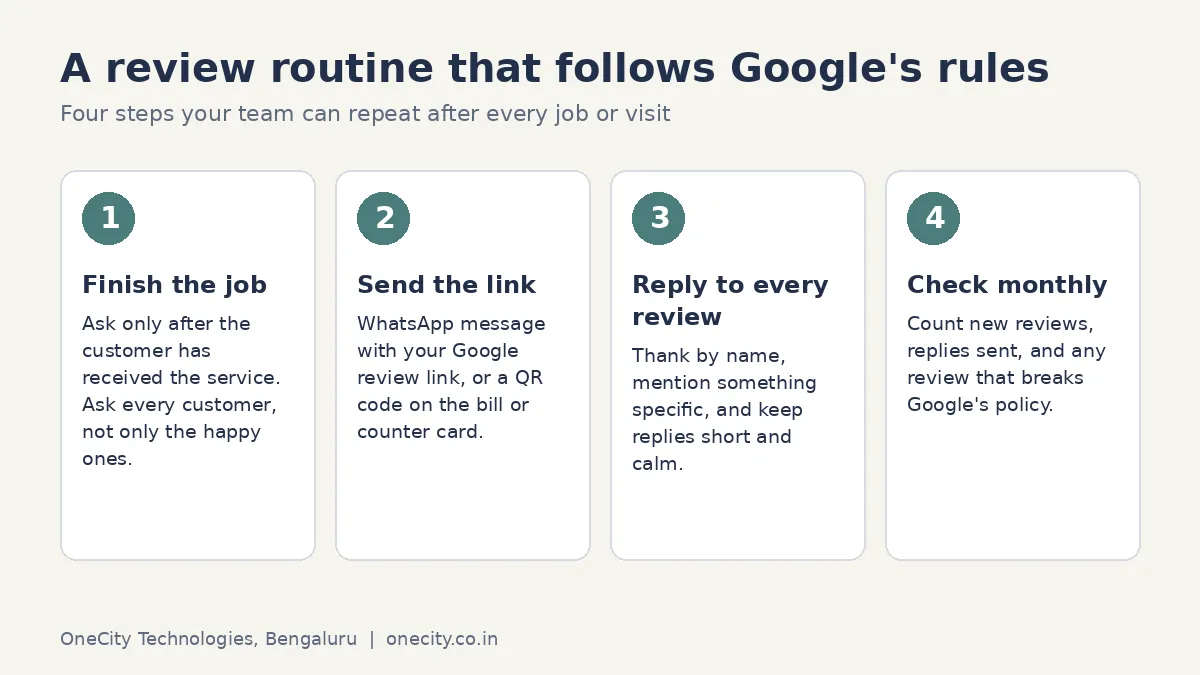
For a Bangalore business managing its own Google Business Profile, the practical takeaway is straightforward: keep listing information complete and accurate, respond to the AI-powered message prompts promptly since Google is clearly investing in that channel, and make sure any review generation process relies on genuine customer requests rather than anything that could be read as an exchange for a reward.
Straight From Google: Technical Clarifications Worth Knowing
At Search Central Live in Milan, Google’s search team addressed several technical questions that had been circulating in the SEO community for months. Topics included how Google chunks page content for retrieval in AI systems, how site-level trust signals are weighed alongside individual page quality, how paywalled content is handled during crawling, and how clicks originating from AI features get counted. Google’s Head of Search, Liz Reid, separately reiterated that the company’s goal is for great content to shine in Search regardless of how it was produced, a notable statement given ongoing industry anxiety about AI-generated content specifically being penalised.
Two other clarifications matter for anyone managing a website’s technical foundation. Google confirmed that LLMs.txt files won’t help or hurt your search rankings. The proposed standard, which some sites have adopted to guide AI crawlers, has no measurable effect either way according to Google’s own statement. That lines up with the decision already made on this site not to build one, since the standard schema markup already in place does the same job for both traditional search and AI systems without adding an unproven file to maintain. Separately, Google reaffirmed that HTML remains the standard format for SEO purposes rather than Markdown files, closing off a debate that had picked up some traction among developers experimenting with AI-first content pipelines.

Search Console Housekeeping Worth Knowing About
A few smaller Search Console changes are worth a mention since they affect how reliable your own reporting is right now. The long-standing bug in the Links report has finally been fixed, giving site owners more trustworthy internal and external link data than the platform has offered for some time. On the other hand, the Page Indexing report was delayed again, this time by roughly two weeks, continuing a pattern of reporting lag that has frustrated site owners through much of 2026. If your own Search Console indexing data looks slow to reflect recent changes, this delay is a genuine, documented cause, not necessarily a sign that something on your site needs fixing.
Regulatory Pressure Is Building Around Google’s Rankings
Outside Google’s own product changes, the UK’s Competition and Markets Authority ordered Google to disclose more about how its search rankings work and to support greater data portability for advertisers and site owners. This is one part of a broader, growing pattern of regulatory scrutiny on Google’s search business globally, and it is worth watching less for its immediate impact on any single Bangalore business and more as a signal that transparency into ranking and AI citation mechanics is becoming a live policy question, not just an SEO community debate.
None of this changes anything for an Indian business immediately, since the CMA’s authority covers the UK market specifically. But regulatory pressure of this kind tends to produce transparency requirements that eventually shape how Google communicates about ranking factors everywhere, not just in the jurisdiction that forced the disclosure. A business owner does not need to track competition law to benefit from this trend; the more Google is required to explain its own mechanics publicly, the less guesswork the entire SEO industry has to do about what actually drives visibility.
AI Mode Keeps Testing New Interfaces
Beyond AI Overviews, Google’s separate AI Mode surface picked up several tests this month worth watching even before they roll out broadly. Citation counts and source favicons are being tested beneath AI Mode answers, giving users a visual sense of how many sources contributed to a response before they even read it. A new Ask Anything search box with autocomplete is also in testing, moving AI Mode’s entry point closer to a conversational assistant than a traditional search box. Perhaps most notably, Google has started rolling out paid Information Agents inside AI Mode, a feature that can complete more complex, multi-step research tasks on a user’s behalf for a fee.
None of these are live broadly yet, and testing features do not always ship in their tested form. But the direction is consistent with everything else Google shipped this month: more transparency about sourcing, more conversational interaction patterns, and a clearer line between free summarisation and paid, deeper research assistance. A business that treats AI Mode as a single, static feature to optimise for once and forget will likely find itself behind when these tests do roll out broadly.
What This Means If You Run a Local Service Business
Pull all of this together and a fairly clear picture emerges for a Bangalore business owner who does not have time to track SEO news weekly. Google is investing heavily in making its AI-generated answers more transparent, more sourced, and more willing to send traffic back to the open web, a meaningfully different posture than the AI Overviews rollout felt like a year ago, a shift covered in more depth in how Bangalore businesses can get found by AI search. At the same time, Google is tightening enforcement in two specific areas: spam policy violations broadly, and review authenticity specifically inside Google Business Profile.
The businesses best positioned heading into the expected Q3 core update are the ones treating this as routine maintenance rather than crisis management, the same steady approach that produced real, verifiable results for the two client accounts covered in our recent case study piece. That means checking Search Console monthly rather than only when something looks wrong, keeping Google Business Profile and local listing information genuinely accurate rather than optimised for appearance, and continuing to publish real, specific, well-sourced content rather than chasing whichever AI-search tactic is trending that week. A full SEO and SEM strategy built around these fundamentals rewards exactly this kind of steady, unglamorous consistency, and penalises exactly the kind of manipulation or shortcut-seeking that spam updates exist to catch.
None of the individual changes in this piece is dramatic on its own. Taken together, they describe a search engine getting more transparent about sourcing, more willing to send traffic back to the open web from inside its AI features, and more strict about manipulation in both organic rankings and local listings. That combination rewards exactly the kind of business already doing things properly, and makes shortcuts progressively harder to sustain.
A Five-Minute Monthly Check Worth Adopting
Given how much moved in a single month, a short, repeatable monthly check is more useful than trying to track every individual announcement as it happens. Open Search Console and look at three things: the Performance report’s overall trend since the start of the month, filtered against the confirmed spam update dates if a dip appeared; the Links report, now that its long-standing bug is fixed, to get an accurate read on your actual backlink profile for the first time in a while; and, once it reaches your property, the AI Performance report specifically, which is covered in more depth in a companion piece on tracking AI visibility.
Pair that with a quick look at your Google Business Profile dashboard for any new prompts or dialogs Google has added, since features like the rewards-for-reviews disclosure tend to appear quietly rather than with an announcement banner. Five minutes a month spent this way catches far more genuinely relevant change than trying to read every SEO news update as it publishes.
Frequently Asked Questions
My rankings dropped in late June. Was it the spam update?
Possibly. The June 2026 spam update rolled out between 24 and 26 June and was Google’s second spam update of the year. If your dip lines up with that window, check your site against Google’s spam policies before assuming a technical fault, since spam update recovery follows a slower timeline than a core update.
Does the new AI Overviews news carousel help my business specifically?
Only if you publish genuinely timely content. The carousel surfaces real-time reporting and prominent links for developing topics, which rewards current, dated commentary over generic evergreen pages that could have been written any time.
Should I be worried about the falling zero-click rate?
The zero-click rate actually fell to 27.6 percent this month, which suggests clicks are redistributing across AI Mode citations, image search, and other surfaces rather than disappearing. Track where your clicks are landing across surfaces rather than only your raw organic total, since a flat overall number can hide real movement between channels.
Is another core update coming soon?
Yes, based on Google’s typical three to four month cadence, the next broad core update is expected in the third quarter of 2026, likely August or September. This is a reasonable window to fix content and technical gaps before it arrives.
Does any of this change basic SEO fundamentals?
No. Every change described here sits on top of the same underlying signals that have mattered for years: technical health, genuine content quality, and clear structure. Nothing here replaces that foundation.
What is Google Search Profiles and does my business need one?
Search Profiles are new publisher pages showcasing a site’s authority and recent coverage under a named author. They are not something you build yourself; they develop from consistent, genuine authorship over time, the same way an on-site author bio and byline do.
Should I worry about the Google Business Profile rewards-for-reviews dialog?
Only if your review generation process offers anything in exchange for reviews, even informally. Google is clearly tightening enforcement here. Genuine, unincentivised review requests remain entirely fine and are the safest long-term approach regardless.
About the Author
L.K. Monu Borkala, Founder & CEO, OneCity Technologies Pvt Ltd
Twenty years in marketing, starting with Yellow Pages print publishing across South India and moving into digital work from 2017. OneCity has built SEO, GEO, and AEO strategy for 650-plus businesses across Bengaluru, Mangaluru, and Mysuru. All strategy and published content is reviewed and approved by Borkala before it goes live.
Connect on LinkedIn | Full profile and credentials | CIN: U72100KA2009PTC048911