Originally published: 21 July 2026
Updated on: 21 July 2026
Google Search Console’s AI Performance report is expanding to more properties this month, showing clicks and impressions generated specifically through AI-powered surfaces. Google also confirmed something many site owners had been guessing at for months: opting your content out of AI Overviews and AI Mode carries no ranking penalty in standard organic search. Here is what both changes actually mean and how to use them.
The Question Everyone Was Guessing At, Now Answered

For as long as AI Overviews have existed, site owners have quietly wondered whether excluding their content from AI summarisation would cost them anything in traditional rankings. Google never gave a direct answer, and in the absence of one, most businesses simply left the default setting alone rather than risk an unknown penalty.
Google published a detailed explainer this month on generative AI controls in Search Console, clarifying exactly how the settings work, and confirmed that opting out of AI Overviews and AI Mode does not affect how a page ranks in standard organic search. The two systems are evaluated separately. A page can be fully excluded from AI summarisation while continuing to compete normally for its traditional keyword rankings, with no penalty attached to that choice either way.
This matters for a specific reason. Some SEO agencies advise clients to leave every AI control at its default setting purely out of caution, without a clear technical basis for that advice. Google’s own clarification removes the guesswork. The decision to appear in AI Overviews or not can now be made on its actual merits, whether AI citation brings your business value, rather than out of fear of an invisible ranking cost that does not exist.

What the AI Performance Report Actually Shows
Search Console’s AI Performance report, now expanding to more properties, tracks clicks and impressions generated specifically through AI-powered surfaces, separate from the standard Performance report’s blended view of traditional search results. This distinction matters more than it sounds. A business watching only its overall Performance report cannot tell how much of its visibility comes from a traditional blue-link ranking versus a citation inside an AI Overview or AI Mode answer. The two numbers get blended into one, which makes it impossible to diagnose whether a traffic change is a ranking problem or a shift in how Google is presenting your existing ranking.
Google also published a clarifying note this month on exactly when an appearance inside an AI Overview counts as an impression in this report, addressing a source of confusion since the feature launched. Precise counting rules matter here because AI Overviews render differently from a standard search result. A page cited inside a summary is not displayed the same way a normal blue link is, and site owners need to know whether that citation is even being counted before drawing conclusions from the numbers.
The report is still rolling out to more properties rather than being universally available, so if you check Search Console and do not see it yet under the Performance section, that is expected rather than a sign of a problem specific to your site.
Why This Report Is Worth Checking Even If You Have Never Used It
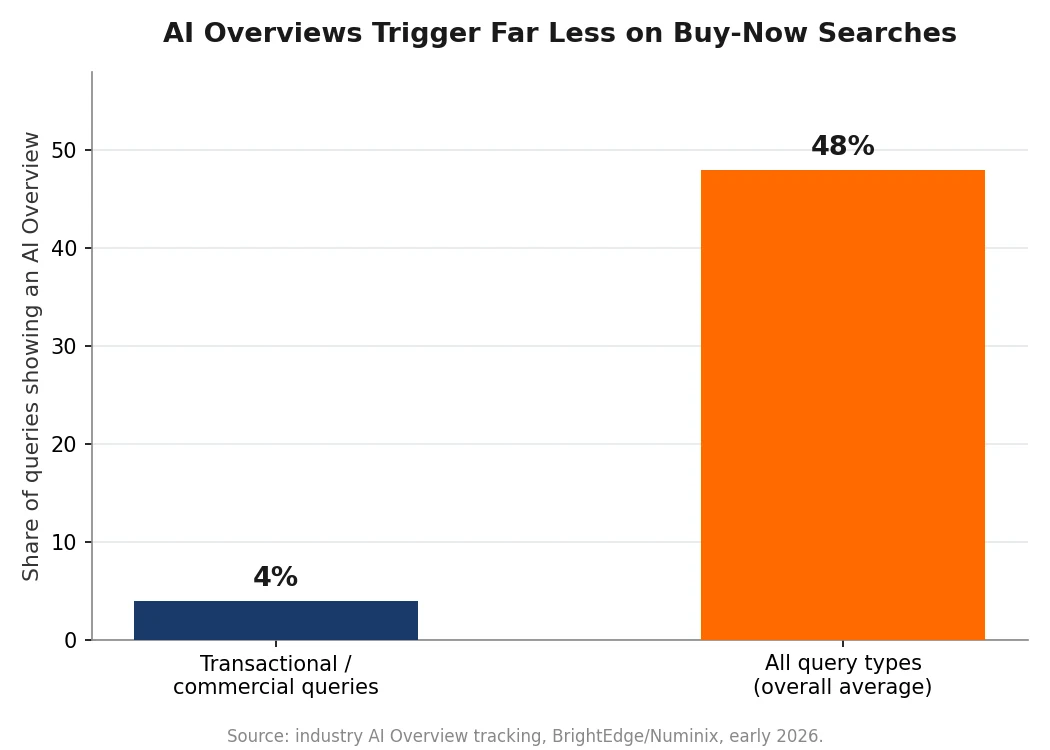
A genuine SEO and SEM strategy increasingly needs to account for two separate channels of visibility rather than one. Traditional organic rankings still drive the majority of clicks for most transactional and highly specific searches, industry tracking has consistently shown AI Overviews trigger far less often on commercial, buy-now queries than on informational ones. But for the comparison-heavy, decision-stage searches that dominate service businesses in a market like Bangalore, “best SEO company in Bangalore,” “which clinic should I choose,” AI Overviews and AI Mode increasingly sit between the searcher and the traditional results entirely.
Without the AI Performance report, a business has no way to separate these two channels. A flat or declining traditional click count could mean rankings genuinely dropped, or it could mean the same underlying ranking now gets displayed as an AI citation instead of a blue link, with the citation itself doing real but differently-measured work. Businesses making decisions about content strategy without this distinction are working from an incomplete picture, sometimes reacting to a phantom ranking problem that is actually a measurement gap.
How to Actually Use This Data
Start by checking whether the AI Performance report has reached your property yet. If it has, compare it against your standard Performance report for the same date range rather than reading either in isolation. A page showing strong AI Performance numbers but weaker traditional clicks is likely being cited reliably in AI Overviews, which argues for further investment in the direct-answer, well-structured content style that earns citations, covered in more detail in how Bangalore businesses can get found by AI search.
If your top pages show almost no AI Performance activity at all, two explanations are worth checking before assuming a problem. The report may simply not have reached your property yet, given its staged rollout. Or your content may genuinely not be structured in a way AI systems find easy to cite, worth checking against a content writing team that understands both traditional keyword intent and direct-answer formatting.
For businesses currently unsure whether to opt out of AI Overviews entirely, the honest answer is that Google’s own clarification removes the risk calculus from that decision. If your business genuinely does not want its content summarised, whether for competitive reasons, brand control, or any other legitimate business reason, that choice now carries no traditional ranking cost. The decision becomes a pure question of whether AI citation brings value to your specific business, which is a different, more useful question than the vague caution most site owners have been operating under.
A few concrete scenarios help make that decision less abstract. A business whose core value proposition depends on proprietary research, original data, or exclusive analysis might reasonably choose to opt out, since AI summarisation could reduce the incentive for a reader to visit the source directly for that specific kind of content. A business whose value comes from local trust, service quality, or being genuinely easy to find and contact has little to lose and plausibly something to gain from staying included, since citation in an AI Overview for a comparison query is free exposure that would otherwise require a page one ranking to achieve at all. Neither choice is inherently correct. What changed this month is that the choice can now be made deliberately, based on your actual business model, rather than by default out of fear of an unverified penalty.
Segment by Query Type, Not Just by Page
One refinement worth adding to the monthly habit above: the AI Performance report becomes far more useful once you segment your pages by query type rather than looking at the site as a whole. Industry tracking has consistently shown that transactional, buy-now queries trigger AI Overviews far less often than informational or comparison-heavy searches, roughly a handful of percentage points for commercial product queries compared to much higher rates for how-to and comparison content. This means a service page targeting “book a consultation” style intent should be judged mostly on its traditional Performance numbers, while an educational blog post targeting “how to choose” or “what is” style intent should be judged more heavily on its AI Performance numbers, since that is where its real citation opportunity lives.
Treating every page on your site as equally likely to earn AI citations misreads how the feature actually distributes across query types. A pricing and cost guide genuinely written to answer a specific question directly is a far stronger AI Performance candidate than a generic service landing page built primarily to convert an already-decided visitor, and the report will reflect that difference clearly once you know to look for it by query type rather than expecting uniform performance across your whole site.
The Search Console Housekeeping Behind This Change
This clarification did not arrive in isolation. Search Console has had a genuinely busy few months of changes to its AI-related reporting, alongside some ordinary bug fixes and delays that are worth knowing about since they affect how much you should trust what you are currently seeing in your own account. The long-standing bug in the Links report has been fixed, giving a more reliable read on your actual backlink profile than the tool has offered in some time, worth revisiting if you have not checked it recently given how much that data may have shifted once the fix landed.
On the less reassuring side, the Page Indexing report was delayed again, by roughly two weeks this time, continuing a pattern that has recurred through much of 2026. If your indexing data looks slower than expected to reflect recent site changes, technical fixes, new content, or corrected schema, this documented lag is a real and current cause, not necessarily evidence that something on your end needs attention. It is worth checking the date on your most recent Page Indexing data before concluding a fix has not taken effect.
A separate, first-time bug affecting the generative AI Discover report also surfaced this month, a reminder that these newer AI-specific reports are still maturing and occasionally show inaccurate data before Google resolves the underlying issue. Treat any single unusual reading in a newly launched report with some scepticism until it is corroborated by a second data point or a longer trend.
What This Means Alongside Everything Else Changing in Search
This report and the AI controls clarification sit alongside a broader set of changes to how AI features work inside Google Search this month, including a live news carousel inside AI Overviews and continued testing around citation transparency in AI Mode, covered in a companion piece on what changed in Google Search this month. Read together, the pattern is consistent: Google is investing in making its AI features more measurable and more transparent for the businesses whose content powers them, not simply expanding the features and leaving site owners to guess at the consequences.
For a business running local SEO alongside broader organic strategy, the practical shift is straightforward. AI visibility is no longer a black box you either trust or avoid on faith. It is a measurable channel with its own report, its own counting rules, and a genuine opt-out that carries no hidden cost. Treating it that way, as a channel to measure and decide on deliberately rather than a mystery to either chase blindly or avoid out of caution, is the actual takeaway from everything Google shipped this month.

A Simple Monthly Habit Worth Building
Given how new this report still is, a simple habit works better than trying to build a sophisticated tracking system around it immediately. Once a month, alongside your regular Search Console review, check whether the AI Performance report has reached your property, and if it has, note your top three pages by AI impressions and compare them against the same three pages’ traditional click performance. Over three or four months, this builds a genuine picture of which content is earning AI citations and which is not, without requiring any tool beyond what Search Console already provides for free.
Pair that check with the direct verification method worth repeating regardless of what any report shows: type the actual questions your customers would ask into ChatGPT, Gemini, and Google’s AI Mode directly, and see whether your business gets named. The report tells you the scale of AI-driven visibility. Asking the questions yourself tells you whether you are actually winning the specific citations that matter to your business.
A Practical Example of Reading the Report
Consider a hypothetical Bangalore business publishing both a service page and a handful of educational blog posts, a pattern common across the SEO agencies and service providers this kind of reporting is built for. Its main service page holds a stable, moderate position in traditional search and converts well, but shows almost no activity in the AI Performance report once it becomes available. That is expected, not a problem. Transactional, decision-stage pages rarely trigger AI Overviews in the first place, so a lack of AI Performance activity here says nothing meaningful about the page’s quality or its traditional ranking health.
Meanwhile, an educational blog post on the same site, one written as a genuine, direct answer to a common question, shows strong AI Performance numbers alongside comparatively modest traditional clicks. Read in isolation, that traditional click number might look like the post is underperforming. Read alongside the AI Performance data, it becomes clear the post is doing real work, just work that shows up as citations rather than clicks, exactly the pattern this report exists to reveal. A business making content decisions from the traditional Performance report alone would have no way to see this, and might mistakenly deprioritise a piece of content that is actually succeeding at exactly what it was written to do.
This is the actual value of checking both reports together rather than either one in isolation. Neither number alone tells the full story, and a business optimising purely for traditional clicks risks quietly starving the exact content type, direct, well-structured, genuinely informative, that both traditional rankings and AI citation reward simultaneously.

Building a Simple Comparison Sheet
For a business serious about tracking this properly rather than glancing at the report occasionally, a simple monthly spreadsheet works better than relying on memory of what last month’s numbers looked like. Three columns are enough to start: the page URL, its traditional Performance clicks for the month, and its AI Performance clicks and impressions once available. Reviewed month over month, this turns a snapshot into a genuine trend, and makes it obvious which pages are shifting from traditional clicks toward AI citation, which is a meaningfully different signal than a page simply losing visibility outright.
This does not need to cover every page on a site. Ten to fifteen of your highest-value pages, the ones actually driving enquiries or supporting your most important commercial terms, is enough to see the pattern clearly without turning a five-minute monthly check into a research project. The goal is a directional read on where visibility is shifting, not a comprehensive audit repeated every month.
Google’s own guidance this month made one thing clear across every change described above: AI visibility is becoming a measurable, decidable part of SEO rather than a black box businesses either trust blindly or avoid out of caution. The report exists, the counting rules are now documented, and the opt-out carries no hidden cost either way. What remains is simply the discipline to check it monthly, alongside the traditional Performance report it complements rather than replaces.
Frequently Asked Questions
Will opting out of AI Overviews hurt my Google rankings?
No. Google confirmed this month that opting out of AI Overviews and AI Mode has no effect on standard organic rankings. The two systems are evaluated separately, so this decision can be made purely on whether AI citation benefits your specific business.
I don’t see the AI Performance report in my Search Console. Is something wrong?
Probably not. The report is still rolling out to more properties rather than being universally available. If it has not appeared yet, that reflects the staged rollout, not necessarily a problem specific to your site.
Why does my indexing data look slow to update?
The Page Indexing report was delayed by roughly two weeks again this month, continuing a pattern that has recurred through 2026. Check the date on your most recent data before assuming a fix has not taken effect.
Should I opt out of AI Overviews for my business?
That depends entirely on whether AI citation brings value to your specific business, since Google’s clarification removes any ranking risk from the decision either way. A business relying heavily on branded trust and direct visits might weigh this differently than one relying on broad informational discovery.
How is the AI Performance report different from the regular Performance report?
The regular Performance report blends all your traditional organic clicks and impressions together. The AI Performance report isolates activity generated specifically through AI-powered surfaces, letting you see how much of your visibility comes from AI citation versus standard rankings, which the blended report cannot show on its own.
My blog post gets fewer clicks than my service pages. Does that mean it’s failing?
Not necessarily. Educational and comparison content tends to trigger AI Overviews far more often than transactional service pages. A blog post with modest traditional clicks but strong AI Performance numbers may be earning real citations that a traditional click count alone would never reveal.
Do I need a separate tool to track AI visibility, or is Search Console enough?
Search Console’s free AI Performance report, once it reaches your property, is a genuine starting point requiring no additional tool or subscription. Pairing it with directly asking ChatGPT, Gemini, and Google’s AI Mode your own likely customer questions covers the two most useful, no-cost verification methods currently available, and neither requires a paid analytics platform to get started.
About the Author
L.K. Monu Borkala, Founder & CEO, OneCity Technologies Pvt Ltd
Twenty years in marketing, starting with Yellow Pages print publishing across South India and moving into digital work from 2017. OneCity has built SEO, GEO, and AEO strategy for 650-plus businesses across Bengaluru, Mangaluru, and Mysuru. All strategy and published content is reviewed and approved by Borkala before it goes live.
Connect on LinkedIn | Full profile and credentials | CIN: U72100KA2009PTC048911
L.K. Monu Borkala
Founder & SEO Director, OneCity Technologies
20 years running SEO campaigns from Bangalore. Full author profile · LinkedIn