Originally published: 21 July 2026
Updated on: 21 July 2026
A Mysuru business copying a Bangalore SEO playbook is solving the wrong problem. Bangalore SEO is a fight for survival in an oversaturated market. Mysuru SEO is mostly a fight to be found at all, against a thinner field of competitors, a different seasonal rhythm tied to Dasara and heritage tourism, and search intent shaped by a smaller, more specific local economy.

Two Cities, Two Different Competitive Realities
Bangalore has hundreds of digital marketing agencies fighting over the same handful of high-volume commercial terms. A term like “SEO company in Bangalore” carries genuine national competition, agencies from Delhi and Mumbai bidding and ranking for it too. Mysuru’s competitive field looks nothing like that. Search “digital marketing company in Mysore” and the results are a mix of small local agencies, a handful of Bangalore or Delhi-based agencies serving Mysuru from outside, and directory listings padded with generic content. The bar to rank well is lower, not because Google treats the city differently, but because far fewer businesses are seriously competing for it.
This changes the actual strategy question. A Bangalore business asks “how do I outrank fifty serious competitors for this term.” A Mysuru business more often should be asking “why is a business in Delhi outranking me for a search specific to my own city,” since outside agencies with broader domain authority sometimes out-rank genuinely local Mysuru businesses simply because nobody local bothered to build the content and technical foundation to compete.
Look closely at the businesses actually ranking for Mysuru-specific commercial terms today and a clear pattern emerges. A meaningful share are agencies headquartered elsewhere, Delhi, Mumbai, sometimes Bangalore itself, serving Mysuru clients remotely with content built around the city name rather than genuine local presence. That is not a criticism of those agencies specifically. It is evidence of an open opportunity: a genuinely local business with real Mysuru specifics, an actual office address, actual local case studies, actual knowledge of local seasonal patterns, starts with a structural advantage that a remote competitor cannot easily replicate, provided that advantage actually gets built into the website rather than left implicit.
Mysuru’s IT Sector Is Real, But It Is Not Bangalore’s
Mysuru does have a genuine and growing IT and technology-services presence, and it would be a mistake to write this off entirely as a heritage-and-tourism-only market. But the sector’s shape differs meaningfully from Bangalore’s. Bangalore’s tech economy is dominated by product companies, large enterprise service providers, and a dense startup ecosystem, all competing loudly and expensively for visibility. Mysuru’s tech presence leans more toward IT services delivery centres, smaller software firms, and startups operating with lower visibility and smaller marketing budgets, often serving clients outside the city entirely rather than competing for local Mysuru business.
That distinction matters for how a Mysuru tech business should approach SEO and SEM. A Bangalore SaaS startup fights for national and even international keyword competition. A Mysuru IT services firm more often needs strong LinkedIn presence and B2B lead generation content aimed at outside markets, paired with genuine local credibility content, rather than a strategy built entirely around local Mysuru search volume that may not exist in meaningful quantity for a B2B technical service.

Mysuru’s Economy Shapes Its Search Intent Directly
Mysuru’s business landscape is genuinely distinct from Bangalore’s, and that shows up directly in what people search for. Heritage tourism built around Mysore Palace and the wider Dasara festival season drives a real, seasonal spike in tourism and hospitality-related searches that Bangalore’s economy does not experience in the same way. Education is a bigger relative share of the local economy, with a meaningful cluster of institutions and coaching centers competing for enrollment-driven searches. The city’s traditional silk and sandalwood trades still support a real base of retail and export-oriented businesses, alongside a growing but comparatively smaller IT and tech-services presence than Bangalore’s.
A Bangalore-style content strategy, heavy on tech-sector and startup-adjacent language, misses most of this. A genuine local SEO approach for Mysuru needs content and Google Business Profile categories that actually reflect heritage tourism, education, and traditional retail and export trades, not a copy-pasted tech-agency template with the city name swapped in.
Education Deserves Its Own Strategy, Not a Bangalore Template
Education is a genuinely larger relative share of Mysuru’s local economy than it is in Bangalore, where the sector competes against a much larger, noisier commercial landscape for attention. Mysuru’s coaching centres, colleges, and training institutes are competing primarily against other Mysuru and nearby Karnataka institutions for enrollment-driven searches, “best coaching centre Mysuru,” “PU college Mysuru admission,” rather than against a national field.
This creates a genuine opening for well-built, specific content addressing real parent and student concerns, admission timelines, fee structures, placement outcomes, rather than generic institutional marketing copy. An institution that publishes direct, specific answers to the exact questions Mysuru parents are searching, not a Bangalore-style broad marketing page, has a real opportunity in a category most local competitors are still treating as a brochure rather than a search-optimised resource.
An Illustrative Example
Consider a hypothetical case that reflects a common pattern in Mysuru’s tourism sector: a heritage homestay near Mysore Palace with genuinely excellent reviews and a strong repeat-guest base, but a Google Business Profile still listed under a generic “Hotel” category, with photos uploaded once at setup and never updated since. Search volume for heritage stays near the palace rises sharply for months ahead of Dasara, but this business’s profile gives Google little reason to surface it specifically for that intent, since nothing on the profile signals heritage positioning distinctly from a hundred other generic hotel listings in the city.
A nearby competitor with a more specific category choice, regularly updated seasonal photos, and a few genuinely well-written blog posts about the palace and Dasara timing captures search interest the first business’s excellent guest experience alone cannot reach. The service quality might be comparable or even better at the first property. The visibility outcome is not, and the gap traces directly back to category choice and content specificity rather than anything about the actual guest experience.

Dasara Season Is a Real Planning Variable, Not a Footnote
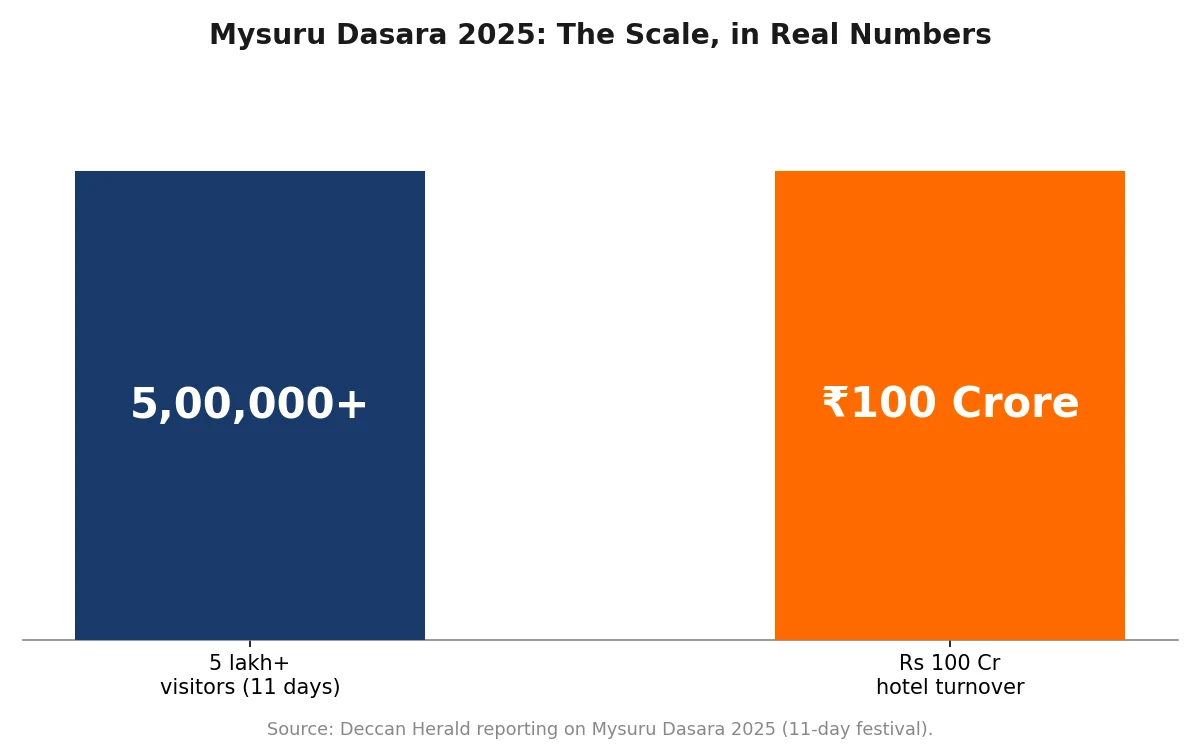
Dasara is not a minor seasonal note for Mysuru businesses the way a festival might be for a Bangalore tech company. It is the single biggest predictable demand spike of the year for tourism, hospitality, retail, and event-adjacent businesses in the city. The scale is genuinely large: the 2025 Dasara festival alone drew over 5 lakh visitors across its 11 days, with hotels reporting roughly Rs 100 crore in turnover. Search volume for tourism and hospitality terms rises well ahead of the festival itself, since Karnataka’s own tourism department confirms Dasara consistently drives the city’s highest annual tourist inflow, as travellers plan Karnataka trips months in advance. A business that only starts optimising its Google Business Profile and content in the weeks immediately before Dasara is optimising too late. The planning window needs to open months earlier, with content, photos, and Google Business Profile posts building up steadily rather than arriving as a last-minute push.
This is a genuinely different seasonal calendar than what drives most Bangalore commercial searches, which stay comparatively flat year-round outside of a handful of national retail seasons. A Mysuru business’s content calendar should be built around this real, predictable annual cycle rather than a generic monthly publishing schedule copied from a Bangalore-focused strategy.
The Google Business Profile Category Problem
One practical, specific difference worth naming directly: Mysuru businesses in tourism, heritage, and hospitality categories often have more specific, less-obvious primary category options available than a generic Bangalore service business does. Choosing “Heritage tour operator” over a generic “Tour operator” category, or a specific homestay or boutique accommodation category over generic “Hotel,” matters more here precisely because the competitive field is thinner. A well-chosen, specific category can meaningfully separate a business from generic competition in a way that barely moves the needle in an oversaturated Bangalore category.
The same logic applies to service-area businesses and traditional retail. A silk retailer or sandalwood products business benefits from a specific, accurate category and genuinely local, specific content, real neighbourhood references, real product detail, rather than a generic retail template, precisely because so few competitors in that specific niche have bothered to build one.

What Genuinely Stays the Same
None of this means Mysuru SEO is a fundamentally different discipline requiring different tools or a different SEO and SEM approach. The fundamentals covered in how Bangalore businesses can get found by AI search, entity clarity, direct-answer content, structured data, apply just as much in Mysuru as in Bangalore. AI Overviews and traditional search reward the same underlying signals regardless of city. What changes is which content those signals need to be built around, and how much lower the competitive bar is to clear in the first place.
Traditional Retail Deserves Genuine Digital Investment, Not an Afterthought
Mysuru’s silk and sandalwood trades represent a genuinely distinct retail category that Bangalore’s economy does not have in the same concentrated form. These businesses often carry deep, real credibility built over decades, but that credibility rarely translates into a comparably strong digital presence. Many operate with a basic website, if any, and Google Business Profiles that understate what makes the business genuinely distinctive: specific craftsmanship details, sourcing, authenticity credentials that matter enormously to buyers, especially the higher-value, often tourist or export-oriented segment of this market.
This is a category where the gap between offline reputation and online visibility tends to be widest, and correspondingly, where the opportunity for a business willing to invest in genuine digital presence is largest. A well-documented, specific website and profile, real photos of craftsmanship, real sourcing information, genuine reviews, competes credibly against both generic e-commerce marketplaces and against other traditional retailers who have not yet made this investment.
A Practical Starting Point for Mysuru Businesses
Start with the Google Business Profile category choice, since it is free and disproportionately impactful in a thinner competitive field. Build content around the real seasonal calendar, Dasara planning content should appear months ahead, not weeks, given the scale of demand the festival genuinely drives. Write with specific, real local detail, actual neighbourhoods, actual product and service specifics, rather than a generic template, since genuine specificity stands out more clearly against a smaller, less sophisticated set of competitors than it would in Bangalore.
For education institutions specifically, replace generic institutional marketing copy with direct, specific answers to real parent and student questions, admission timelines, fee structures, placement outcomes. For traditional retail and export businesses, invest in documenting genuine craftsmanship and sourcing detail online, since this category’s offline credibility rarely yet has a matching digital presence, which is exactly where the opportunity sits.
Finally, do not assume a national or Bangalore-based agency automatically understands this. A business that hires an agency with no genuine Mysuru presence often ends up with exactly the generic, city-name-swapped content this piece has been describing as the problem, not the fix.
What Genuinely Differentiated Content Actually Looks Like
It is worth being concrete about what “genuine specificity” means in practice, since the phrase can sound abstract. A generic tourism page says a homestay is “conveniently located near major attractions.” A genuinely specific one names the actual walking distance to Mysore Palace, mentions the specific auto-rickshaw fare range to Chamundi Hill, and describes which rooms get palace-facing views during the Dasara illumination specifically. A generic coaching centre page lists “experienced faculty and proven results.” A specific one names the actual admission cycle dates for the current year, states a real, verifiable pass percentage from the most recent batch, and answers the specific fee-structure questions a parent would actually type into Google.
This same principle extends to the traditional retail category. A generic silk retailer page describes “premium quality silk sarees.” A specific one names the actual weaving technique, states genuine sourcing detail, whether the silk comes from a specific known cooperative or region, and shows real photographs of the weaving or finishing process rather than stock product photography identical to a hundred other listings. None of this requires sophisticated technical work. It requires the discipline to write what is actually true and specific about the business, rather than defaulting to the same generic language every competitor in the category already uses.
This is precisely the kind of content a remote, Bangalore-or-Delhi-based agency serving a Mysuru client without genuine local knowledge struggles to produce credibly. Specificity of this kind generally requires either a genuinely local team or a client relationship close enough that the agency actually gathers these details directly, rather than working from a generic template applied across every city a national agency happens to serve.
A Mysuru business applying this thinking should track a slightly different set of signals than a Bangalore business would. Position and click trends around the Dasara planning window, roughly July through September, matter more here than a flat monthly average would suggest, since a genuinely well-prepared business should see a real seasonal build in tourism and hospitality-related search visibility ahead of the festival, not just during it. A business that only checks Search Console occasionally and sees a flat annual average is missing the seasonal pattern this piece has been describing entirely.
For education and traditional retail businesses, the more useful signal is often direct enquiry volume tied to specific, named content, does the admission-timeline blog post actually generate enquiries during the real admission season, does the craftsmanship-focused product page actually drive contact form submissions, rather than a generic traffic number disconnected from the business’s real seasonal and category-specific rhythm. A dedicated Mysuru service strategy built around these actual patterns, rather than a generic monthly report template copied from a Bangalore account, catches this kind of signal far more reliably.
None of the differences described in this piece require abandoning sound SEO fundamentals. They require recognising that Mysuru is a genuinely distinct market with its own competitive density, seasonal rhythm, and category mix, not a smaller version of Bangalore that happens to share a state. A strategy built around what actually drives Mysuru’s economy, heritage tourism, education, traditional retail, and a differently-shaped IT sector, consistently outperforms a Bangalore template with the city name changed.
A Mysuru customer searching for a service today behaves differently than a Bangalore customer in one more subtle way worth naming: word of mouth and family or community recommendation still plays a proportionally larger role in a city of Mysuru’s size than in Bangalore’s more anonymous, transaction-driven market. This does not reduce the importance of search visibility, but it does mean reviews and reputation signals on the Google Business Profile carry outsized weight, since a Mysuru searcher comparing options online is often implicitly cross-referencing what they may have already heard informally, and a business whose online reputation does not match its real local standing loses credibility fast in a market this size.
Frequently Asked Questions
Is Mysuru SEO actually easier than Bangalore SEO?
The competitive field is thinner, which makes ranking for local, less contested terms genuinely more achievable. It is not automatically easier for every term, especially not for anyone competing against outside agencies with strong existing domain authority, but the bar to stand out is lower than in Bangalore’s oversaturated market.
How far in advance should Dasara-related content be planned?
Months, not weeks. Tourism and hospitality search volume for Karnataka trip planning rises well ahead of the festival itself, so Google Business Profile updates, photos, and content should build up steadily over the preceding months rather than arriving as a last-minute push.
Does my business need different Google Business Profile categories than a similar business in Bangalore?
Not necessarily different categories, but the value of choosing a highly specific category over a generic one is greater in Mysuru’s thinner competitive field, where fewer businesses have bothered to optimise this level of detail.
Should I hire a Mysuru-based agency instead of a Bangalore or national one?
What matters more than location is whether the agency understands Mysuru’s actual economic and seasonal specifics, heritage tourism, education, traditional retail and export trades, rather than applying a generic template. A Bangalore-based agency with genuine local knowledge and a real Mysuru presence can serve this well.
Do the AI search fundamentals from Bangalore-focused content still apply here?
Yes. Entity clarity, direct-answer content, and structured data reward the same signals regardless of city. What changes is the specific content built around those signals, not the underlying mechanics.
How big is the Dasara opportunity really, in concrete terms?
Substantial. The 2025 festival alone drew over 5 lakh visitors across 11 days, with hotels reporting roughly Rs 100 crore in turnover, figures confirmed by Deccan Herald’s reporting on the event. That scale makes Dasara-season preparation a genuine business priority, not an optional seasonal extra.
Is Mysuru’s IT sector a real SEO opportunity or mostly irrelevant?
It is real but shaped differently than Bangalore’s. Mysuru’s tech presence leans toward IT services delivery and smaller firms often serving outside markets, meaning B2B lead generation and LinkedIn presence often matter more than local Mysuru search volume for this specific sector.
About the Author
L.K. Monu Borkala, Founder & CEO, OneCity Technologies Pvt Ltd
Twenty years in marketing, starting with Yellow Pages print publishing across South India and moving into digital work from 2017. OneCity operates from offices in Bengaluru, Mangaluru, and Mysuru, giving direct, on-the-ground perspective across all three markets rather than a single-city view applied everywhere. All strategy and published content is reviewed and approved by Borkala before it goes live.
Connect on LinkedIn | Full profile and credentials | CIN: U72100KA2009PTC048911
L.K. Monu Borkala
Founder & SEO Director, OneCity Technologies
20 years running SEO campaigns from Bangalore. Full author profile · LinkedIn