In-House SEO Team vs Hiring an SEO Company
Updated: 1 September 2026
A real cost and capability comparison for Bangalore businesses deciding whether to build an SEO team internally or work with an agency.
Reviewed against the March 2026 Spam Update • December 2025 Core Update • August 2025 Spam Update
Every growing Bangalore business eventually asks the same question: hire one person to handle SEO internally, or retain an agency that already has a full team. The honest answer depends less on cost alone and more on how much skill breadth a business actually needs, since SEO today spans technical work, content, and authority building, three genuinely different skill sets that rarely live inside one person at the same depth an agency team can offer.
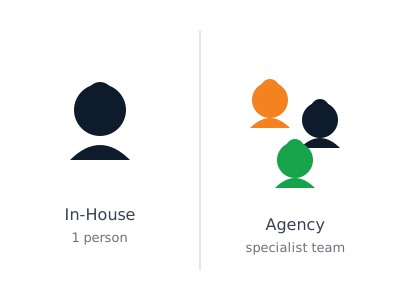
Skill Breadth: One Person Versus a Team
A single in-house SEO hire in Bangalore typically brings strength in one or two of these three areas, not all three equally. A hire with a content background writes well but may lack the technical depth to diagnose a Core Web Vitals problem or interpret a Search Console crawl error. A hire with a technical background can fix site issues confidently but may produce thinner, less persuasive content than the business needs. An agency retainer, by contrast, distributes these three skill areas across specialists who each spend their full working time on one discipline.
The Real Cost Comparison
Cost comparison between the two options needs to include more than the visible salary or retainer figure. A full-time in-house hire adds employer costs beyond salary, and importantly adds a single point of failure, if that person leaves, takes leave, or simply lacks a specific skill, SEO work for the business pauses or degrades until a replacement is found or trained. An agency retainer, priced comparably to a single mid-level hire in many cases, provides continuity across a small team rather than dependence on one individual.
| Factor | In-House Hire | SEO Agency |
|---|---|---|
| Skill coverage | Usually 1-2 of 3 core areas | Content, technical, and authority combined |
| Continuity risk | Single point of failure | Spread across a small team |
| Ramp-up time | 3-6 months to full productivity | 3-6 months to full account knowledge |
| Management need | Requires SEO-literate manager | Account manager handles translation |
Management Overhead
Management overhead differs meaningfully between the two models as well. An in-house hire needs a manager who understands enough about SEO to evaluate their work quality, set priorities, and catch mistakes, which is often unrealistic for a business owner without SEO background themselves. An agency, by contrast, typically assigns an account manager whose job includes translating specialist work into plain business language the client can actually evaluate, reducing the management burden on the business owner considerably.
Which Businesses Suit Which Model
The businesses best suited to an in-house hire are usually larger organisations with enough ongoing SEO-adjacent work, content production, technical maintenance, and campaign management, to justify a dedicated full-time role, and with someone internally capable of managing that hire even without being an SEO specialist themselves. Smaller and mid-sized Bangalore businesses without this internal capacity typically get more consistent output from an agency relationship, simply because the agency model does not depend on one individual bandwidth or skill ceiling.
The Hybrid Model
A hybrid model works well for many Bangalore businesses sitting between these two extremes. One common structure keeps content production in-house, since a team member close to the business often writes more authentic, specific content than an outside writer can, while retaining an agency for technical audits, strategy direction, and link building, the areas requiring specialist skill and tooling most businesses cannot justify building internally. This hybrid captures the authenticity advantage of an internal voice alongside the technical depth an agency team provides.
Switching from one model to the other carries real transition cost worth planning for honestly. Moving from an agency to an in-house hire means the new hire needs time to reach the same working knowledge of the business history, past campaigns, and technical quirks the agency already holds, often three to six months before reaching full productivity. Moving from in-house to an agency means the agency needs a genuine onboarding period covering the same ground before its recommendations reflect real understanding of the business rather than a generic template applied blindly.
- An in-house hire claiming equal senior expertise in content, technical SEO, and link building at a junior salary
- An agency assigning a large specialist team to a small retainer budget, often actually junior staff spread thin
- Either option promising guaranteed rankings within a fixed timeframe
- No clear handover plan if the in-house hire or agency account manager leaves
Why This Decision Matters More After Recent Algorithm Updates
The March 2026 Spam Update rewards genuine expertise and penalises thin, templated work regardless of whether that work comes from an in-house hire or an external agency. The real question is not which model is cheaper on paper, but which model actually delivers the depth of skill across content, technical, and authority work that current algorithm standards require.
A Realistic Salary and Retainer Comparison
Bangalore salary ranges for an in-house SEO hire vary considerably by seniority, but a genuinely capable mid-level specialist commands a meaningful monthly cost once salary, statutory benefits, and basic tooling access, paid keyword and audit tools, are included. An agency retainer covering a comparable scope typically sits in a similar overall range, but distributes that budget across a small team rather than one individual, which is the core trade-off this decision comes down to more than any single number.
How Skill Gaps Actually Show Up in Practice
A skill gap in an in-house SEO hire rarely announces itself directly, it shows up gradually as specific categories of work simply do not happen. A content-strong, technically-weak hire produces a steady stream of blog posts while Core Web Vitals scores quietly decline and nobody notices until traffic drops. A technically-strong, content-weak hire keeps the site fast and error-free while the content calendar stalls and competitors out-publish the business consistently. Recognising which category a current or prospective hire genuinely covers, rather than assuming broad competence from a confident interview, prevents this blind spot from persisting for months before its effects become visible in performance data.
Interviewing for an In-House SEO Role Without SEO Expertise Yourself
A business owner without SEO background can still interview effectively by focusing on specific, verifiable past work rather than general claims. Asking a candidate to walk through a real technical issue they diagnosed and fixed, a specific piece of content they wrote and why they structured it that way, and a specific link or authority-building result they can point to, reveals actual depth far more reliably than asking generic questions about SEO philosophy that any candidate can answer convincingly regardless of true skill level. Checking a candidate professional history on LinkedIn for consistency with their claimed experience adds a further, easy layer of verification.
What an Agency Team Structure Actually Looks Like
Understanding what a genuine agency team structure looks like helps a business evaluate whether a retainer price reflects real specialist coverage or a thin team spread across many clients. A properly resourced small agency retainer typically involves a strategist overseeing the account, a content specialist, a technical SEO specialist, and an account manager coordinating communication, though for a smaller retainer these roles sometimes combine across fewer people rather than disappearing entirely. Asking an agency directly how many total clients a specific team member handles reveals whether the team structure shown in a sales pitch reflects genuine dedicated capacity or an unsustainable spread.
Onboarding Time: What Both Models Actually Require
Neither an in-house hire nor a new agency relationship becomes fully productive immediately, and businesses underestimate both ramp-up periods equally often. An in-house hire needs time to learn the business specific products, customer language, and competitive landscape before content and strategy genuinely reflect real understanding rather than generic industry knowledge. An agency needs a comparable period reviewing historical data, understanding past campaigns, and building working familiarity with the account before its recommendations move past generic advice into something genuinely tailored. Businesses expecting either model to perform at full capability within the first month are setting an unrealistic bar neither option can meet.
Measuring Whether the Chosen Model Is Actually Working
Six months into either an in-house hire or an agency relationship, a business should have enough data to judge honestly whether the chosen model is delivering. The right measurement compares cost per qualified enquiry against a reasonable baseline, not simply whether any SEO activity is happening. A business seeing steady output, published content, completed technical fixes, active link building, but no meaningful movement in actual enquiries after six months has a signal worth investigating regardless of which model produced that output, since activity alone was never the actual goal.
Combining Part-Time In-House Support With an Agency
A less commonly discussed middle option involves a part-time or junior in-house hire handling day-to-day content publishing and basic technical monitoring, while an agency provides strategic direction, more complex technical work, and authority building on a lighter retainer than a full-service engagement would require. This structure works well for a business with enough budget for some internal capacity but not a senior full-time hire, capturing meaningful cost savings compared to either extreme while still accessing genuine specialist strategic input.
Red Flags Specific to Agency Team Claims
Beyond the general red flags already covered, a few claims specific to agency team structure deserve direct questioning. An agency claiming a large named team of ten or more specialists for a modest retainer, without being able to describe which specific team members will actually touch this specific account regularly, is likely presenting an aspirational team roster rather than genuine dedicated capacity. Similarly, an agency unable or unwilling to name the specific person who will serve as the primary point of contact throughout the engagement makes accountability difficult to establish from the outset.
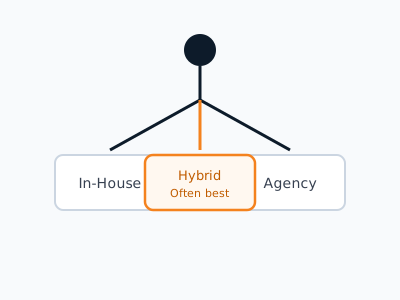
A Practical Decision Framework
A business genuinely uncertain between the two models benefits from a structured framework rather than an instinctive choice. Start by honestly assessing internal capacity to manage a specialist hire: without someone able to evaluate SEO work quality, an in-house hire operates with minimal oversight regardless of their actual competence. Next, assess the realistic scope required: a business needing broad coverage across content, technical work, and authority building simultaneously rarely gets that from one person at senior depth. Finally, assess budget flexibility: a fixed monthly retainer offers more predictable cost planning than an in-house hire, whose total cost can fluctuate with benefits, tooling upgrades, and eventual replacement hiring costs if the role turns over.
Industry-Specific Considerations for Bangalore Businesses
Certain Bangalore industries lean more naturally toward one model than the other based on how specialised the required content and technical knowledge actually is. A healthcare or legal services business often benefits from an in-house content contributor who genuinely understands the regulatory and clinical nuance required, paired with an agency for the technical and authority-building work that does not require industry-specific expertise. A straightforward local service business, a restaurant, a salon, a repair shop, typically has no comparable need for deep in-house industry knowledge and gets full value from a complete agency relationship without needing to split the work at all.
What Changes as a Business Scales
The right model for a five-person startup rarely remains the right model once that same business reaches fifty employees and multiple locations. Growing businesses should revisit this decision periodically rather than assuming whatever worked at an earlier stage remains optimal indefinitely. A startup that began with a single agency retainer may eventually justify bringing content production in-house once volume and specificity needs grow large enough, while a startup that began with an ambitious in-house hire may find a hybrid or agency model more efficient once the business needs broader specialist coverage than one person, however capable, can realistically sustain.
Building an Internal Job Description That Actually Works
Businesses hiring an in-house SEO role often write a job description listing every possible SEO skill without prioritising which ones matter most for their specific situation. A more effective approach names the two or three skills that genuinely matter most for the business current stage, technical audit capability for a site with known performance problems, or content production speed for a business scaling publishing volume, and treats the remaining skills as a bonus rather than a hard requirement. This produces a more honest hiring process and a more realistic set of candidates than a job description demanding senior-level mastery across every SEO discipline simultaneously.
Retention and the Cost of Losing an In-House Hire
The single point of failure risk covered earlier has a specific financial dimension worth naming directly. Replacing a departed in-house SEO hire involves recruitment time and cost, a training period before the replacement reaches full productivity, and a real gap in ongoing SEO work during the transition, sometimes several months in total. This total replacement cost rarely factors into the initial hiring decision but matters considerably over a multi-year horizon, particularly for a business in a competitive category where a few months of reduced SEO activity allows competitors to gain ground that takes considerably longer to recover than it took to lose.
How to Evaluate an Existing In-House Hire Objectively
A business already several months into an in-house SEO hire benefits from an honest, structured evaluation rather than a vague sense of whether things feel like they are working. Comparing organic traffic and enquiry trends against the period before the hire started, reviewing whether Search Console shows genuine technical improvement over time, and honestly assessing whether content output has been consistent rather than sporadic all provide concrete evidence beyond a general impression. A business finding genuinely mixed results after this honest review, worth checking against Google search quality guidelines, has legitimate grounds to consider supplementing with agency support rather than assuming the current arrangement must simply be given more time indefinitely.
The Role of Company Culture in This Decision
A less quantifiable but genuinely relevant factor is how comfortable a business feels having SEO strategy influenced by someone embedded in company culture versus an external perspective. An in-house hire absorbs company context naturally through daily proximity, sometimes producing content and messaging that feels more authentically aligned with brand voice. An external agency brings comparative perspective from working across other clients and industries, sometimes surfacing opportunities an insider too close to the business might not notice. Neither perspective is objectively superior, and recognising which one a specific business genuinely values more can reasonably factor into an otherwise close decision between the two models.
A Final Practical Recommendation
For most small and mid-sized Bangalore businesses without a clear existing preference, starting with an agency relationship and revisiting the in-house question after twelve to eighteen months of real performance data tends to produce better decisions than committing to a senior in-house hire immediately. This sequencing lets a business learn what genuine SEO work actually requires, through direct exposure to an agency reporting and process, before committing to building that capability internally, at which point any eventual in-house hire benefits from a business owner or manager who now understands enough to evaluate that hire effectively, closing the management oversight gap that otherwise makes an early in-house hire considerably riskier than it needs to be.
This guide will be reviewed and updated periodically as typical Bangalore salary benchmarks, agency pricing norms, and the broader market for specialist SEO talent continue to shift, since the right answer for a specific business today may look different again in a year or two as these underlying conditions change.
None of this framework replaces an honest conversation within the business itself about what genuinely matters most: predictable cost, broad specialist coverage, internal control over brand voice, or minimal management overhead. Different owners reasonably weigh these priorities differently even when looking at the exact same set of facts, and the right answer for one Bangalore business is not automatically the right answer for a similar business down the street with a different owner, different team, and different risk tolerance for the single point of failure an in-house hire genuinely represents.
Frequently Asked Questions
Is it cheaper to hire in-house or use an SEO agency?
It depends on scope. A single in-house hire costs less than a full agency team on paper, but covers narrower skill breadth. An agency retainer priced comparably to one mid-level hire often delivers wider specialist coverage across content, technical, and authority work combined.
Can one in-house person really handle all of SEO?
Rarely at senior depth across all three core areas, content, technical SEO, and authority building. Most in-house hires are genuinely strong in one or two of these areas, which is fine if the business scope matches that strength, but risky if the business expects full coverage from one person.
How long does it take a new in-house SEO hire to become productive?
Typically three to six months to reach full working knowledge of the business history, technical setup, and past campaign performance, similar to the ramp-up period an agency also needs when starting a new client relationship.
What is the biggest risk of an in-house-only SEO approach?
Single point of failure. If the hire leaves, takes extended leave, or simply lacks a needed skill, SEO work pauses or degrades until the gap is filled, with no built-in continuity the way a small agency team provides.
Does a hybrid model actually work in practice?
Yes, commonly. Keeping content production in-house for authentic voice while using an agency for technical audits, strategy, and link building captures the strengths of both models without the full cost or full risk of either extreme alone.
What salary should I expect to pay an in-house SEO hire in Bangalore?
Salary varies considerably by seniority and scope, but a genuinely capable mid-level specialist commands a meaningful monthly cost once statutory benefits and basic tooling access are included, often comparable to a mid-tier agency retainer covering similar scope.
How many clients does a typical agency team member handle at once?
This varies widely and is worth asking directly. A specialist spread across too many accounts simultaneously cannot give any single client the attention a dedicated retainer implies, regardless of how the team is presented in a sales pitch.
Can a part-time in-house hire work alongside an agency?
Yes, this hybrid structure works well for businesses with some budget for internal capacity but not a senior full-time hire, combining day-to-day content publishing internally with strategic and technical work from an agency on a lighter retainer.
Does the right SEO model change as a business grows?
Often yes. A model that works well for a small startup may not remain optimal at fifty employees and multiple locations. Revisiting this decision periodically, rather than assuming an early-stage choice remains correct indefinitely, helps a growing business stay efficient.
Do certain industries suit one model better than the other?
Yes. Regulated or specialised industries like healthcare and legal services often benefit from in-house content expertise paired with agency technical support, while straightforward local service businesses typically get full value from a complete agency relationship alone.
Related Guides
SEO Company in Bangalore
Our full guide to choosing and working with an SEO company in Bangalore.
SEO Pricing in Bangalore
Real pricing benchmarks and what should be included at each price point.
SEO Contract Red Flags
What to check in an agency contract before you sign anything.
How to Choose an SEO Company in India
A step-by-step vetting process before you commit to any agency.
SEO Company in Bangalore
Our full guide to choosing and working with an SEO company in Bangalore.
SEO Pricing in Bangalore
Real pricing benchmarks and what should be included at each price point.
SEO Contract Red Flags
What to check in an agency contract before you sign anything.
How to Choose an SEO Company in India
A step-by-step vetting process before you commit to any agency.
OneCity Technologies Pvt Ltd (CIN: U72100KA2009PTC048911, incorporated 2009) has advised Bangalore businesses on SEO team structure since 2006. Written by L.K. Monu Borkala, Founder & CEO. Verify our registration at the MCA21 portal. | Published: | Updated:
Not Sure Which Model Fits Your Business?
Tell us your current setup and we will give you an honest read on whether in-house, agency, or hybrid makes the most sense.
Rajajinagar, Bengaluru · Kankanady, Mangaluru · Kuvempu Nagara, Mysuru