International & Remote SEO Services from India
Updated: 28 August 2026
We are a Bengaluru-based SEO team serving businesses in Australia, Canada, and New Zealand entirely remotely. No local office in your country, we are not going to pretend otherwise. What we offer instead is 20 years of SEO work, country-specific guidance, transparent pricing in your currency, and a delivery model built around the time difference rather than ignoring it.
Compliant with Google’s March 2026 Spam Update • December 2025 Core Update • August 2025 Spam Update
What This Page Is Not
This is not a page pretending we have a Sydney, Toronto, or Auckland office. We do not. If you specifically need an agency you can walk into for a face-to-face meeting, we are not the right fit, and we would rather tell you that now than after you have signed a contract. What follows is what we can genuinely offer, including country-specific detail on how SEO actually works differently in each of these three markets, and the trade-offs involved in working with us remotely.
Search engine optimisation is not identical across countries. Search behaviour, competition density, advertising regulation, language conventions, and even which search engine dominates all shift from Australia to Canada to New Zealand. A generic "we do SEO for any country" page does not reflect that. This one tries to.
Why Businesses in Australia, Canada, and New Zealand Hire a Remote India-Based SEO Team
The honest reason most clients start this conversation is cost. Indian SEO teams typically charge 40 to 60 percent less than local agencies in Australia, Canada, or New Zealand for comparable technical SEO and content work, because operating costs, office space, salaries, overheads, are structurally lower here. That gap is real and it does not mean lower quality; it means a different cost base built on two decades of running SEO campaigns in Bangalore and across India.
Beyond cost, three other reasons come up consistently in discovery calls:
- English-first work with no translation layer. Our content, reporting, and communication are all in English from the outset, no outsourcing chain, no language gap between you and the person doing the work.
- The time difference works in your favour for turnaround. Work submitted at the end of your business day is often reviewed and progressed by our team overnight in your time zone, so tasks move forward while your own team is offline.
- Deep experience with Google’s algorithm history. We have operated through every major update since 2006, Panda, Penguin, Hummingbird, BERT, the Helpful Content System, and the current March 2026 Spam Update, December 2025 Core Update, and August 2025 Spam Update. That discipline is not unique to serving India; the same technical and content standards from our SEO and SEM work apply to any market.
How the Time Difference Actually Works
India Standard Time (IST) is UTC+5:30. Here is roughly where that lands relative to your business hours, accounting for daylight saving where it applies:
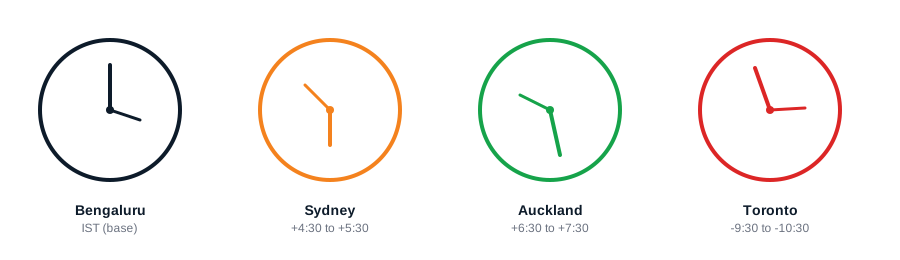
| Your Location | Approximate Offset from IST | What This Means Practically |
|---|---|---|
| Sydney / Melbourne (AEST/AEDT) | +4:30 to +5:30 hours ahead | Your morning overlaps our afternoon, good window for live calls |
| Auckland / Wellington (NZST/NZDT) | +6:30 to +7:30 hours ahead | Best overlap is your early morning with our late afternoon |
| Toronto / Eastern Canada (EST/EDT) | 9:30 to 10:30 hours behind | Your morning is our evening, async reporting works better than live calls most days |
| Vancouver / Pacific Canada (PST/PDT) | 12:30 to 13:30 hours behind | Minimal live overlap; we structure work around written updates and scheduled weekly calls |
In practice, we schedule recurring calls early morning IST for monthly strategy reviews, and handle day-to-day communication through email, shared documents, and a reporting dashboard rather than expecting real-time chat throughout the day.
What Remote Delivery Actually Looks Like
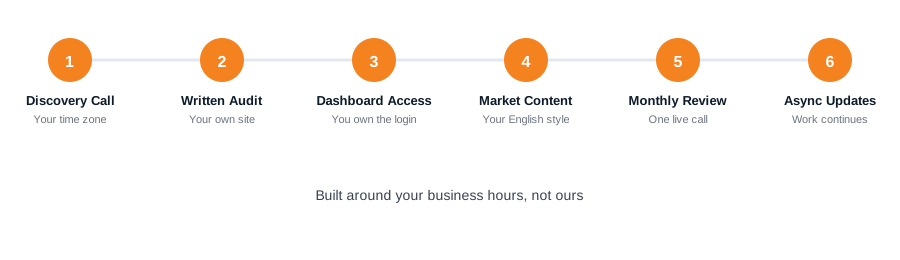
Onboarding Call
A video call to understand your business, current site, and goals, scheduled at a time that works for your business hours, not ours.
Written Audit & Proposal
A specific technical and content audit of your actual website, delivered as a document you can review on your own time, followed by a written proposal.
Shared Dashboard Access
You get direct owner-level access to your own Google Search Console, GA4, and reporting dashboard, not a locked-down agency login.
Market-Specific Content
Content written via our content writing team in Australian, Canadian, or New Zealand English conventions, not Indian English defaults, based on input we collect from you upfront.
Monthly Video Review
One scheduled live call per month for strategy review, plus written monthly reports covering rankings, traffic, and enquiries.
Async-First Communication
Day-to-day updates via email and shared documents so work continues without requiring you to be online at the same time we are.
SEO for Australian Businesses
Australia is the largest of the three markets we cover on this page, and also the most competitive for national terms. A tradesperson in Parramatta competing for "plumber near me" faces different dynamics than a Melbourne CBD accounting firm competing for "small business accountant," but both share a market shaped by strong Google Maps reliance, an advertising environment regulated by the Australian Competition and Consumer Commission, and a business registration system built around the Australian Business Number.
Most Australian small businesses we work with are registered for an ABN and, once turnover crosses the threshold, for GST at 10 percent. None of that directly affects SEO mechanics, but it does affect the trust signals a website needs, an ABN displayed clearly on a site, along with a registered business address, does more for local credibility with both users and Google than most business owners realise.
What Differs From Indian or Generic SEO Work
- Spelling and terminology. "Organise," "colour," "specialise," and "mobile" rather than "cell phone", small details that signal authenticity to an Australian reader and their absence signals the opposite.
- Advertising claims. The ACCC actively enforces against misleading claims in advertising, including on websites. We flag comparative or superiority language for your own legal review rather than publishing it without scrutiny.
- Local competition structure. Outside Sydney, Melbourne, Brisbane, Perth, and Adelaide, many regional Australian markets have surprisingly thin SEO competition, which means well-executed local SEO for regional service businesses, trades, allied health, agribusiness services, can move faster than in dense metro markets.
- NDIS-related services. For businesses in the disability services and allied health space linked to the National Disability Insurance Scheme, content needs to reflect NDIS terminology accurately, since this is a heavily searched and heavily regulated category.
Further reading on registering and structuring a business correctly in Australia is available directly from the Australian Government's own business portal, which we point clients to rather than attempting to give tax or legal guidance ourselves: business.gov.au.
E-Commerce and Payments in the Australian Market
Shopify has a strong hold on Australian e-commerce, particularly among small and mid-sized retailers, followed by WooCommerce for businesses already on WordPress. Buy-now-pay-later options such as Afterpay and Zip originated in Australia and remain expected checkout options for many consumer categories, their absence on a checkout page is often noticed by Australian shoppers even if they do not use them. For SEO purposes, product schema markup that correctly reflects these payment options, along with AUD pricing displayed without ambiguity, supports both user trust and eligibility for Google Shopping-adjacent rich results. Freight and delivery-time expectations also differ sharply between metro and regional Australia, and product pages that address this directly tend to reduce pre-purchase support queries as well as improve on-page relevance for delivery-related search queries.
SEO for Canadian Businesses
Canada is unusual among the three markets here because it is genuinely bilingual at a regulatory level. A business operating in Quebec faces requirements under Quebec's French-language rules that simply do not exist for a business in Ontario or British Columbia, and treating Canadian SEO as a single undifferentiated English-language market is a common mistake we see in websites built by agencies unfamiliar with the country.
Federally, most Canadian businesses register for a Business Number through the Canada Revenue Agency, and GST or the combined Harmonized Sales Tax applies depending on the province, the rate itself is not something we advise on, since it varies and changes, but the registration signals matter for site trust in the same way an ABN does in Australia.
What Differs From Indian or Generic SEO Work
- Quebec-specific content requirements. For businesses with a Quebec-facing storefront or consumer offering, French-language content is not optional under the Charter of the French Language. We work with a dedicated French-language reviewer for Quebec content rather than machine translation, since compliance and tone both matter here.
- CASL compliance for email and outreach. Canada's Anti-Spam Legislation is stricter than equivalent rules in many other markets. Any email marketing or outreach component of an SEO and content programme needs to reflect CASL consent requirements, and we flag this explicitly rather than assuming it is already handled.
- PIPEDA and privacy expectations. The Personal Information Protection and Electronic Documents Act shapes what a compliant privacy policy and cookie consent setup should look like on a Canadian-facing site.
- Seasonal and regional search patterns. Winter-driven service categories (heating, snow removal, indoor recreation) spike predictably, and a national campaign needs different content cadence for Calgary versus Toronto versus Vancouver given genuinely different climates and demographics within one country.
For businesses wanting to understand federal registration requirements directly rather than through a third party, the Government of Canada's own business services portal is the authoritative source: canada.ca business services.
E-Commerce and Payments in the Canadian Market
Shopify's home market is Canada, and it shows, adoption among Canadian small and mid-sized retailers is very high, often ahead of WooCommerce in this specific market compared to Australia or New Zealand. Interac e-Transfer and Interac Online remain widely used payment expectations alongside standard card processing, and checkout pages that only support US-style payment rails can quietly underperform with Canadian shoppers who expect Interac as an option. CAD and USD pricing confusion is also a real issue for cross-border Canadian retailers close to the US market; clear currency labelling on every price shown, not just at checkout, avoids both cart abandonment and duplicate-content-style confusion for Google when a site inadvertently mixes currency signals across pages.
SEO for New Zealand Businesses
New Zealand is the smallest of the three markets here by population and search volume, and that changes the SEO calculus in a specific way: lower search volume also means lower competition for most commercial terms outside a handful of categories (tourism, real estate in Auckland and Queenstown, and a few professional services niches). For a well-run local business, ranking for a realistic set of local terms is often achievable faster here than in Australia or Canada, simply because fewer competitors are investing seriously in SEO.
Business registration in New Zealand runs through the New Zealand Business Number system, and GST is charged at a flat 15 percent nationally, unlike Canada, there is no separate provincial layer to account for, which simplifies e-commerce tax display requirements considerably.
What Differs From Indian or Generic SEO Work
- Market size realism. We do not oversell New Zealand SEO potential. Search volumes for most commercial terms are a fraction of Australia's. The right expectation is steady, achievable local visibility, not the traffic numbers a similar campaign might produce in a larger market.
- Fair Trading Act compliance. Similar in spirit to Australia's ACCC rules, New Zealand's Fair Trading Act governs misleading advertising claims, and we flag comparative language for review rather than publishing it unchecked.
- Tourism and agribusiness adjacency. A large share of New Zealand's searchable commercial activity sits close to tourism (accommodation, tours, hospitality) or agribusiness-adjacent services, both of which have their own seasonal and international-visitor search patterns worth planning content around.
- Privacy Act 2020. New Zealand's updated privacy legislation shapes what data collection disclosure should look like on forms and cookie banners, distinct from both Australian and Canadian requirements.
Official guidance on registering and running a compliant business in New Zealand is available directly from the government's own resource: business.govt.nz.
E-Commerce and Payments in the New Zealand Market
Shopify and WooCommerce both have meaningful presence in New Zealand, though the overall e-commerce market is proportionally smaller, which means fewer but often less competitive product-search opportunities for a well-optimised store. POLi and standard card processing dominate checkout, with a growing share of Afterpay adoption mirroring the Australian trend given the close economic ties between the two countries. One detail specific to New Zealand worth flagging on product and pricing pages: the flat 15 percent GST rate with no provincial variation makes tax-inclusive pricing display simpler and more consistent than in Canada, and getting this right consistently across every product page avoids the kind of pricing-display errors that erode trust with a small, close-knit online market where word of mouth carries real weight.
Where We're Covering This Ground: A Quick Visual
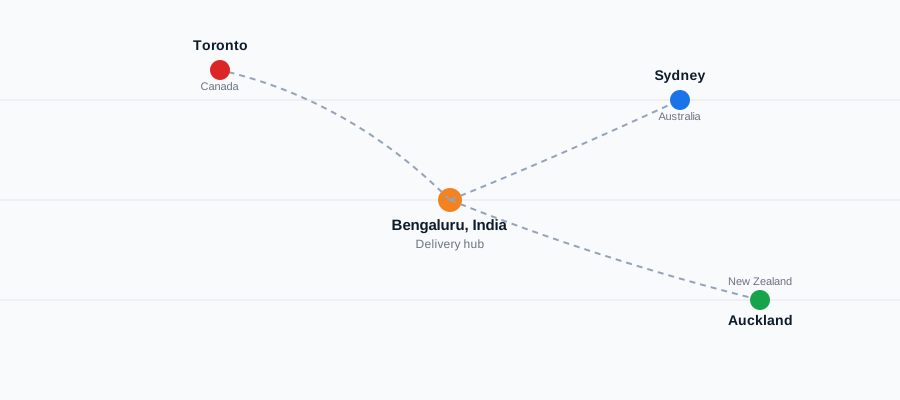
One delivery team in Bengaluru, three distinct markets, three distinct approaches, not one template stretched across all of them.
Indicative Pricing
Pricing below is converted from our standard INR-based rates, the same structure behind our domestic SEO pricing, and confirmed in your currency at proposal stage, since exchange rates move. As an export of services under Indian tax rules, GST does not apply to these invoices on our end; any GST, HST, or tax obligation on your end as the purchaser is a matter for your own accountant.
| Business Size | Approx. Monthly Range (USD) | Scope |
|---|---|---|
| Small business, single service line | $220 – $480 | Technical fixes, local SEO if applicable, basic content, monthly reporting |
| Growing business, multiple services or locations | $550 – $1,450 | Full content plan, technical SEO, structured local SEO, dedicated reporting |
| Competitive market or larger site | $1,800+ | Dedicated strategist, content team, advanced technical work |
AUD and CAD quotes are provided at the same proposal stage based on the exchange rate at that time. We do not lock in a currency-specific number on this page because doing so accurately would mean updating it daily. If you already run paid search campaigns, we typically recommend maintaining those while SEO foundations are built, rather than switching off paid traffic prematurely.
How We Handle Access and Data Working Remotely
Handing website, analytics, and Search Console access to a team on the other side of the world is a legitimate concern, and we would rather address it directly than hope it does not come up.
- You control access, we do not. Google Search Console, GA4, and Google Business Profile are added as users under permissions you grant and can revoke at any time from your own account. We never ask you to hand over your primary login credentials.
- CMS access is role-based. On WordPress, Shopify, or custom builds, we request an editor or admin-level user account created for our team specifically, not shared credentials, so any change is attributable and revocable.
- No client data leaves agreed systems. Reporting lives in shared Google Sheets, Looker Studio dashboards, or a system you already use, we do not export client data into unrelated third-party tools without asking first.
- An NDA is standard practice, not an unusual request. For clients handling sensitive commercial information, we sign a mutual non-disclosure agreement before any account access is granted, and this is built into our onboarding process by default for international clients.
Common Mistakes We See in Sites Built Without Market-Specific SEO Input
Before we ever start a technical audit, we look at whether a site's existing content and structure suggest it was built with the target market genuinely in mind, or adapted from a template with the country name swapped in. A few patterns show up repeatedly across all three markets we cover here.
- Currency and spelling mismatches on the same page. A site that prices in USD while using Australian spelling, or mixes "color" and "colour" inconsistently across different pages, signals to both users and Google that the content was not built cohesively for one audience.
- Generic stock imagery that reads as placeless. Photos that could be from anywhere do less for local trust than even simple, honest imagery that reflects the actual country or city being served, this is part of why we built country-specific visuals into this page rather than reusing one generic international graphic across all three sections.
- Ignoring regional competition density. Treating "Australia" or "Canada" as a single market rather than recognising that a Perth-based trade business faces different competition than one in Sydney, or that Halifax and Toronto have very different search landscapes, leads to content strategies that are too broad to rank for anything specific.
- Missing or incorrect structured data for the local business type. LocalBusiness schema that omits the correct country, or uses an address format that does not match local postal conventions, can quietly prevent a site from being eligible for local search features it should otherwise qualify for.
- Treating GST, HST, and VAT as interchangeable. These are different tax systems with different display requirements. A site built by an agency unfamiliar with Australian, Canadian, or New Zealand tax display norms sometimes gets this visibly wrong on pricing pages, which damages trust with a purchase-ready visitor at the worst possible moment in their decision.
None of these are exotic problems. They are the kind of details that a team without direct experience in a specific market tends to miss, and the kind of details we build a checklist around precisely because we have seen them recur across client work.
Getting Started: What We Need From You
A discovery call moves faster when we already have a few basics, though none of this is required before that first conversation:
- Your website URL and, if you have one, existing Google Search Console or GA4 access (even view-only helps us prepare)
- A short description of your main products or services and the three competitors you consider most relevant
- Which specific cities, provinces, or regions matter most to your business, since this shapes local SEO priority
- Any existing brand or style guide, so market-specific content matches your voice rather than a generic default
- Your preferred call time in your own time zone, so we schedule around you rather than asking you to work around IST
None of this needs to be perfect or complete before reaching out, a discovery call is where we fill in the gaps together.
Who This Is a Good Fit For, and Who It Isn’t
Good Fit
Businesses comfortable managing a vendor relationship over video calls and written reports, who want strong technical and content SEO work at a lower cost than local agencies, and who do not require in-person meetings.
Not a Good Fit
Businesses that specifically need a local team for in-person workshops, on-site photography, or a physical office relationship. We would rather say this upfront than take on a client we cannot properly serve.
Worth a Conversation
Not sure which category you fall into? A 20-minute discovery call usually makes it clear quickly, with no obligation either way.
What We Bring From Two Decades in the Indian Market
I have watched enough Bangalore businesses get burned by agencies overselling international reach they didn't have that I did not want to write this page the same way. When an Australian or Canadian enquiry comes in, I personally review the discovery call notes before we scope anything, because a remote engagement only works if the person leading strategy has actually sat through client calls across odd hours and knows where the real friction points are, not just in theory, but from running this exact playbook for coastal Karnataka and Bangalore clients since 2006.
We are not going to fabricate Australian, Canadian, or New Zealand case studies we do not have. What we can point to honestly is a track record built since 2006 across Bangalore, Mangaluru, and Mysuru, the same technical SEO discipline, the same content and on-page standards, and the same reporting transparency we apply domestically. Our client reviews and portfolio reflect that Indian market history, not a claim to international experience we have not yet earned. If that honesty matters to you as much as it matters to us, a conversation is worth having.
We also build the surrounding digital presence when needed, website design, custom development, landing pages, mobile apps, and brand identity work, under the same in-house team, so an international client is not passed between multiple vendors for related work.
L.K. Monu Borkala
Founder & SEO Director, OneCity Technologies
20 years running SEO campaigns from Bangalore, personally involved in strategy for every international engagement described on this page. Full author profile · LinkedIn
Frequently Asked Questions
Does OneCity have an office in Australia, Canada, or New Zealand?
No. We are based in Bengaluru, India, with offices in Bengaluru, Mangaluru, and Mysuru. We deliver SEO for Australian, Canadian, and New Zealand clients entirely remotely, and we are upfront about that rather than implying a local presence we do not have.
How do calls and meetings work across the time difference?
We schedule recurring calls in the early morning IST, which lands in the prior evening or same-day business hours across Australia, New Zealand, and Canada depending on the specific time zone. Most ongoing communication happens async via email and shared dashboards, with live calls reserved for monthly strategy reviews.
Why would I hire a remote India-based SEO team instead of a local agency?
Primarily cost. Indian SEO teams typically charge 40 to 60 percent less than agencies in Australia, Canada, or New Zealand for comparable technical and content work, because operating costs are lower. The trade-off is no in-person meetings and a working relationship built over video calls and written reports.
What currency do you bill in?
We invoice in USD, AUD, or CAD depending on your preference, converted from our INR-based pricing at the time of the proposal. GST does not apply to export-of-services invoices under Indian tax rules.
Is my content written by someone who understands my market, not just generic English content?
Our content team writes in Australian, Canadian, or New Zealand English conventions rather than Indian English defaults, and we ask for market-specific input from you before writing anything customer-facing.
Do you understand Australian Consumer Law requirements for advertising claims?
We are not lawyers and do not provide legal advice. What we do is flag any content that makes a comparative or superiority claim so you or your legal advisor can confirm it meets ACCC advertising standards before publishing.
Can you write bilingual English and French content for Quebec clients?
We work with a French-language reviewer for Quebec-facing content rather than machine-translating from English, since Quebec's language requirements for consumer-facing business content are specific and machine translation is not adequate for compliance or tone.
Is New Zealand too small a market to justify ongoing SEO?
Search volumes are lower than Australia or Canada, but so is competition. For most New Zealand small businesses, ranking for a smaller number of highly relevant local terms is achievable faster than in larger markets, which can offset the lower volume.
Related Services
SEO Company in Bangalore
Our flagship domestic SEO service, the same team and standards behind our international work.
SEO Agency in Bangalore
ROI-focused SEO for Bangalore businesses across industries.
SEO Company in Mangalore
Our Mangaluru-based team, serving coastal Karnataka since 2006.
GEO & AEO Services
Preparing content to be cited in AI Overviews, ChatGPT, and voice search, relevant in any market.
How to Choose an SEO Company
A practical checklist for vetting any SEO provider, including us.
Digital Marketing Agency Bangalore
Full-funnel SEO, ads, and content, delivered by the same in-house team.
Local SEO & Maps
Google Business Profile and local visibility work, applicable across all three international markets.
PPC & Google Ads
Paid search support alongside SEO for faster initial visibility.
Social Media Marketing
Organic and paid social support to complement search visibility.
Content Writing
Market-specific content written for your country's English conventions.
Website Design
SEO-ready site builds and redesigns for international clients.
Custom Web Design
Bespoke development when a template will not do the job.
Landing Pages
Conversion-focused pages to support paid and organic campaigns.
Mobile App Development
Android and iOS builds for businesses expanding beyond a website.
Logo & Branding
Brand identity work to match a market-appropriate website.
Our Story
How OneCity started in 2006 and how the team has grown since.
About the Founder
L.K. Monu Borkala's background and 20 years in SEO.
Portfolio
Work delivered across our Indian client base since 2006.
Client Reviews
Feedback from our existing Indian client base.
Contact Us
Start a discovery call to see if remote delivery works for you.
OneCity Technologies Pvt Ltd (CIN: U72100KA2009PTC048911, incorporated 2009) delivers SEO from Bengaluru, India, for domestic and international clients. Written by L.K. Monu Borkala, Founder & CEO. Verify our registration at the MCA21 portal. | Updated:
Talk to Us Before You Decide
A 20-minute discovery call, scheduled at a time that works for your business hours, will tell you quickly whether remote delivery fits how your business operates.
Rajajinagar, Bengaluru · Kankanady, Mangaluru · Kuvempu Nagara, Mysuru