Questions to Ask Before Hiring an SEO Agency in 2026
Updated: 1 September 2026
The traditional checklist, CIN, pricing, timelines, still matters. It is no longer the whole checklist. Here is what changed and the questions most agencies still cannot answer.
Reviewed against the June 2026 Spam Update, March 2026 Spam Update, December 2025 Core Update
Every SEO hiring guide from the last decade covers the same ground: verify the company is registered, ask who does the actual work, check pricing against realistic ranges, avoid ranking guarantees. All of that remains true and worth checking. None of it tells you whether the agency you are about to hire has any idea how to get your business cited in an AI Overview, ChatGPT, or Google’s AI Mode, surfaces that now sit between a meaningful share of your prospective customers and your website.
The Traditional Checklist Still Matters
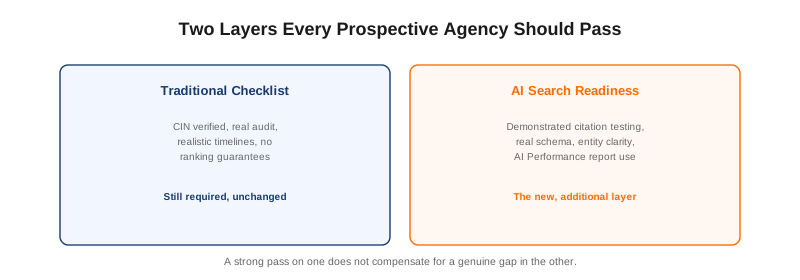
Before adding anything new, the fundamentals from any reputable hiring guide remain non-negotiable. Confirm the agency is a genuinely registered company with a verifiable CIN checkable on the MCA21 portal. Ask who specifically manages accounts and how long they have worked in SEO, not just how large the team is. Insist on a written technical audit specific to your actual website before discussing pricing, since an audit that could apply to any business was not built for yours. Demand realistic timelines, competitive terms take months, not weeks, and treat any guaranteed ranking position as an immediate red flag. Require that you retain owner-level access to your own Search Console, GA4, and Google Business Profile rather than an agency that locks these under its own login.
None of this has changed. What has changed is that this checklist alone no longer tells you whether an agency understands where search is actually heading, and a growing number of business owners are discovering this gap only after signing a year-long contract with an agency still optimising exclusively for a search results page that increasingly shares space with, or gets bypassed entirely by, an AI-generated summary.
Why AI Search Readiness Belongs on This List Now
Google’s AI Overview now appears on a substantial share of searches, and separate surfaces, AI Mode, ChatGPT, Perplexity, are increasingly handling the kind of comparison and research queries that used to land directly on a traditional search results page. An agency still operating purely on traditional keyword-and-backlink logic is optimising for a shrinking part of the picture. This is not a fringe consideration. It is quickly becoming as fundamental as mobile optimisation was a decade ago, and most agencies, including many with otherwise solid traditional track records, have not caught up.
The AI Search Readiness Questions Most Agencies Cannot Answer
Ask a prospective agency these questions directly, and pay close attention to whether the answers sound rehearsed or genuinely specific.
- Do you test whether our business currently gets cited in AI Overviews, ChatGPT, or Gemini for our key search terms? A genuinely capable agency should be able to run this test in front of you during the sales conversation, typing a real customer question into these tools and showing you whether your business, or a competitor, gets named.
- How do you implement structured data beyond a generic template? Article, FAQPage, and BreadcrumbList schema, correctly implemented and validated, give AI systems an unambiguous map of your content, not a generic schema plugin installed once and never revisited.
- How do you approach entity clarity across our website, Google Business Profile, and directory listings? AI systems weigh consistent, corroborated facts about a business more heavily than scattered or inconsistent ones.
- Can you show me a real client’s AI Performance report in Search Console? An agency actively using this data to inform strategy is operating with real evidence, not guesswork.
- Do you write content as a direct answer to the actual question, or as a preamble that gets to the point eventually? Content that states a clear answer within the first two or three sentences gets pulled into AI-generated summaries far more reliably.
A Direct Comparison Worth Making
| What to Check | Traditional-Only Agency | AI-Search-Ready Agency |
|---|---|---|
| Schema markup | Generic plugin, installed once | Article, FAQPage, BreadcrumbList, page-specific, validated |
| Content structure | Builds to a conclusion | States a direct answer in the opening sentences |
| Entity consistency | Rarely discussed | Actively audited across site, GBP, directories |
| Measurement | Rankings and traffic only | Adds AI Performance report and direct AI-platform testing |
| Opt-out awareness | May not know this is even a setting | Can explain Google’s confirmation that opting out carries no ranking penalty |
Why This Matters More Since the June 2026 Spam Update
Google’s June 2026 spam update and its ongoing AI Overview expansion both reward the same underlying signals this checklist is built around: genuine expertise, consistent entity information, and content that actually answers the question asked. Agencies still relying on generic, templated content across many clients are increasingly exposed by these updates, since scaled, low-effort content is precisely what recent spam policy enforcement targets. Ask any prospective agency, current or new, exactly how their process has adjusted for this shift.
How to Verify an Agency’s AI Readiness Claims, Not Just Take Them on Faith
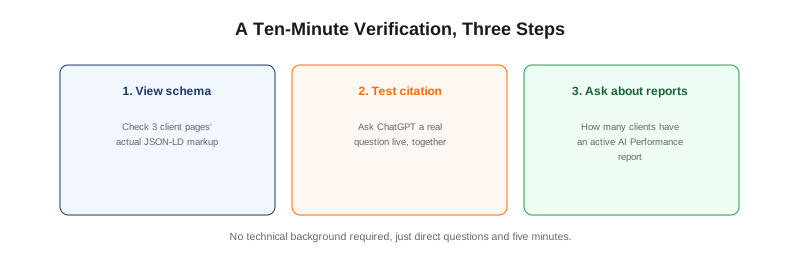
Any agency can claim AI search expertise in a sales conversation. Verifying it takes about ten minutes and requires no technical knowledge on your part. Ask to see the actual schema markup on three of their existing client websites, most browsers let you view page source directly, and look for genuine Article, FAQPage, and BreadcrumbList JSON-LD blocks rather than a single generic Organization schema repeated identically across unrelated clients. Ask for the name of one existing client and, with their permission, test whether that client’s business gets cited in ChatGPT or Google’s AI Mode for a relevant search, directly in front of the agency during your conversation.
Ask specifically how many of their current clients have an active AI Performance report in Search Console, and what that data has shown so far. A vague answer or a claim that the report "isn’t relevant yet" suggests the agency has not actually engaged with this measurement layer, regardless of how confidently they discussed AI search earlier in the conversation. None of this verification requires you to understand SEO technically. It requires five minutes and a willingness to ask a direct question rather than accept a confident-sounding answer at face value.
Red Flags That Apply Specifically to AI Search Claims
- Claims of "AI SEO" or "GEO expertise" with no ability to demonstrate an actual citation test on the spot
- Schema markup described only as "we add schema" with no specifics on which types or why
- No awareness that opting out of AI Overviews is even a real, documented setting in Search Console
- Content samples that read as generic and template-like rather than direct, specific answers
- Inability to explain the difference between traditional Search Console Performance data and the newer AI Performance report
Why This Verification Actually Matters for Your Bottom Line
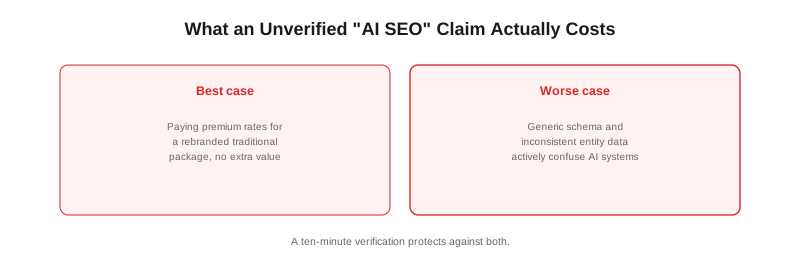
An agency claiming AI search expertise without genuine capability is not a harmless exaggeration. Businesses paying premium rates for "AI SEO" services that amount to no more than a rebranded traditional package are spending real money on a claim that will not deliver the additional visibility they are paying for. Worse, an agency that genuinely does not understand entity clarity or structured data may implement changes that actively confuse AI systems evaluating your business, generic schema applied without genuine connection to your actual services, inconsistent entity information introduced across your website and directories, doing measurable harm rather than simply failing to help.
This is precisely why the verification steps in this guide matter beyond simple due diligence. A ten-minute conversation, testing whether an agency can actually demonstrate AI citation for a real client, checking their schema implementation directly, protects you from a genuinely costly category of underperformance that a purely traditional evaluation would miss entirely.
What Genuine AI Search Expertise Actually Looks Like in Practice
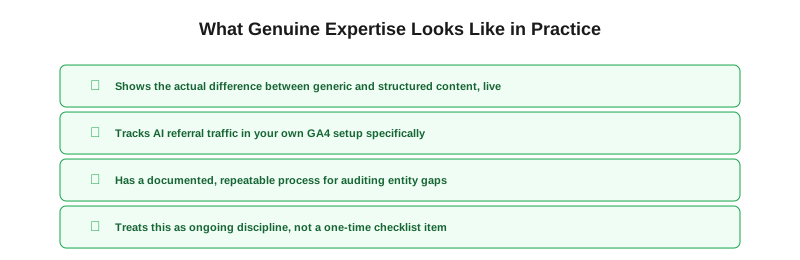
Beyond the specific questions already covered, a genuinely capable agency demonstrates its expertise through specific, observable habits rather than marketing language alone. It should be able to show you, in real time, the difference between how a generic business description reads to an AI system versus a specifically structured one, using an actual example rather than an abstract explanation. It should track AI referral traffic in your own GA4 setup specifically, not just mention that this is theoretically possible. It should have a documented, repeatable process for auditing entity gaps, similar to the structured audit process covered in our piece on finding and fixing entity gaps, rather than treating AI search readiness as a one-time checklist item completed once and never revisited.
The Difference Between Claiming and Demonstrating
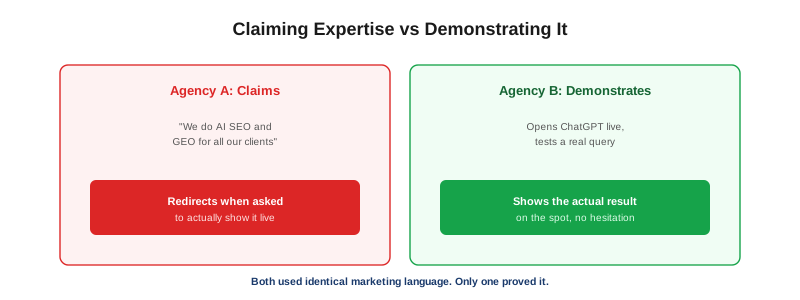
Any agency can claim familiarity with GEO, AEO, or AI search optimisation in a sales conversation, since these terms have become common marketing language across the industry regardless of genuine underlying capability. The distinction that actually matters is between an agency that claims this expertise and one that can demonstrate it directly, in front of you, using your specific business or a real, named client as the example. Ask for this demonstration explicitly rather than accepting a confident verbal description, since the gap between marketing language and genuine capability in this specific area has grown wide enough that the claim alone tells you very little.
An Illustrative Example of the Gap in Action
Consider a hypothetical case reflecting a pattern increasingly common across Bangalore’s agency market: two agencies pitching a similar service business, both mentioning "AI SEO" and "GEO expertise" prominently in their sales materials. The first agency, when asked directly to test whether the prospective client’s business currently appears in ChatGPT or Google’s AI Mode for a relevant search, opens the tool and demonstrates the result live, showing exactly what currently appears and why. The second agency responds that this "isn’t really how it works" or redirects to a general explanation of AI trends without ever actually running the test.
Both agencies used identical marketing language. Only one demonstrated genuine, verifiable capability when asked directly. This gap, between claiming and demonstrating, is precisely what the questions in this guide are designed to surface, and it is a distinction a business owner can identify within minutes of asking, without needing any technical background themselves.
How This Fits Alongside Traditional Evaluation Criteria
None of this AI-specific evaluation replaces the traditional hiring checklist covered in how to choose an SEO company in India. It sits alongside that checklist as an additional, increasingly necessary layer. A prospective agency should pass both evaluations, traditional fundamentals and genuine AI search readiness, since a strong performance on one does not compensate for a genuine gap in the other.
Frequently Asked Questions
Should my Bangalore business optimise specifically for ChatGPT now?
Not instead of the broader AI-search fundamentals already in place. The study's own authors recommend prioritising Google's AI surfaces first, then treating ChatGPT as the leading standalone alternative. The same entity clarity and structured data work serves both.
Can a smaller or newer agency still be AI-search-ready?
Yes. This is about genuine understanding and process, not agency size or years in business. A smaller agency that can demonstrate real AI citation testing and proper schema implementation is more AI-search-ready than a large, established agency that has not adapted.
Will asking these questions slow down my hiring process?
Only briefly, and it is worth it. A capable agency can answer these questions clearly within the same conversation as the traditional checklist. An agency that struggles or deflects has told you something important before you have signed anything.
Does OneCity actually follow this checklist itself?
Yes, and we would rather you ask us these exact questions directly than take that claim on faith. Our own SEO company in Bangalore page and GEO and AEO services page both reflect this approach in practice, not just in description.
Should I still check pricing and contract terms if the agency passes the AI readiness questions?
Yes, absolutely. AI search readiness is an addition to the traditional checklist, not a replacement for it. Pricing realism, contract terms, and account access all still matter exactly as much as before.
Does a genuinely strong traditional agency automatically have AI search expertise too?
Not automatically, though the two often correlate since a genuinely diligent, technically capable agency tends to keep pace with search developments generally. Never assume this correlation holds without verification, since the specific skills involved, entity clarity, structured data, AI citation testing, are distinct enough from traditional keyword and backlink work that a strong agency in one area can genuinely lag in the other.
How do I know if an agency's schema implementation is genuinely good, not just present?
Ask them to show you the actual JSON-LD markup on a real client page and explain what each block accomplishes specifically, entity connections, credential documentation, FAQ structure. A genuinely capable agency explains this confidently and specifically. One relying on a generic plugin installation struggles to explain much beyond "we added schema."
Is it reasonable to ask an agency to demonstrate AI citation testing during a sales call?
Yes, entirely reasonable. This takes only a few minutes and directly tests a specific, verifiable claim rather than accepting a general assurance. Any agency genuinely confident in this capability should have no hesitation demonstrating it live.
Related Reading
SEO Company in Bangalore
Our flagship Bangalore SEO service, built around the standards covered in this guide.
SEO Agency in Bangalore
ROI-focused SEO for Bangalore businesses across industries.
GEO & AEO Services
How we prepare content to be cited in AI Overviews, ChatGPT, and voice search.
How to Choose an SEO Company in India
The full traditional hiring checklist this guide builds on.
How Bangalore Businesses Can Get Found by AI Search
The mechanics behind AI citation, explained in depth.
Our Story
How OneCity started in 2006 and what changed along the way.
SEO Company in Bangalore
Our flagship Bangalore SEO service, built around the standards covered in this guide.
SEO Agency in Bangalore
ROI-focused SEO for Bangalore businesses across industries.
GEO & AEO Services
How we prepare content to be cited in AI Overviews, ChatGPT, and voice search.
How to Choose an SEO Company in India
The full traditional hiring checklist this guide builds on.
How Bangalore Businesses Can Get Found by AI Search
The mechanics behind AI citation, explained in depth.
Our Story
How OneCity started in 2006 and what changed along the way.
OneCity Technologies Pvt Ltd (CIN: U72100KA2009PTC048911, incorporated 2009) has run SEO campaigns since 2006. Every claim in this guide reflects what we tell our own prospective clients, whether or not they choose to work with us. Written by L.K. Monu Borkala, Founder & CEO. Verify our registration at the MCA21 portal. | Updated:
Want to See How This Checklist Applies to Your Business?
Ask us these exact questions. We would rather earn your business by answering them directly than by a sales pitch.
Rajajinagar, Bengaluru · Kankanady, Mangaluru · Kuvempu Nagara, Mysuru