How Much Should a Small Business Actually Budget for Digital Marketing?
Updated: 2 September 2026
Generic percentage rules rarely match your actual situation. Here is a more useful way to think about what your business specifically should spend.
Reviewed against the June 2026 Spam Update, March 2026 Spam Update, December 2025 Core Update
The common advice to "spend 5 to 10 percent of revenue on marketing" is not wrong, but it is not particularly useful either, since it ignores your specific customer value, competitive intensity, and growth stage. A more useful starting point is working backward from what a new customer is actually worth to your business, not forward from an arbitrary revenue percentage.
Start With Customer Value, Not Revenue Percentage
Calculate what a single new customer is worth to your business over a reasonable period, not just their first purchase. A business where a typical customer generates significant repeat revenue over a year can justify a meaningfully higher acquisition cost than a business built on one-time transactions. This number, not a generic revenue percentage, should anchor your actual budget decision.
- Calculate genuine customer lifetime value, not just first-purchase revenue
- Identify your realistic acquisition cost ceiling based on that value
- Separate budget for testing and validation from budget for scaled, proven channels
- Account for your specific competitive intensity, a crowded Bangalore category costs more to compete in than a niche one
A More Useful Framework Than a Flat Percentage
For an early-stage or newer business still validating what works, allocate a smaller, defined testing budget, enough to gather real data across a few months without betting the business on unproven channels. For an established business with known customer value and a track record, a larger, more confident budget aligned to actual acquisition economics makes more sense than an arbitrary percentage.
A Direct Comparison
| Business Stage | Reasonable Budget Approach |
|---|---|
| Early-stage, unproven channels | Small, defined testing budget across 2-3 months, enough for real data |
| Established, known customer value | Budget aligned directly to acquisition cost ceiling from customer value |
| Highly competitive category | Higher budget needed just to achieve baseline visibility |
| Niche, lower-competition category | Meaningful results achievable at lower spend |
Why SEO Budget Specifically Deserves Patience
Unlike paid ads, where budget effectiveness is visible within days, SEO investment typically needs three to six months before genuine trend data is available, particularly following Google's ongoing spam and core update activity through 2026, which rewards sustained quality over quick spending bursts. Budgeting for SEO in month-long increments and judging results too early is one of the most common, avoidable mistakes.
What a Realistic Bangalore Budget Range Looks Like
Real pricing benchmarks matter more than a percentage rule once you are ready to actually commit budget. Our own SEO pricing guide for Bangalore covers realistic monthly ranges based on competition and scope, which is a more useful anchor than an abstract percentage once you know roughly what you can afford to spend monthly.
- A budget recommendation with no reference to your actual customer value or acquisition economics
- Pressure to commit a large budget before any real testing or validation
- No distinction between testing-phase spend and scaled, proven-channel spend
- A flat percentage rule applied with no discussion of your specific competitive category
A Simple Worked Example
Consider a hypothetical Bangalore service business where a typical customer generates roughly ₹40,000 in revenue over a year of repeat business. If that business can reasonably afford to spend up to 20 percent of that value acquiring each new customer, roughly ₹8,000 per acquisition becomes a realistic ceiling to work backward from, rather than an arbitrary monthly marketing figure disconnected from what customers are actually worth. A different business where a typical customer generates only ₹5,000 once, with no repeat revenue, needs a very different acquisition cost ceiling, even if both businesses are the same size by revenue.
This is precisely why two businesses of similar size can reasonably have very different marketing budgets, and why comparing your budget directly to a competitor's without knowing their actual customer economics rarely produces a useful benchmark.
How to Actually Calculate Your Own Customer Value
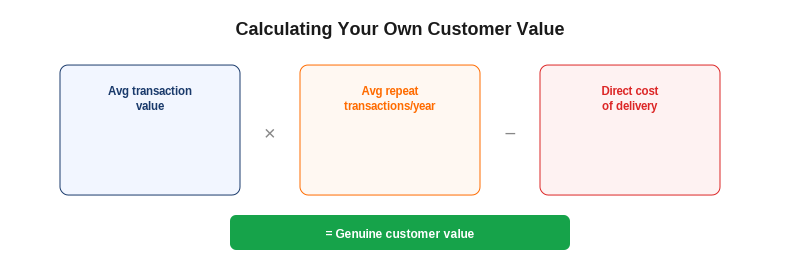
Calculating genuine customer lifetime value does not require sophisticated tools. Start with your average transaction value, then multiply by the average number of repeat transactions a typical customer makes over a reasonable period, a year for most service businesses, longer for categories with extended relationships. Subtract your direct cost of delivering the service to arrive at a genuine profit-based customer value, since revenue alone overstates what you can actually afford to spend acquiring that customer.
A business with no existing repeat-customer data can still estimate this reasonably by asking a handful of long-standing customers directly how often they have used the service and roughly how much they have spent overall, building a rough but grounded estimate rather than guessing blindly or defaulting to an industry-average figure that may not reflect your specific business at all.
Why Industry Benchmark Percentages Mislead More Than They Help
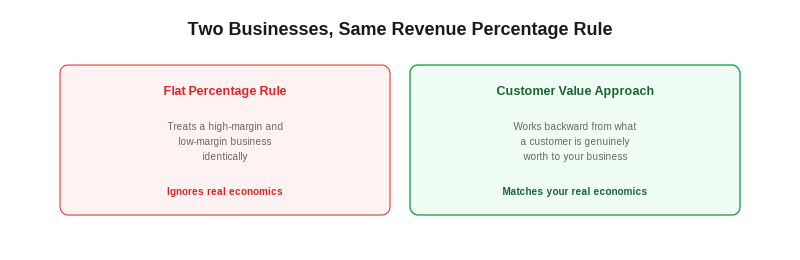
Generic advice citing "spend X percent of revenue on marketing" implicitly assumes every business in a given revenue bracket has comparable customer value, competitive intensity, and growth stage, an assumption that rarely holds in practice. A high-margin professional services business and a low-margin retail business at identical revenue levels have fundamentally different capacities to spend on acquisition, yet a flat percentage rule treats them identically. This is precisely why working backward from genuine customer value, rather than forward from a generic percentage, produces a far more useful and specific budget figure for your actual business.
Budgeting for Testing Versus Budgeting for Scale
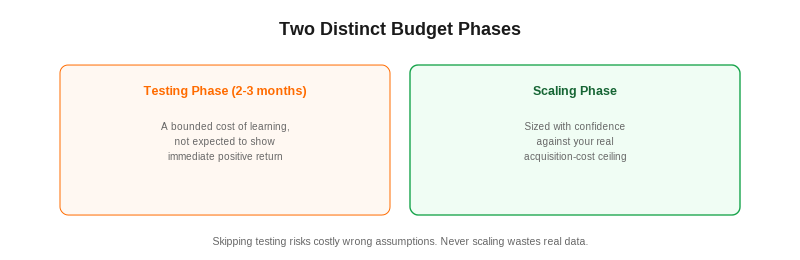
A newer business or one entering a new channel should think about its budget in two distinct phases rather than a single ongoing figure. The testing phase, typically two to three months, exists specifically to gather real data on what actually converts, and should be sized as an acceptable, bounded cost of learning rather than an investment expected to show immediate positive return. The scaling phase, once genuine data confirms what works, can be sized with real confidence against the acquisition-cost ceiling calculated from actual customer value, since by this point the guesswork has been replaced with real evidence.
Businesses that skip the testing phase and commit immediately to a large, confident budget based on assumption alone risk discovering, expensively, that their assumptions about channel performance or customer value were wrong. Businesses that never move past the testing phase, treating every month as a small, tentative experiment indefinitely, risk under-investing relative to what the data already justifies.
How This Interacts With the SEO-Versus-Paid-Ads Decision
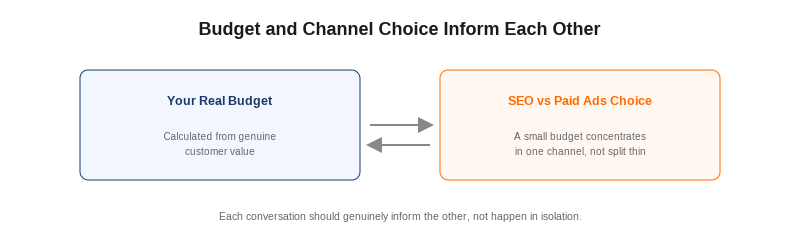
The budget framework in this guide connects directly to the SEO versus paid ads decision covered elsewhere in this content series. A business with a modest total budget benefits from concentrating it deliberately in one channel matching its actual timeline and validation needs, rather than splitting a small figure thinly across both channels, where neither receives enough investment to test or perform. Once a clearer picture of genuine customer value and channel performance emerges, the budget conversation and the channel-priority conversation should be revisited together, since each informs the other.
A Second Worked Example: Two Businesses, Same Revenue, Different Budgets
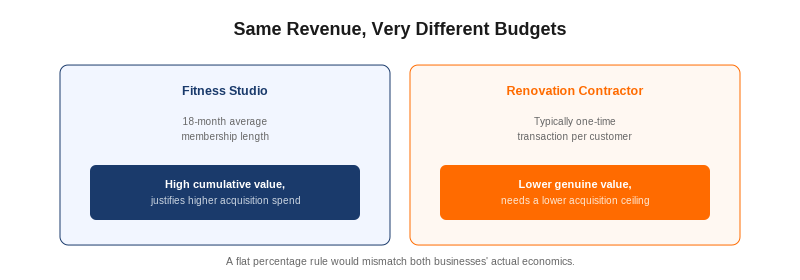
Consider two hypothetical Bangalore businesses at identical annual revenue, a subscription-based fitness studio and a one-time home renovation contractor. The fitness studio's customers generate revenue monthly over an average membership length of eighteen months, producing a high cumulative customer value that justifies a correspondingly higher acquisition spend per new member. The renovation contractor's customers typically transact once, occasionally referring friends but rarely returning as repeat customers themselves, producing a much lower genuine customer value per acquisition despite potentially larger individual transaction sizes.
Applying the same generic revenue percentage to both businesses would produce a marketing budget mismatched to each business's actual economics, likely too conservative for the fitness studio given its real long-term customer value, and potentially too aggressive for the contractor relative to what a single transaction can support. Calculating each business's actual customer value first, then working backward to an appropriate acquisition budget, avoids this mismatch entirely.
What Genuinely Stays the Same
Regardless of your specific budget size, the same discipline applies: know your customer value, test before scaling, and choose between SEO and paid ads based on your actual timeline and runway rather than a generic rule. A genuine SEO company in Bangalore should help you think through this framework specifically, not just quote a number disconnected from your actual business economics.
Frequently Asked Questions
Is the 5-10% of revenue rule completely wrong?
Not wrong, but incomplete. It can work as a rough sanity check once you already know your customer value and acquisition economics, but used as the sole basis for a budget decision, it ignores your specific competitive intensity and business stage.
How much should I budget just to test whether digital marketing works for my business?
Enough to gather genuine data across two to three months without betting the business on unproven channels, typically a modest, clearly defined amount you are comfortable treating as a real investment in learning rather than guaranteed return.
Does a highly competitive Bangalore category always mean a higher budget is required?
Generally yes for baseline visibility, though a highly specific, well-differentiated strategy can sometimes achieve meaningful results at a lower spend than a generic approach would need in the same competitive category.
Should my SEO and paid ads budgets be evaluated on the same timeline?
No. Paid ads show effectiveness within days to weeks. SEO typically needs three to six months before genuine trend data is available. Judging SEO spend on a paid-ads timeline is a common, avoidable mistake.
What is the biggest budgeting mistake small businesses make?
Setting a budget based on a generic percentage or competitor benchmark without first calculating their own actual customer value, then judging results against an unrealistic timeline that does not match the channel actually being funded.
How do I calculate customer value if I have no existing repeat-customer data?
Ask a handful of long-standing customers directly how often they use your service and roughly how much they have spent overall, building a rough but grounded estimate rather than guessing blindly or relying on an industry average that may not reflect your specific business.
Should my testing-phase budget and scaling-phase budget be sized differently?
Yes, distinctly. The testing phase should be sized as an acceptable, bounded cost of learning over two to three months, while the scaling phase, once real data confirms what works, can be sized with genuine confidence against your calculated acquisition-cost ceiling.
How does my budget decision connect to choosing between SEO and paid ads?
Directly. A modest total budget benefits from concentrating deliberately in one channel matching your actual timeline and validation needs, rather than splitting a small figure thinly across both, where neither receives enough investment to perform or be properly tested.
Related Reading
SEO Company in Bangalore
Our flagship Bangalore SEO service.
SEO Agency in Bangalore
ROI-focused SEO for Bangalore businesses across industries.
SEO Pricing in Bangalore
Real pricing benchmarks once you are ready to commit budget.
SEO vs Paid Ads: Which Should You Invest In First
The channel decision this budget guide builds on.
How to Choose an SEO Company in India
The full hiring checklist once your budget is set.
Our Story
How OneCity started in 2006 and what changed along the way.
OneCity Technologies Pvt Ltd (CIN: U72100KA2009PTC048911, incorporated 2009) has run SEO and digital marketing campaigns since 2006. Every recommendation in this guide reflects how we advise our own clients. Written by L.K. Monu Borkala, Founder & CEO. Verify our registration at the MCA21 portal. | Updated:
Want Help Working Out Your Actual Number?
Tell us your customer value and goals honestly, and we will help you calculate a realistic budget, not just quote a percentage.
Rajajinagar, Bengaluru · Kankanady, Mangaluru · Kuvempu Nagara, Mysuru