SEO vs Paid Ads: Which Should You Invest In First?
Updated: 2 September 2026
Most businesses cannot afford both at full scale from day one. Here is how to actually decide which to prioritize based on your specific situation, not a generic rule.
Reviewed against the June 2026 Spam Update, March 2026 Spam Update, December 2025 Core Update
The honest answer to "SEO or paid ads first" depends on how quickly your business needs revenue, how much runway you have, and how competitive your specific market is, not a universal rule either channel deserves by default. Both channels work. The question is which one matches your actual situation right now.
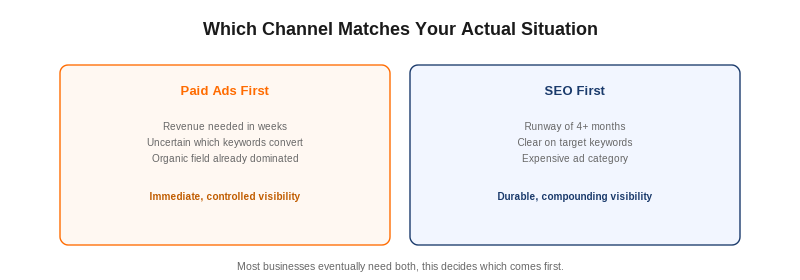
When Paid Ads Should Come First
If your business needs revenue within weeks, not months, paid ads make more sense as the immediate priority. A new business, a seasonal push, or a cash-flow-sensitive situation cannot wait the four to eight months competitive SEO terms typically take to show meaningful movement. Paid ads deliver visibility the moment a campaign goes live, at a cost you control directly through budget.
Paid ads also make sense when testing which keywords and messaging actually convert before committing to a longer-term SEO content strategy built around the wrong terms. Running a small ad budget to validate real search intent and conversion rates before investing months into SEO content for the same terms is a efficient use of both channels together.
- Your business needs revenue within weeks, not months
- You want to validate which keywords actually convert before committing to SEO content
- You are entering a new market or launching a new offering with no existing search visibility
- Your competitors already dominate organic results for your key terms and building competing content will take a long time
When SEO Should Come First
If your business has a longer runway and existing traffic or reputation to build on, SEO's compounding nature makes it the stronger long-term investment. Unlike paid ads, where visibility stops the moment spending stops, SEO work continues generating traffic long after the initial investment, provided the underlying content and technical foundation remains sound.
SEO also makes more sense first for businesses in categories where paid ad costs are already extremely high due to competition, since a strong organic position provides a genuine, durable alternative to escalating cost-per-click in an expensive category.
A Direct Comparison
| Factor | Favors Paid Ads First | Favors SEO First |
|---|---|---|
| Timeline need | Revenue needed within weeks | Runway of 4+ months available |
| Cost structure | Willing to pay per click ongoing | Wants durable, compounding visibility |
| Market validation | Uncertain which terms convert | Clear on target keywords already |
| Competitive field | Organic field extremely dominated already | Genuine opportunity to build real content advantage |
| Budget size | Small, needs immediate measurable return | Can sustain months of investment before full payoff |
Why This Decision Matters More Since Recent Algorithm Updates
Google's spam update activity through 2026 has made low-effort, quickly-built SEO content riskier than it once was. A business choosing SEO first needs to commit to genuine, sustained quality rather than a quick content push, which reinforces why the timeline and runway question matters so much in this decision.
The Honest Answer: Most Businesses Need Both, Eventually
Very few successful businesses run on only one channel indefinitely. Paid ads provide the immediate visibility and keyword validation that informs a stronger SEO content strategy later. SEO provides the durable, compounding visibility that reduces long-term dependence on ad spend. The real strategic question is not which channel to choose permanently, but which to prioritize first given your specific runway, and when to bring the second channel in as the first matures.
- An agency insisting you must choose one channel exclusively and permanently
- No plan to eventually build the channel you are not starting with
- Paid ad strategy with no data being fed back into content or keyword decisions
- SEO strategy ignoring converting keywords already identified through ad testing
How to Actually Measure Which Channel Is Working
Track cost per genuine enquiry, not just cost per click, for paid ads, and track branded search growth alongside position and traffic trends for SEO. A paid campaign generating clicks but few real enquiries needs adjustment regardless of how the SEO decision plays out. An SEO investment showing position improvement but no corresponding enquiry growth after a reasonable period deserves the same scrutiny. Neither channel should be evaluated purely on its own generic industry benchmark; your specific enquiry-to-visibility ratio, tracked consistently over time, tells you more than any external average.
A Worked Example of the Decision in Practice
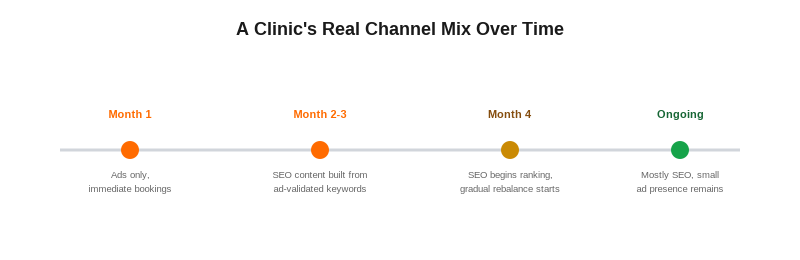
Consider a hypothetical case reflecting a common pattern: a newly opened Bangalore clinic with six months of cash runway and no existing patient base needs visibility within weeks, not months, making paid ads the clear initial priority. A modest, targeted ad budget generates appointment bookings immediately while the clinic simultaneously begins building genuine SEO content addressing real patient questions, informed directly by which specific search terms the ad campaigns show converting best. By month four, the SEO content begins ranking for lower-competition terms, and the clinic gradually shifts budget weight from ads toward content and technical SEO investment as organic visibility compounds, while maintaining a smaller ongoing ad presence for the highest-intent, most competitive terms that organic alone may never fully capture.
This is not a rigid formula every business must follow identically. It illustrates the underlying principle: start with the channel matching your actual runway and validation needs, then evolve the mix deliberately as real data accumulates, rather than committing permanently to whichever channel felt right on day one.
Why This Decision Should Be Revisited, Not Made Once and Forgotten
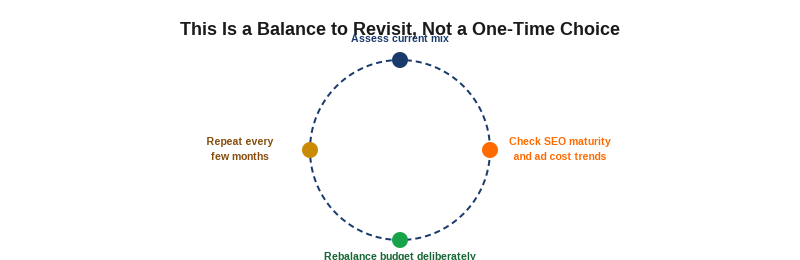
A business's optimal SEO-to-paid-ads balance is not static. A business that started paid-ads-first due to genuine early cash-flow urgency should reassess this balance every few months as SEO content matures and organic visibility grows, since continuing to run the same ad spend indefinitely once organic traffic for the same terms has become strong represents a real, avoidable inefficiency. Conversely, a business that started SEO-first because it had genuine runway should reconsider adding paid ads if a specific, high-value opportunity emerges requiring faster visibility than organic alone can currently provide, a competitor entering the market aggressively, a time-sensitive business opportunity.
Treating this as a one-time decision made at the start of a marketing relationship, rather than an ongoing balance revisited as circumstances change, is one of the more common ways businesses either overspend on ads longer than necessary or underinvest in ads during a genuine short-term need.
How Recent Search Changes Affect This Decision Specifically
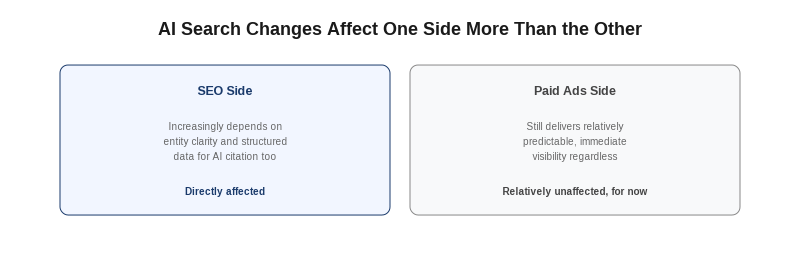
The AI-driven changes covered throughout this content series, AI Overviews reducing some traditional click-through opportunities, the rise of AI referral traffic through platforms like ChatGPT, affect the SEO side of this decision more directly than the paid ads side, at least for now. Paid ads still deliver relatively predictable, immediate visibility regardless of how AI features reshape organic search. SEO's payoff timeline and channel mix, however, increasingly depends on building genuine entity clarity and structured data that serves both traditional rankings and AI citation simultaneously, meaning the SEO investment side of this decision benefits from the AI-search-readiness discipline covered elsewhere in this content series specifically, not just traditional keyword-and-content planning alone.
How Category-Specific Ad Costs Shape This Decision
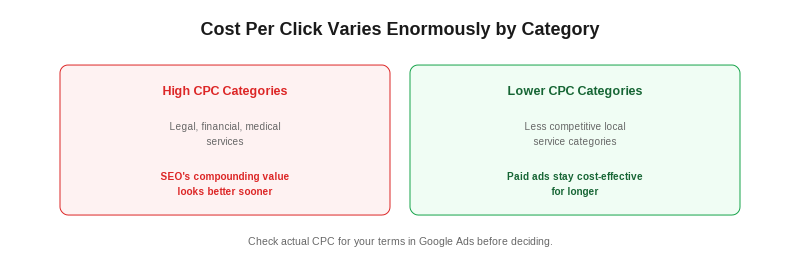
Cost per click varies enormously by category, and this variance directly affects which channel makes more financial sense as a starting point. A Bangalore business in a category with high paid ad competition, certain legal, financial, or medical services, faces a cost-per-click that can make even a modest ad budget stretch to only a handful of clicks daily, making SEO's slower but ultimately cheaper-per-click compounding visibility comparatively more attractive despite the longer timeline. A business in a less competitive ad category can often achieve meaningful, cost-effective visibility through paid ads alone for considerably longer before SEO's compounding advantage becomes the more economical path.
Checking actual cost-per-click estimates for your specific target terms, available directly within Google Ads' own keyword planning tools, before committing to either channel as the priority gives a informed starting point rather than a generic assumption that one channel is universally cheaper or faster than the other regardless of category.
What Genuinely Stays the Same
Regardless of which channel you prioritize first, the same SEO and SEM fundamentals apply: genuine keyword relevance, honest measurement, and a full local SEO foundation that supports both paid and organic visibility simultaneously rather than treating them as unrelated efforts.
Frequently Asked Questions
Can I run both SEO and paid ads at the same time with a limited budget?
Yes, though usually with one channel receiving the majority of the budget while the other runs at a smaller, testing scale. A common approach is a modest paid ad budget for immediate visibility and keyword validation alongside a longer-term SEO content investment.
How long before I should expect to shift budget from ads to SEO?
This depends heavily on your specific competitive field, but many businesses start seeing SEO investment pay off meaningfully within four to eight months for competitive terms, at which point gradually shifting budget toward SEO while maintaining a smaller ads presence often makes sense.
Is SEO always cheaper than paid ads in the long run?
Generally yes for durable, ongoing visibility, since paid ads stop generating traffic the moment spending stops while SEO content continues working after the initial investment. The upfront cost and timeline for each differs significantly, which is why the decision is not simply about long-term cost alone.
What if my competitors are already spending heavily on both channels?
A differentiated content and keyword strategy, rather than trying to outspend an already well-resourced competitor directly, is usually the more realistic path, particularly for SEO specifically, where a competitor's ad spend does not directly block your organic ranking opportunity.
Should this decision be made by my agency or by me as the business owner?
Both, ideally. An agency should recommend a strategy based on genuine understanding of your business's runway and goals, but the underlying business decision, how much revenue urgency you actually have, is information only you can provide accurately.
How often should I revisit this decision once I have made it?
Every few months at minimum, since the optimal balance shifts as SEO content matures, as paid ad costs in your category change, and as your own cash-flow situation evolves. Treating this as a one-time decision made at the start of an engagement misses genuine opportunities to rebalance.
Does the rise of AI Overviews and AI search change which channel I should prioritise?
It affects the SEO side more directly, since organic visibility increasingly depends on the same entity clarity and structured data work that also serves AI citation. Paid ads remain relatively unaffected by this specific shift, delivering predictable visibility regardless of how AI features reshape organic search.
Can paid ads data inform a better SEO strategy?
Yes, directly. Which keywords and messaging actually convert in a paid campaign gives concrete, real evidence for prioritising SEO content investment around those same terms, rather than guessing at keyword strategy without this validation.
Related Reading
SEO Company in Bangalore
Our flagship Bangalore SEO service.
SEO Agency in Bangalore
ROI-focused SEO for Bangalore businesses across industries.
SEO Pricing in Bangalore
What agencies actually charge, useful context for budget planning.
SEO and SEM Services
Our combined approach to both channels together.
How to Choose an SEO Company in India
The full hiring checklist once you decide SEO is a priority.
Our Story
How OneCity started in 2006 and what changed along the way.
OneCity Technologies Pvt Ltd (CIN: U72100KA2009PTC048911, incorporated 2009) has run SEO and digital marketing campaigns since 2006. Every recommendation in this guide reflects how we advise our own clients. Written by L.K. Monu Borkala, Founder & CEO. Verify our registration at the MCA21 portal. | Updated:
Not Sure Which Channel Fits Your Situation?
Tell us your timeline and budget honestly, and we will recommend a starting point, not just sell you both channels at once.
Rajajinagar, Bengaluru · Kankanady, Mangaluru · Kuvempu Nagara, Mysuru