Flutter App Development Company in Bangalore
OneCity Technologies builds Flutter apps in Bangalore that run on Android and iOS from one codebase. A business app with login and an admin panel takes 10 to 14 weeks and costs Rs 1,00,000 to Rs 2,50,000. This page covers each step of our process, the cost tiers, and what Google Play and the App Store require in 2026.
Is Flutter the Right Choice for Your App?
Flutter is Google's open-source toolkit for building apps in the Dart language. It draws its own interface instead of using each phone's built-in controls, and release builds compile ahead of time to native code. The result is one team, one set of fixes, and screens that look the same on Android and iOS. Google Pay, BMW and Alibaba all appear in Flutter's own showcase.
Flutter is not the answer for every project. This is how we advise clients in the first call:
| Your situation | Best fit | Why |
|---|---|---|
| Business app for Android and iOS with standard screens: bookings, orders, forms, dashboards | Flutter | One codebase covers both stores, so you pay for one build team and one round of bug fixes. |
| Your in-house team already writes JavaScript and React | React Native can suit | Easier to staff from your own people. We compare both in discovery before you commit. |
| Heavy hardware use: augmented reality, advanced camera processing, Bluetooth peripherals | Native, or Flutter after a test | Many Flutter plugins exist for these, but we build a small proof of the exact feature before quoting. |
| Catalogue or content that works well in a browser | Website or PWA | No store approval and no install. See our website development services. |
Our 8-Step Flutter Development Process
The durations below describe a business app with login, a backend and an admin panel, which fits the 10 to 14 week range. Simple apps compress steps 2 to 5. Larger apps stretch them. Each step ends with something you can open, test or approve.
Step 1. Discovery and scope
We list your users, the one job the app must do well, and every feature you want. We then split the list into version 1 and later versions. You get a feature list, a screen count, a timeline and a written quote.
You provide: your business goal, two or three apps you admire, and any existing data or APIs.
Step 2. User flows and wireframes
We map how a person moves through the app: sign-up, the main task, payment, support. Wireframes show every core screen plus the empty, error and offline versions that most quotes skip. These cause the most rework when added late.
You receive: clickable wireframes you can tap through on your own phone.
Step 3. UI design in Figma
Full-colour screens in your brand colours, with Android and iPhone variants where each platform expects different behaviour. We test text length in Kannada and Hindi as well as English, because translated labels often break layouts built for English.
You do: approve every screen before any code is written.
Step 4. Backend and admin panel
We build the API, user login, payments and the admin panel your team uses to manage content, orders and users. We have used Laravel with a Filament admin panel and Supabase on our own apps, and we pick between them in discovery.
You receive: a working admin panel on a staging server from the first sprints.
Step 5. Flutter build in two-week sprints
The app is built screen by screen. Every two weeks you get an installable test build: an APK for Android and a TestFlight invitation for iPhone. You tap through real features instead of reading status reports.
You do: review each sprint build and send one consolidated list of changes.
Step 6. Testing on real devices
We test on physical phones, including low-end Android devices, on slow mobile data, with permissions denied and with the screen rotated. We also check login, data storage and payment flows for security problems. Then you run acceptance testing against a checklist we prepare.
Step 7. Store release
We prepare the signed builds, store listing text, screenshots and privacy policy, and submit to Google Play and the App Store. The section below lists the 2026 rules that decide how long this takes.
Step 8. Launch support and maintenance
We release in stages, watch crash reports and store reviews, and fix what real users find. Annual maintenance contracts (AMC) start at Rs 5,000 per month and cover bug fixes, updates for new Android and iOS versions, and small changes.
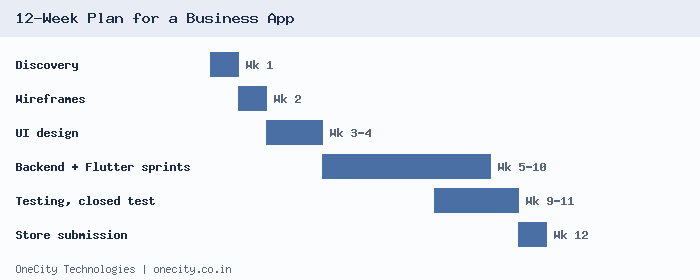
Example 12-week plan for a business app
| Weeks | Work | You approve |
|---|---|---|
| 1 | Discovery and scope | Feature list and quote |
| 2 | Flows and wireframes | Wireframes |
| 3 to 4 | UI design in Figma, backend set-up begins | Every screen |
| 5 to 10 | Flutter sprints and backend, one test build every two weeks | Each sprint build |
| 11 | Device testing and fixes | Acceptance checklist |
| 12 | Store submission and staged release | Go-live |
Flutter App Cost in Bangalore
These ranges match our mobile app development page and cover Android and iOS built from one Flutter codebase.
| App type | What is included | Timeline | Cost |
|---|---|---|---|
| Informational | 5 to 8 screens, content, contact form, no backend | 5 to 7 weeks | Rs 50,000 to Rs 80,000 |
| Business app | Login, backend, admin panel, push notifications | 10 to 14 weeks | Rs 1,00,000 to Rs 2,50,000 |
| E-commerce | Catalogue, cart, Razorpay payments, orders, admin panel | 14 to 18 weeks | Rs 2,00,000 to Rs 5,00,000 |
| On-demand or delivery | Several apps and panels, maps, live tracking | 18 to 26 weeks | Rs 4,00,000 to Rs 8,00,000 |
| SaaS or enterprise | Roles, multiple tenants, third-party integrations | 24 to 36 weeks | Rs 6,00,000 to Rs 15,00,000+ |
Flutter Apps From Our Team, and Where Each One Stands
We list the status of every app so you can see what is live and what is still in build.
MasjidGo
A GPS-based masjid finder built for MCF Charitable Trust as a Sadaqah Jariyah project. Built features include a Qibla compass, 12 languages, dark mode, azan notifications and an Imam portal for managing more than one masjid. The backend runs on Supabase. The Google Play submission is in progress.
Success Tie
OneCity's own app for young people, built around daily character-building lessons. The first batch has 25 lessons. The backend allows a lesson to go live only after a human scholar has approved it, and the code enforces that rule. Version 1 keeps streaks on the phone and has no user accounts. Flutter app, Laravel 11 backend, Filament admin panel.
Cab service driver app (Bangalore client)
A Flutter driver app with 18 screens and a Laravel admin panel, on an 8 to 10 week schedule. Scope includes fare breakdown fields for extra kilometres, tolls, parking and driver bata, document expiry alerts, CSV report export and WhatsApp Business API messages.
Publishing Your Flutter App: What Google Play and the App Store Require in 2026
Store rules changed a lot in the last two years, and they decide how long step 7 takes. This is what applies today.
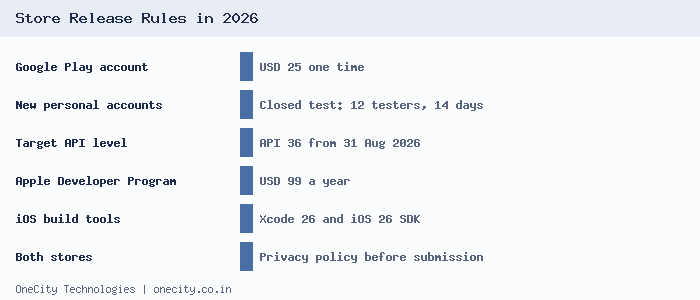
- Register the developer accounts in your business name. Google Play charges USD 25 once. The Apple Developer Program charges USD 99 a year. Keeping the accounts in your name means you own the listing, the reviews and the download history.
- Plan 14 days for the Google Play closed test. Personal accounts created after 13 November 2023 need a closed test with at least 12 testers opted in for 14 continuous days before production access. Google's help page has the exact conditions. Check which account type you hold before you plan the launch date.
- Target Android 16. From 31 August 2026, new apps and updates on Google Play must target API level 36, with an extension available to 1 November 2026. See the Android target API requirements.
- Build iOS with Xcode 26. Since 28 April 2026, App Store uploads need Xcode 26 or later with the iOS 26 SDK. Apple lists current deadlines on its upcoming requirements page.
- Publish a privacy policy and a data-deletion page. We built both for the MasjidGo store listing.
- Release in stages. Start with a small share of users, watch crash reports for a few days, then widen the rollout.
Handling User Data Under India's DPDP Rules
The Digital Personal Data Protection Rules, 2025 were notified on 13 November 2025. Published timelines put the main duties for businesses that collect personal data at 13 May 2027. If your app collects names, phone numbers, location or health details, we build a clear consent screen, collect only what each feature needs, and add a path for users to ask for deletion. This is a build guide, not legal advice. Have your own counsel confirm what applies to your business. For regulated sectors, see our healthcare software development work.
Industries We Build Flutter Apps For
- Healthcare. Appointment booking and patient portals, often paired with hospital management software.
- Transport and logistics. Driver apps, trip records, fare breakdowns and admin reporting.
- Education. Attendance, parent communication and learning apps.
- Retail and e-commerce. Catalogues, orders and Razorpay payments.
- Real estate. Property listings and lead capture linked to a custom CRM.
- Community and religious organisations. Facility finders, event updates and donation flows, as in MasjidGo.
What We Need From You to Start
- The business goal in one sentence, and who will use the app.
- Two or three apps you like, and what you like about each.
- Your logo, brand colours and any existing content.
- A must-have list for version 1, kept to the features that earn money or save time.
- One person with authority to approve designs and builds.
- Accounts in your business name for Google Play, Apple, your payment gateway and SMS provider.
Ready to scope your app? Send us your requirements or call 99023 30233, and we will reply with questions for the discovery call.
Frequently Asked Questions
How much does a Flutter app cost in Bangalore?
A simple informational app costs Rs 50,000 to Rs 80,000. A business app with login, backend and admin panel costs Rs 1,00,000 to Rs 2,50,000. E-commerce apps run Rs 2,00,000 to Rs 5,00,000, and on-demand apps Rs 4,00,000 to Rs 8,00,000. All prices cover Android and iOS from one codebase.
How long does it take to build a Flutter app?
An informational app takes 5 to 7 weeks. A business app with login and an admin panel takes 10 to 14 weeks. E-commerce apps take 14 to 18 weeks and on-demand apps 18 to 26 weeks. Add 14 days if your Google Play account needs the closed test.
Is Flutter good enough for a business app?
Yes, for most business apps. Release builds compile to native code, and companies such as Google Pay, BMW and Alibaba appear in Flutter's showcase. We still test on real low-end phones before launch, and we prototype unusual hardware features before quoting them.
Can you move our existing native app to Flutter?
Yes. We review the current app and its API documents, then rebuild the screens in Flutter while reusing your backend. Migration is quoted after that review, because the effort depends on how much logic sits inside the old app and how clean the API is.
Which backend do you use with Flutter?
We choose in discovery. Success Tie uses Laravel 11 with a Filament admin panel, and our cab driver app uses a Laravel admin panel. MasjidGo runs on Supabase. Laravel suits custom admin work, and Supabase suits apps that need quick authentication and a hosted database.
Will you publish the app on Google Play and the App Store?
Yes. We prepare signed builds, listing text, screenshots and the privacy policy, then submit. The accounts should be in your business name. A new personal Google Play account needs a 14-day closed test with 12 testers first, so we plan launch dates around it.
What happens after the app launches?
We release in stages and watch crash reports and store reviews. Annual maintenance contracts start at Rs 5,000 per month and cover bug fixes, updates for new Android and iOS versions, and small changes. Larger apps with a backend and several panels cost more to maintain.
Author: L.K. Monu Borkala, Founder, OneCity Technologies.