A simple mobile app in India costs Rs 50,000 to Rs 2 lakh. A medium app with login, backend and admin panel costs Rs 2 lakh to Rs 5 lakh. Complex apps with real-time features, payment gateways and third-party integrations start at Rs 5 lakh and go up to Rs 15 lakh or more depending on the feature set.
These are 2026 prices based on what agencies and freelancers in Bangalore, Hyderabad and Pune actually charge. This guide breaks down costs by app type, framework choice, team structure and the hidden expenses most quotes leave out.
Mobile App Development Cost by Complexity
The biggest factor in your app’s cost is how many features it needs. We group apps into four tiers based on what we see in client projects at our mobile app development practice in Bangalore.
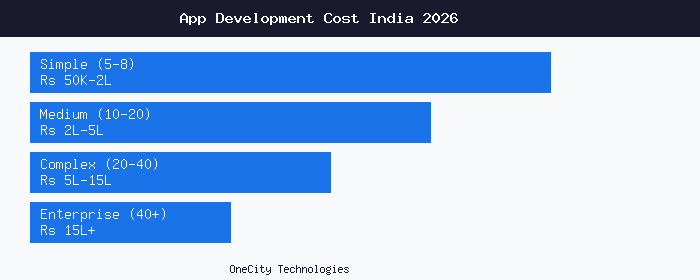
| App Type | Screens | Key Features | Timeline | Cost Range |
|---|---|---|---|---|
| Simple | 5 to 8 | Static content, contact form, basic navigation | 5 to 7 weeks | Rs 50,000 to Rs 2,00,000 |
| Medium | 10 to 20 | User login, REST API, admin panel, push notifications | 10 to 14 weeks | Rs 2,00,000 to Rs 5,00,000 |
| Complex | 20 to 40 | Real-time chat, payment gateway, maps, analytics dashboard | 14 to 20 weeks | Rs 5,00,000 to Rs 15,00,000 |
| Enterprise | 40+ | Multi-tenant, custom integrations, compliance, role-based access | 20 to 36 weeks | Rs 15,00,000+ |
These ranges cover both Android and iOS when built with a cross-platform framework like Flutter. If you build separate native apps for each platform, multiply the cost by 1.6 to 1.8 times, because you are paying two development teams working in parallel.
Framework Choice and Its Effect on Cost
The framework your developer uses changes both the initial build cost and long-term maintenance cost. Three options dominate the Indian market in 2026.
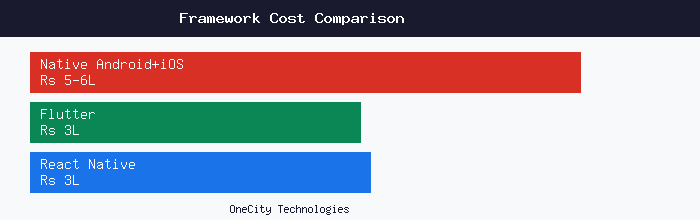
Native Android + iOS (Kotlin and Swift)
Building separate native apps gives you the best performance and full access to platform APIs. The trade-off is cost. You need two codebases, two teams and two rounds of testing. A medium-complexity app that costs Rs 3 lakh in Flutter costs Rs 5 lakh to Rs 6 lakh as separate native builds. Maintenance doubles too, because every bug fix and feature update happens twice.
Native makes sense for apps that need heavy device integration: camera processing, AR features, Bluetooth hardware control. For most business apps, it is overkill.
Flutter (Google)
Flutter compiles to native ARM code from a single Dart codebase. You get Android and iOS apps that look identical and perform within 5% of native speed for typical business logic. Our Flutter development team in Bangalore has shipped apps like MasjidGo (GPS-based mosque finder), TravelMax (cab service) and Success Tie (gamified character building), all from single codebases.
Flutter’s cost advantage: 40% to 50% lower than separate native builds. Development time drops by a similar margin because your team writes one set of code, runs one set of tests and maintains one repository.
React Native (Meta)
React Native uses JavaScript and maps to native components. It costs roughly the same as Flutter for most projects. The choice between them usually depends on your team’s existing skills. If your developers know JavaScript, React Native has a shorter learning curve. If you are starting fresh, Flutter’s tooling and documentation are more structured.
What Goes Into the Cost: A Line-by-Line Breakdown
When an agency quotes Rs 3 lakh for an app, that number covers several distinct work phases. Understanding each phase helps you compare quotes from different vendors.
1. Discovery and Requirements (5% to 8% of total)
Feature listing, user flow mapping, competitor analysis, technical architecture decisions. This phase produces the document your development team works from. Skipping it leads to scope changes mid-project, which increase cost by 20% to 40% on average.
2. UI/UX Design (10% to 15% of total)
Wireframes, high-fidelity mockups in Figma, interactive prototypes. A well-designed app converts better, but design costs scale with screen count. A 10-screen app needs Rs 30,000 to Rs 60,000 in design. A 30-screen app needs Rs 80,000 to Rs 1,50,000.
3. Frontend Development (25% to 35% of total)
Building the app screens, navigation, animations, local data handling. This is the Flutter or React Native work. Cost depends on screen complexity: a settings page takes 2 hours, a real-time map with driver tracking takes 40 hours.
4. Backend Development (20% to 30% of total)
API development, database design, user authentication, file storage, server configuration. We use Laravel with Filament admin panels. Firebase is an option for smaller apps that need real-time features without a custom backend. Backend cost drops significantly if you use a BaaS (Backend as a Service) like Firebase or Supabase, but custom backends give you more control.
5. Testing and QA (10% to 15% of total)
Device testing across Android versions 10 to 15, iOS 15 to 18, different screen sizes and network conditions. We test on 10+ physical Android devices and 3+ iPhones. Automated testing with integration tests adds cost but catches bugs before your users do.
6. Deployment (3% to 5% of total)
Google Play Store submission (one-time Rs 1,875 fee), Apple App Store submission (Rs 8,300 per year), app listing text, screenshots, privacy policy, compliance documentation. First-time submissions take longer because Apple’s review process requires specific privacy and data handling disclosures.
Hidden Costs Most Quotes Leave Out
The quoted price is rarely the final price. These are expenses that appear after the app launches.
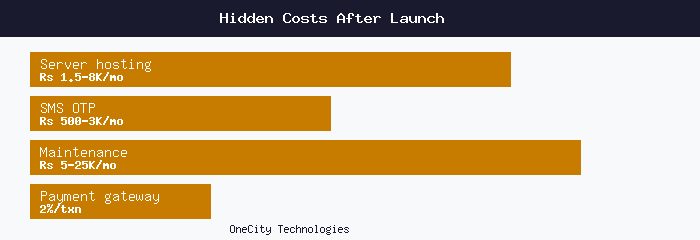
| Expense | Typical Monthly Cost | Notes |
|---|---|---|
| Server hosting (VPS) | Rs 1,500 to Rs 8,000 | Shared hosting works for small apps. VPS needed for 500+ daily users. |
| SSL certificate | Free to Rs 500 | Let’s Encrypt is free. Paid certificates needed for some payment integrations. |
| Push notification service | Free to Rs 2,000 | Firebase Cloud Messaging is free up to a limit. OneSignal charges after 10,000 subscribers. |
| SMS OTP verification | Rs 500 to Rs 3,000 | MSG91 and Twilio charge per SMS. Budget Rs 0.15 to Rs 0.25 per OTP. |
| Payment gateway | 2% per transaction | Razorpay and PayU charge per successful payment. No monthly fee for basic plans. |
| Map API usage | Rs 0 to Rs 5,000 | Google Maps gives $200 free credit monthly. Most small apps stay within free limits. |
| App maintenance (AMC) | Rs 5,000 to Rs 25,000 | Bug fixes, OS update compatibility, minor feature changes, crash monitoring. |
A medium-complexity app with 1,000 daily active users typically costs Rs 8,000 to Rs 15,000 per month in running expenses after launch. Factor this into your first-year budget.
Freelancer vs Agency: Which Costs Less?
Freelancers on platforms like Upwork and Fiverr quote Rs 500 to Rs 2,000 per hour. Bangalore agencies charge Rs 1,500 to Rs 5,000 per hour. The freelancer looks cheaper until you account for what each option actually delivers.
Rs 50K to Rs 3L
Single developer, limited testing, no design team, no post-launch support guarantee
Rs 1.5L to Rs 8L
Full team (designer + developer + tester + PM), structured process, AMC contracts, accountability
For a simple informational app or MVP prototype, a freelancer works. For anything that handles user data, payments or needs to scale, an agency provides the process and accountability you need. Freelancer projects also carry a risk: if the developer becomes unavailable mid-project, finding someone to take over uncommented, undocumented code is expensive.
At OneCity, we provide source code, Figma files and full documentation at project handover. You are never locked in. See our web and app development services for the complete process.
How to Reduce Your App Development Cost
Five strategies that work without cutting quality.
- Start with an MVP. Build 5 to 7 core features first. Launch, get user feedback, then add features in version 2. This approach costs 40% to 60% less than building everything at once and reduces the risk of building features nobody uses.
- Use Flutter instead of native. A single codebase for Android and iOS saves 40% to 50% on development cost and reduces maintenance to one team. Read our Flutter development guide for details.
- Choose a standard backend. Laravel, Node.js or Firebase cover 90% of business app needs. Custom backend frameworks cost more to build and more to maintain because fewer developers know them.
- Reuse open-source components. Authentication (Firebase Auth), maps (Google Maps), payments (Razorpay SDK), analytics (Firebase Analytics). Each reused component saves 20 to 40 hours of development time.
- Fix scope before development starts. The discovery phase costs Rs 10,000 to Rs 30,000 but prevents scope creep that adds Rs 50,000 to Rs 2,00,000 to the final bill.
Industry-Specific App Costs in India
Costs vary by industry because compliance, integrations and feature complexity differ.
| Industry | Typical App Type | Starting Cost | Key Cost Driver |
|---|---|---|---|
| Healthcare | Patient portal, telemedicine | Rs 4,00,000 | HIPAA compliance, video calling integration |
| E-commerce | Product catalogue, cart, checkout | Rs 3,00,000 | Payment gateway, inventory sync |
| Education | LMS, attendance, parent portal | Rs 2,50,000 | Video streaming, real-time notifications |
| Transport | Ride booking, driver app | Rs 5,00,000 | Real-time GPS tracking, route optimisation |
| Real estate | Property listing, virtual tours | Rs 3,50,000 | Map integration, media-heavy listings |
| Religious/community | Facility finder, event management | Rs 1,50,000 | GPS features, offline caching |
These are starting prices for Flutter-based cross-platform builds. Native Android + iOS builds add 60% to 80% on top.
What OneCity Charges for Mobile App Development
We quote a fixed price after a one-week discovery phase. Payment is milestone-based: 30% at project start, 40% at first working build, 30% at deployment. The price does not change unless you add features after development starts.
Our current rates for Flutter app development:
- Simple app (5 to 8 screens): Rs 50,000 to Rs 2,00,000. Timeline: 5 to 7 weeks.
- Medium app (10 to 20 screens): Rs 2,00,000 to Rs 5,00,000. Timeline: 10 to 14 weeks.
- Complex app (20+ screens): Rs 5,00,000 to Rs 15,00,000. Timeline: 14 to 20 weeks.
AMC starts at Rs 5,000 per month for simple apps and Rs 15,000 per month for complex apps. AMC covers bug fixes, OS update compatibility, minor feature additions and crash monitoring.
Contact our team with your app idea for a free estimate. We respond within 24 hours on working days.
Frequently Asked Questions
How much does a simple app cost in India?
A simple mobile app with 5 to 8 screens, basic navigation and a contact form costs Rs 50,000 to Rs 2,00,000 in India. This covers design, development, testing and Play Store submission. Using Flutter keeps the cost at the lower end because one codebase serves both Android and iOS.
Is Flutter cheaper than native app development?
Yes. Flutter costs 40% to 50% less than building separate native Android and iOS apps. You write one codebase instead of two, run one test suite and maintain one repository. A medium app costing Rs 3 lakh in Flutter would cost Rs 5 lakh to Rs 6 lakh as separate native builds.
What is the monthly cost of running a mobile app?
A medium-complexity app with 1,000 daily active users costs Rs 8,000 to Rs 15,000 per month. This includes server hosting (Rs 1,500 to Rs 8,000), third-party API fees, SMS OTP charges and maintenance. Firebase-based apps cost less because Google provides generous free tiers for small apps.
How long does it take to build a mobile app in Bangalore?
A simple app takes 5 to 7 weeks. A medium app with user authentication and admin panel takes 10 to 14 weeks. Complex apps with real-time features and payment integration take 14 to 20 weeks. These timelines include discovery, design, development, testing and deployment phases.
Should I hire a freelancer or an agency for app development?
Hire a freelancer for simple MVPs or prototypes under Rs 1 lakh. For apps that handle user data, payments or need long-term maintenance, an agency provides a full team, structured testing and AMC contracts. Agency projects cost more upfront but reduce risk and total cost of ownership.
Author: L.K. Monu Borkala