How to Read Your SEO Report: A Plain-Language Guide
Updated: 1 September 2026
Most SEO reports are written to look impressive, not to be understood. Here is what the numbers actually mean and which ones tell you if the work is working.
Reviewed against the June 2026 Spam Update, March 2026 Spam Update, December 2025 Core Update
An SEO report full of charts and percentages can look impressive while telling you almost nothing useful. Knowing which numbers actually matter, and which are filler dressed up to look like progress, is the difference between evaluating your agency's work and simply trusting a confident-looking document.
The Numbers That Actually Matter
Average position for your real target keywords, the terms that would actually bring you paying customers, matters more than any other single metric. A position moving from 40 to 25 is real progress even if it does not yet feel like it, since page one typically starts around position 10. Watch the trend over three to six months, not a single month's fluctuation.
Organic clicks to your site, ideally broken down by page, tells you whether position improvements are translating into actual visits. Position and clicks should move together over time. If position is improving steadily but clicks are flat, something else is worth asking about.
Impressions, how often your site appeared in search results at all, matters most as context for the other two numbers. Rising impressions with flat clicks often means your site is appearing for searches but not compelling enough to click, worth investigating rather than ignoring.
- Average position for your actual target keywords, tracked over 3-6 months
- Organic clicks, ideally by page, compared against position trends
- Impressions, read alongside clicks rather than alone
- Direct enquiries or calls, cross-checked against your own records
- Technical health items actually fixed, named specifically
The Numbers Worth Treating Skeptically
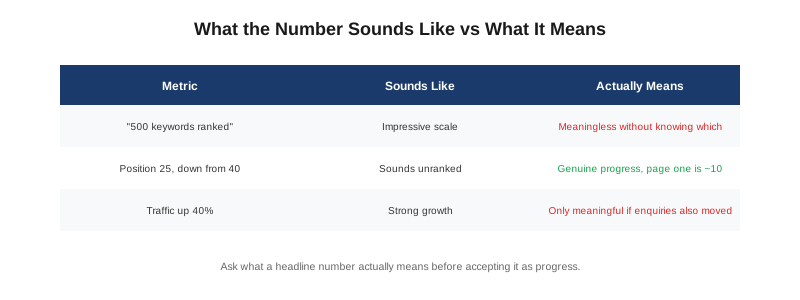
"Keywords ranked" as a raw count means little on its own. Ranking for a thousand keywords nobody searches for is worthless. Ask specifically about the terms that would actually bring you business, not the total count.
Vanity traffic growth without enquiry correlation can reflect irrelevant traffic. A large traffic increase that does not correspond to any increase in real enquiries or calls is worth questioning directly rather than celebrating on its face.
A Direct Comparison
| Metric | What It Sounds Like | What It Actually Tells You |
|---|---|---|
| "500 keywords ranked" | Impressive scale | Meaningless without knowing which specific terms and their positions |
| Traffic up 40% | Strong growth | Only meaningful if enquiries also moved, or the traffic matches real buyer intent |
| Position 1 for a term nobody searches | Great ranking | Worthless visibility if the term has no real search volume |
| Average position 25, trending down from 40 | Sounds unranked | Genuine progress, page one is roughly position 10 |
Why Enquiry Correlation Matters More Since Recent Updates
Google's ongoing algorithm updates through 2026 have consistently rewarded content matching real search intent over content chasing keyword volume. A report showing keyword or traffic growth disconnected from real enquiries often reflects exactly the kind of low-intent optimisation these updates are increasingly designed to de-prioritise.
Questions Worth Asking About Any Report
Ask which three keywords matter most to your business specifically, and what their exact position trend has been over the last six months, not just the current snapshot. Ask which pages received clicks last month and whether that matches which pages the agency has actually been working on. Ask directly whether traffic growth correlates with any increase in real enquiries, and if not, why not.
- A report emphasising total keyword count with no mention of which specific terms matter
- Traffic charts with no accompanying enquiry or conversion data
- No comparison against your own actual Search Console access
- Technical work described only in generic terms, never named specifically
- Reluctance to explain any specific number when asked directly
You Do Not Need Technical Expertise to Do This
Understanding these few numbers does not require SEO expertise. It requires knowing which three or four metrics to look for and asking direct questions when a report avoids them. A genuine SEO company in Bangalore confident in its work should welcome these questions rather than treating them as an inconvenience, since a client who understands the report is a client who trusts the relationship for the right reasons.
Reading a Report Section by Section
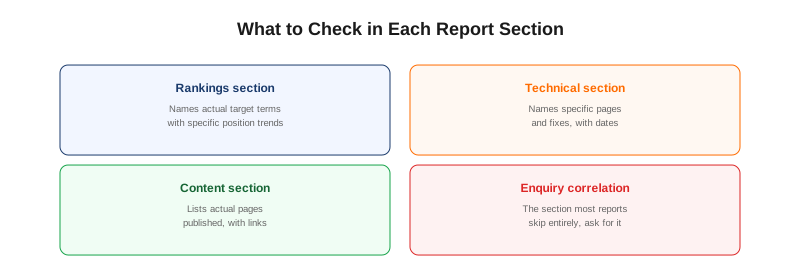
Most agency reports follow a similar structure, and knowing what matters in each section speeds up your review considerably. The summary or executive section at the top should state, in plain language, what specifically happened this month and why, not just restate the headline numbers already visible in the charts below it. If this section reads identically to last month's summary with only the numbers changed, that repetition itself is worth noting.
The keyword or ranking section should name your actual target terms specifically, with their position trend, rather than an aggregated "keywords in top 10" count that obscures which specific terms moved and which did not. The technical or on-page section should name specific pages and specific fixes, dates included, not a general statement that "technical optimisation continued." The content section should list what was actually published, with links, not just a count of "pieces of content delivered."
What "Good" Actually Looks Like in Each Section
A strong ranking section might read: "Average position for 'SEO company Bangalore' improved from 34 to 29 this month, continuing the gradual trend since March. 'Local SEO Bangalore' held steady at position 12, already page one." A weak equivalent might read only: "Rankings continue to improve across target keywords." The first version gives you something to verify directly in your own Search Console. The second gives you nothing checkable at all.
A strong technical section names the specific page, the specific issue, and the specific fix: "Fixed duplicate title tag on /seo-company-bangalore, resolved slow-loading hero image on the homepage reducing Largest Contentful Paint from 4.2 seconds to 2.1 seconds." A weak equivalent reads: "Continued technical optimisation across the site." Only the specific version lets you independently confirm the claimed work actually happened.
The Enquiry Correlation Section Most Reports Skip Entirely
Very few standard agency reports include a section directly correlating traffic or ranking changes against actual enquiry or call volume, yet this is arguably the single most important section for a business owner specifically. Ask your agency directly to add a simple monthly line: total enquiries or calls this month, compared against the previous month, alongside a brief note on whether this correlates with the traffic and ranking data reported elsewhere. This single addition transforms a report full of SEO-specific metrics into one that actually answers the question a business owner cares about most: is this translating into real business.
Reading the Trend, Not the Snapshot
A single month's numbers rarely tell the full story either way. Position, clicks, and impressions all fluctuate normally month to month due to seasonality, algorithm updates, and ordinary search volume variation. The useful read comes from a three-to-six-month trend line, not any single report in isolation. A dip in one month following a confirmed spam or core update, for instance, often recovers within the next rollout cycle and should not by itself trigger panic or a change in strategy, provided the surrounding trend still points the right direction overall.
This is also why comparing your own report against your actual Search Console access matters. A report summarising six months of data in one paragraph can smooth over exactly the kind of short-term volatility worth understanding in context, while direct access to the underlying data lets you see the real shape of the trend for yourself.
A Worked Example of a Genuinely Well-Written Report
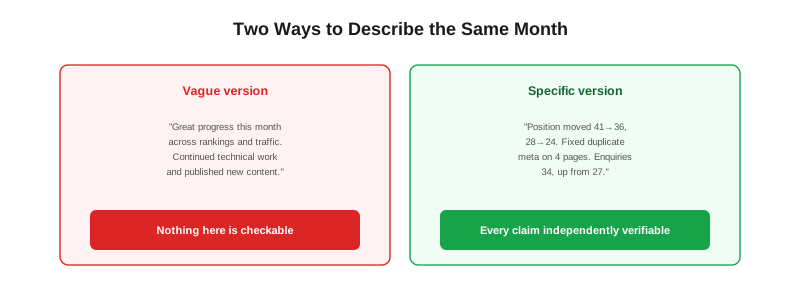
Consider what a specific monthly report actually reads like, compared to the vague equivalent most businesses receive. "This month, average position for your top three target terms moved from 41 to 36, 28 to 24, and 15 to 12 respectively, with the third now solidly on page one. Organic clicks rose 18 percent month over month, tracking consistently with the position improvement. We fixed a duplicate meta description issue across four service pages and resolved a mobile usability error flagged in Search Console affecting the pricing page specifically. Two new pages went live this month, targeting specific terms, both linked from the homepage navigation. Enquiries this month totalled 34, up from 27 last month, a trend consistent with the traffic and ranking improvement reported above."
Every claim in that paragraph is specific and independently checkable: exact positions, exact percentage changes, exact pages named, exact enquiry counts. Compare this against a typical vague equivalent: "Great progress this month across rankings and traffic. We continued our technical optimisation work and published new content. Please reach out with any questions." Both paragraphs could describe the same underlying month of real work. Only one gives you anything to actually verify.
How Report Expectations Differ by Business Type
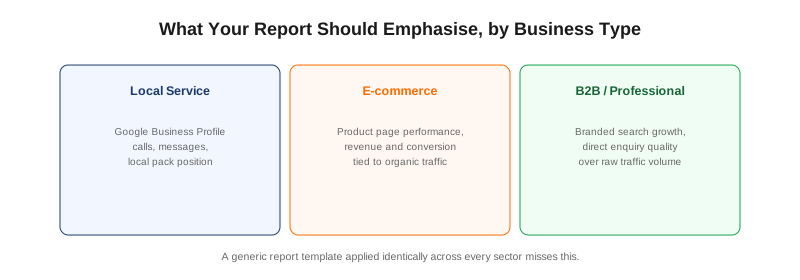
A local service business's report should include Google Business Profile-specific metrics directly, calls and messages generated through the profile, local pack ranking position for key terms, alongside the standard organic metrics, since a meaningful share of this business type's real value comes through the profile rather than the website alone. An e-commerce business's report should include product page-specific performance and, where available, actual revenue or conversion data tied to organic traffic, not just visits, since traffic volume disconnected from purchase behaviour tells an incomplete story for this business type specifically. A B2B or professional services business's report should weight branded search growth and direct enquiry quality, similar to what matters for the CA and financial firms covered elsewhere in this series, over raw traffic volume, since B2B decision cycles rarely convert on the first visit regardless of how well the underlying SEO work is performing.
When a Report Format Itself Signals a Problem
Beyond the content of any single report, the format and consistency of reporting over time carries its own signal. A report that changes structure every month, making month-to-month comparison difficult, may reflect genuine adaptation to new priorities, or it may reflect an agency avoiding the accountability a consistent format naturally creates by making it harder to notice when the same vague language repeats. A report that arrives significantly late, or not at all, in a given month, even once, deserves a direct question about why, since consistent, on-time reporting is a low-cost commitment any agency should reliably meet regardless of how the underlying SEO work itself is progressing.
Cross-Checking a Report Against Your Own Raw Data
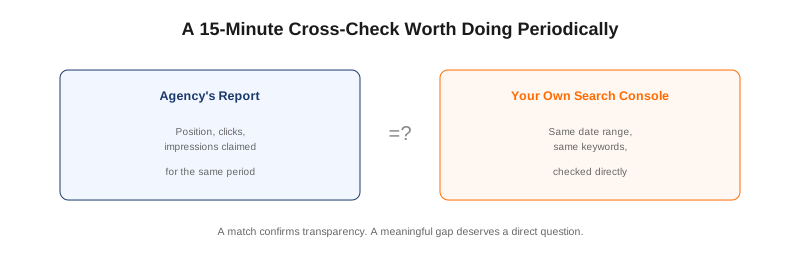
The single most reliable way to evaluate any report's honesty is to pull the same date range directly from your own Search Console and GA4 access and compare it against what the report claims. This takes perhaps fifteen minutes and requires no special expertise, simply matching the position, click, and impression figures in the report against what you see in your own account for the same period and the same keywords. A report whose numbers consistently match your own raw data is demonstrating genuine transparency. Meaningful, unexplained discrepancies between a report's claims and your own account data are worth raising directly and immediately, since this is precisely the kind of gap that indicates either carelessness or, in a worse case, deliberate embellishment.
This cross-check is worth doing at least occasionally throughout an engagement, not only when something already feels wrong. A business that spot-checks its reports periodically from the start establishes an expectation of accuracy that a business only checking after suspicion has already arisen cannot recreate as easily.
What Genuinely Stays the Same
None of this replaces the fundamentals covered in what to expect during your first 90 days or in verifying an agency's case studies before signing. Reading your own reports well is the ongoing version of the same verification discipline that should have started before you ever signed a contract. A business that develops the habit of reading reports this closely, checking specific claims against real data, asking direct questions about vague language, tends to enjoy a fundamentally different, more accountable relationship with any agency than one that simply accepts whatever arrives each month at face value.
Frequently Asked Questions
What is a realistic timeline for seeing position improvements in my report?
Low-competition local terms often move within six to twelve weeks. Competitive city-wide or national terms typically take four to eight months of consistent work. A report showing no movement at all after six months on targeted terms is worth a direct conversation.
Should I be concerned if traffic grows but enquiries do not?
Yes, this is worth investigating directly. It can mean the traffic arriving is not relevant to what your business offers, or that your website itself is not converting visitors effectively once they arrive, both worth understanding specifically rather than accepting the traffic number alone as success.
How often should I expect to receive a report?
Monthly is standard for most ongoing SEO engagements, with a brief explanation accompanying the numbers rather than raw data alone. Quarterly can work for smaller or slower-moving accounts, but should still include specific detail, not just a summary.
Can I verify these numbers myself instead of relying only on the agency's report?
Yes, and you should. If you retain owner-level access to your own Search Console and GA4, as you should from day one of any engagement, you can check position, clicks, and impressions directly rather than relying entirely on a summarised report.
Does this apply the same way to a business early in its SEO journey?
Yes, though expectations should be calibrated accordingly. A business three months into a new engagement should see different numbers than one three years in, but the same principle, specific numbers over vague reassurance, applies at every stage.
Should my report format stay identical every single month?
Largely yes, in structure. A consistent format makes month-to-month comparison easier, and significant unexplained changes to that format are worth asking about directly.
What should I do if my agency resists adding enquiry correlation to the report?
Ask why directly. This is a reasonable, low-effort addition for any agency with access to your call and enquiry data, and resistance to including it is worth understanding specifically rather than accepting without explanation.
How specific should the language in a good report actually be?
Specific enough that you could independently verify every claim using your own Search Console or GA4 access. If a sentence could describe any client's month equally well, it is too generic to be useful.
Related Reading
SEO Company in Bangalore
Our flagship Bangalore SEO service.
SEO Agency in Bangalore
ROI-focused SEO for Bangalore businesses across industries.
What to Expect in Your First 90 Days
The onboarding checklist this report guide builds on.
How to Verify an SEO Company's Case Studies
The same verification discipline, applied before you sign.
Search Console's New AI Performance Tools
What the newest report type actually shows.
Our Story
How OneCity started in 2006 and what changed along the way.
OneCity Technologies Pvt Ltd (CIN: U72100KA2009PTC048911, incorporated 2009) has run SEO campaigns since 2006. Every recommendation in this guide reflects how we report to our own clients. Written by L.K. Monu Borkala, Founder & CEO. Verify our registration at the MCA21 portal. | Updated:
Want Us to Walk Through a Sample Report With You?
Send us a recent report from your current provider and we will help you understand what it actually shows, no obligation to work with us afterward.
Rajajinagar, Bengaluru · Kankanady, Mangaluru · Kuvempu Nagara, Mysuru