Signs Your SEO Is Working (Even If Rankings Haven't Moved Yet)
Updated: 1 September 2026
Rankings for competitive terms are the slowest metric to move, and the easiest one to stare at anxiously. Here are the earlier signals worth checking instead.
Reviewed against the June 2026 Spam Update, March 2026 Spam Update, December 2025 Core Update
A competitive keyword's average position can sit nearly flat for weeks while genuine, meaningful progress is happening beneath it. This is not a reason to lower your standards for what counts as real progress. It is a reason to know which earlier signals actually predict future ranking movement, so you are not judging an entire investment by the single slowest number available.
Impressions Growing Is an Earlier Signal Than Position
Before a page ranks well enough to earn clicks, it typically starts appearing in search results more often, even at a low position. A steady, genuine rise in impressions for your target terms over consecutive months is one of the clearest early signals that Google is recognising your content as increasingly relevant, well before that recognition translates into a page-one position.
- Impressions for target keywords rising month over month, not just fluctuating
- New pages beginning to appear in search results at all, even at low positions
- Average position trending in the right direction over a 3-month window, even if slowly
- Technical health metrics (Core Web Vitals, crawl errors) improving
- Branded search volume for your business name showing gradual growth
Technical Health Improvements Are Real Progress, Even Invisibly
Fixing crawl errors, improving Core Web Vitals, resolving duplicate content, and cleaning up canonical issues rarely show up as an immediate ranking jump. They remove obstacles that were actively working against your visibility. A site with improving technical health metrics is removing friction Google's own systems were penalising, even before that improvement shows up as a rankings change.
A Direct Comparison
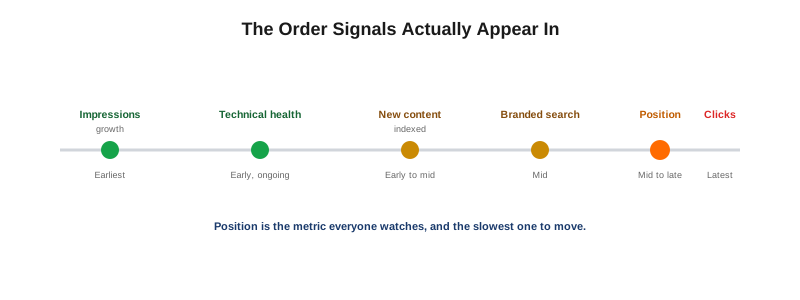
| Signal | How Early It Appears | What It Predicts |
|---|---|---|
| Impressions growth | Earliest, often within weeks | Google recognising relevance before ranking well |
| Technical health improvement | Early, ongoing | Removing obstacles blocking future ranking gains |
| New content getting indexed and appearing | Early to mid | Content is being evaluated, not ignored |
| Branded search volume rising | Mid | Growing awareness independent of ranking |
| Average position improving | Mid to late | The metric everyone watches, but the slowest to move |
| Click and enquiry growth | Late | The ultimate goal, dependent on the above |
Why This Order Matters More Since Recent Updates
Google's spam and core update activity through 2026 has consistently rewarded sites that build genuine, sustained quality over time rather than sites chasing quick ranking wins. This makes the earlier signals, impressions growth and technical health, more reliable indicators of durable progress than an early ranking spike would be, since a spike unsupported by real quality often reverses in the next update cycle.
Branded Search Growth Is an Underrated Signal
A gradual rise in people searching for your business name directly, visible in Search Console, often reflects growing awareness from content and citation work that has not yet translated into ranking movement for competitive generic terms. This is a genuine, measurable sign that your visibility work is reaching real people, even before it shows up in the metric everyone tends to watch first.
- An agency reporting only "everything is on track" with no specific, checkable metric
- No mention of impressions or technical health trends, only a promise that rankings will improve eventually
- Dismissing your specific questions about early signals as "too technical to explain"
- No access to your own Search Console to verify any of these signals yourself
When to Actually Start Worrying
If impressions are flat or declining, if technical health metrics are not improving despite genuine effort, and if branded search shows no growth after several months of real work, that combination is a legitimate reason for concern, distinct from simply "rankings for a hard term haven't moved yet." The distinction matters: one pattern reflects normal, expected timelines for a slow-moving metric, the other reflects a genuine lack of underlying progress.
How to Actually Read the Impressions Trend, Step by Step
Open Search Console's Performance report and set the date range to the last three months, then compare it directly against the three months before that, rather than eyeballing a single chart. Look specifically at total impressions for your genuine target keywords, not the site-wide total, since a rising site-wide number can hide a flat or declining trend on the specific terms that actually matter to your business. A genuine upward trend across this comparison, even a modest one, is meaningfully different from month-to-month noise within a single quarter.
Segment this same view by page where possible. A new service page climbing in impressions over its first few months is a distinct, encouraging signal separate from your homepage's more stable, slower-moving trend. Treating every page's performance as one undifferentiated number hides exactly the kind of early, page-specific progress worth noticing and reinforcing with further content investment.
Vanity Metrics Versus Leading Indicators, and Why the Difference Matters
It is worth being explicit about a trap many business owners fall into: mistaking metrics that feel good to look at for metrics that actually predict future success. Total keyword count, gross traffic numbers disconnected from relevance, and social share counts often feel like progress without being genuine leading indicators of the outcome you actually want, more enquiries and more revenue.
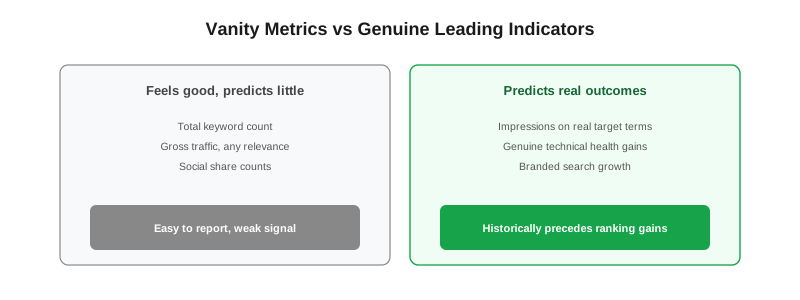
The signals covered in this piece, impressions growth on real target terms, technical health improvement, branded search growth, are leading indicators specifically because industry experience and Google's own communications consistently show them preceding ranking and traffic gains, not because they are simply easier or more flattering numbers to report. A report heavy on vanity metrics and light on these genuine leading indicators is worth questioning directly, not because the vanity numbers are false, but because they do not reliably predict whether your investment is working.
A Worked Example
Consider a hypothetical Bangalore business three months into a new SEO engagement. Its target keyword's average position has moved from 34 to 31, a change easy to dismiss as negligible. But its impressions for that same term have grown from roughly 400 a month to 1,100 a month over the same period, its Core Web Vitals score has moved from a failing to a passing grade following genuine technical fixes, and branded searches for the business name have grown by roughly 20 percent.
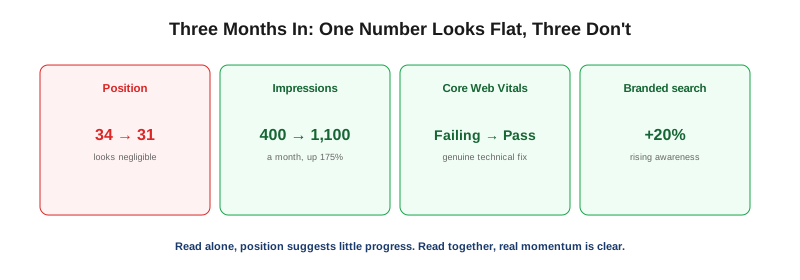
Read in isolation, the position number alone would suggest disappointing progress. Read alongside the other three signals, a clear, coherent story of genuine early momentum emerges, one that a position number three months into a competitive engagement was never going to capture on its own. This is precisely the pattern worth learning to recognise, since a business judging only the slowest-moving number would reasonably conclude nothing meaningful had happened, when in fact several genuine, connected signals were already pointing in the right direction.
How This Applies Differently Across Business Types
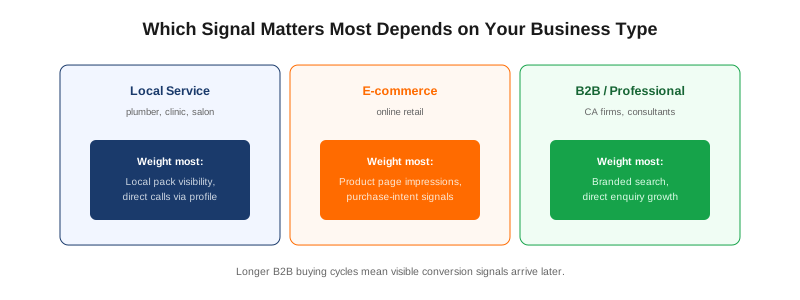
A local service business, a plumber, a clinic, a salon, should weight Google Business Profile-specific signals, local pack visibility, direct calls and messages through the profile, alongside the broader signals covered here, since a meaningful share of local search intent resolves through the profile itself rather than a traditional organic click. An e-commerce business should pay closer attention to product page impressions and add-to-cart or purchase-intent signals specifically, since general traffic growth without a corresponding conversion signal can mask a mismatch between the keywords gaining visibility and genuine buyer intent. A B2B or professional services business, similar to the CA and financial firms covered elsewhere in this series, should weight branded search and direct enquiry growth more heavily than raw impression volume, since B2B buying cycles often involve longer research periods before a visible conversion signal appears.
The Compounding Nature of These Early Signals
None of these signals move in isolation from each other. Growing impressions typically feed a gradual rise in clicks even before average position improves substantially, since a larger volume of searches showing your content, even at a modest position, naturally produces more absolute clicks over time. Technical health improvements compound similarly, a site that fixes Core Web Vitals issues this quarter is better positioned to benefit from next quarter's content investments than a site still carrying the same unresolved technical debt. Branded search growth often precedes and then reinforces generic-term ranking gains, since a business becoming more recognisable to searchers tends to also become more recognisable to Google's own systems evaluating trust and relevance over the same period.
This compounding pattern is precisely why the earliest months of a genuine SEO investment often feel slower than they actually are. The visible ranking outcome sits at the end of a chain of earlier, connected improvements, and judging the investment only by where that chain currently ends, rather than by how quickly and reliably it is progressing through its earlier links, systematically underestimates real progress that is already underway.
Building Your Own Simple Monthly Tracking Habit
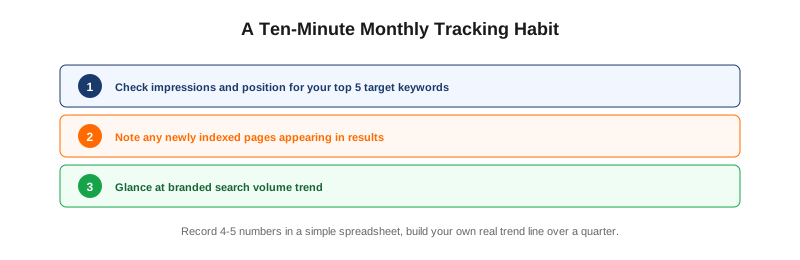
A business owner does not need sophisticated tools to track these signals consistently. A simple monthly habit, checking Search Console's impressions and average position trend for your top five target keywords, noting any newly indexed pages, and glancing at branded search volume, takes perhaps ten minutes and builds a genuine, month-over-month record far more useful than an anxious daily check of a single ranking number. Recording these figures in a simple spreadsheet, even just four or five numbers each month, lets you see your own real trend line develop over a quarter or two, exactly the kind of longer view this entire piece has been advocating for.
This habit also puts you in a stronger position when reviewing any report your agency provides, since you arrive already knowing your own trend rather than relying entirely on someone else's summary of numbers you have never looked at directly yourself.
Reading These Signals Around Update Windows Specifically
Google's spam and core update rollouts, covered throughout this content series, add real short-term noise to every one of these signals, and understanding this timing matters for interpreting your own data correctly. A dip in impressions or position immediately following a confirmed update rollout, followed by a genuine recovery within the following weeks, reflects normal reassessment rather than a real, sustained decline. This is different from a dip that continues worsening or fails to recover well after an update has fully rolled out, which deserves closer attention.
Checking the timing of any confirmed update against your own performance dip is a simple, useful diagnostic step before drawing any conclusion about whether your SEO investment itself is the cause of a temporary decline. A business that panics and demands sweeping changes during a normal post-update recovery window risks introducing exactly the kind of disruptive, undocumented changes that do cause lasting harm, turning a temporary, expected fluctuation into a real, self-inflicted problem.
The Danger of Overcorrecting Based on a Single Bad Month
A single month showing a dip across several of these signals simultaneously is worth noting and monitoring, but it rarely justifies an immediate, dramatic strategy change on its own. Overcorrecting, firing an agency, demanding a full content overhaul, abandoning a keyword strategy, based on one month's data is a common and often counterproductive reaction. The three-to-six-month window emphasised throughout this piece exists precisely because monthly SEO data carries genuine, normal variance that a single data point cannot reliably distinguish from a real, sustained problem.
A more measured response to a single concerning month is to note it, continue tracking the same signals for the following month or two, and only treat the pattern as a genuine concern if it persists or worsens across that fuller window. This measured approach protects against both extremes, ignoring a real problem for too long, and reacting destructively to normal short-term variance.
What a Good Agency Proactively Surfaces, Without Being Asked
A attentive agency does not wait for a client to ask about impressions or technical health trends. It surfaces these signals proactively in every report, explaining specifically what moved, why, and what it predicts, rather than requiring the client to interrogate a vague summary for the details that actually matter. If your current reporting only ever discusses position and traffic, with no mention of the earlier, predictive signals covered in this guide, that is itself worth raising directly, since it may reflect either an incomplete measurement approach or, less charitably, a report designed to avoid the more nuanced conversation these signals would require.
Asking your agency directly to include impressions trends, technical health status, and branded search movement in every report going forward is a reasonable, specific request any competent agency should accommodate without difficulty. The response to that request, whether enthusiastic and immediate or reluctant and vague, tells you something real about how closely your visibility is actually being monitored day to day, beyond whatever the headline ranking number happens to show in any given month.
What Genuinely Stays the Same
None of this replaces the value of eventually seeing real ranking and enquiry growth, which remains the actual goal. What it does is give you a way to read your SEO report honestly during the months before rankings catch up, rather than treating a flat position number as the only available signal of whether your investment is working. A business that learns to read these earlier signals confidently spends less time anxious about a single slow-moving metric and more time focused on the work that produces durable, long-term visibility.
Frequently Asked Questions
How long should I wait before expecting rankings to actually move?
Competitive city-wide or national terms typically take four to eight months of consistent work. The earlier signals covered here should show genuine movement well before that window closes, which is what makes them useful to check in the meantime.
What if impressions are growing but clicks are not?
This can reflect a genuine, early-stage pattern, appearing in results without yet ranking well enough to earn clicks, or it can reflect a mismatch between your content and what searchers actually want. Tracking whether impressions keep climbing over several months helps distinguish between the two.
Should I switch agencies if rankings haven't moved after three months?
Not necessarily, if the earlier signals in this guide are trending well. Three months is often still within a normal timeline for competitive terms. Switching makes more sense when the earlier signals are also flat or absent.
Can I check these signals myself without deep SEO knowledge?
Yes. Search Console's own Performance report shows impressions, clicks, and position trends directly, and comparing a recent three-month window against the previous one requires no technical expertise, just the discipline to look regularly.
Does branded search growth really indicate SEO progress specifically?
It reflects growing awareness, which SEO content and citation work often contributes to alongside other marketing efforts. It is a useful supporting signal rather than a definitive one on its own, best read alongside the other signals in this guide.
Should I weight these signals differently depending on my business type?
Yes. A local service business benefits from weighting Google Business Profile signals heavily, an e-commerce business should focus on product-page and purchase-intent signals, and a B2B business often benefits more from branded search and direct enquiry tracking than raw impression volume alone.
How do I segment Search Console data by individual page rather than site-wide?
Search Console's Performance report allows filtering by page directly, letting you compare a specific new service page's trend against the site-wide average, which often reveals encouraging page-specific progress a blended total would hide.
Is it possible for all these signals to look good and rankings still never improve?
This is uncommon over a long enough window, since these signals are leading indicators specifically because they have historically preceded ranking gains. If this pattern persists for six months or longer with no ranking movement at all, it is worth a direct, specific conversation with your agency about what is different in your particular situation.
Related Reading
SEO Company in Bangalore
Our flagship Bangalore SEO service.
SEO Agency in Bangalore
ROI-focused SEO for Bangalore businesses across industries.
How to Read Your SEO Report
The plain-language guide to reading the numbers behind these signals.
What to Expect in Your First 90 Days
Early-stage expectations for a new SEO engagement.
How to Choose an SEO Company in India
The full hiring checklist.
Our Story
How OneCity started in 2006 and what changed along the way.
OneCity Technologies Pvt Ltd (CIN: U72100KA2009PTC048911, incorporated 2009) has run SEO campaigns since 2006. Every recommendation in this guide reflects how we set expectations with our own clients. Written by L.K. Monu Borkala, Founder & CEO. Verify our registration at the MCA21 portal. | Updated:
Not Sure If Your Current SEO Is Actually Working?
Send us your Search Console access and we will walk you through exactly what these signals show for your business, no obligation to work with us afterward.
Rajajinagar, Bengaluru · Kankanady, Mangaluru · Kuvempu Nagara, Mysuru