How to Transition Away from an Underperforming SEO Agency Without Losing Your Rankings
Updated: 1 September 2026
A poorly managed agency transition can undo months of genuine progress. Here is how to switch without losing the rankings you have already earned.
Reviewed against the June 2026 Spam Update, March 2026 Spam Update, December 2025 Core Update
Leaving an underperforming SEO agency is often the right call, but a badly managed transition can cost you rankings you have already earned, not just fail to improve them further. Knowing what to protect and verify before, during, and after a switch matters as much as the decision to switch itself.
Before You Give Notice: Secure Your Own Access First
Confirm you have owner-level access to your own Google Search Console, GA4, and Google Business Profile before initiating any transition conversation. If your current agency controls these under their own login, request ownership transfer or admin access immediately, since a contentious departure sometimes results in delayed or denied access to accounts you are legally entitled to control.
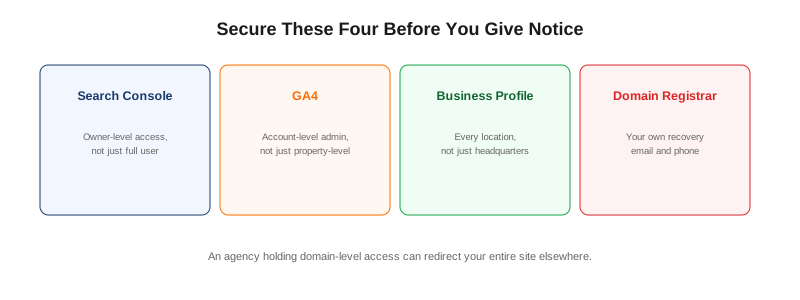
- Owner-level Search Console, GA4, and Google Business Profile access confirmed in your name
- A full export of current rankings, traffic, and technical health as a documented baseline
- A list of all content published and technical changes made during the current engagement
- Domain and hosting credentials confirmed to be in your control, not the agency's
- Any DNS or third-party tool access reviewed for anything set up under the agency's own accounts
During the Transition: Avoid These Specific Mistakes
Do not make sweeping technical or content changes immediately after switching, even well-intentioned ones. A new agency eager to demonstrate value sometimes rewrites content or restructures URLs faster than is necessary, and rapid, large-scale changes right after a transition can trigger the same kind of scrutiny Google applies to any sudden, unusual site-wide shift. A measured, documented transition protects rankings better than an aggressive relaunch.
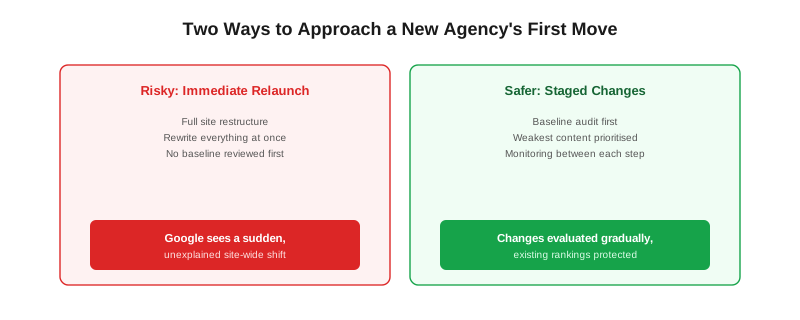
A Direct Comparison
| Action | Risky Approach | Safer Approach |
|---|---|---|
| URL structure changes | Restructure immediately for a "fresh start" | Only change URLs with a real, specific reason, with proper 301 redirects |
| Content rewrites | Rewrite everything at once | Prioritise weak content first, phase the rest |
| Account access | Let the old agency's access lapse without transfer | Confirm ownership transfer before ending the relationship |
| Technical changes | Multiple simultaneous major changes | Staged, documented changes with monitoring between each |
| Redirects | Ignored or handled carelessly | Every changed URL properly redirected and verified |
Why a Measured Transition Matters More Since Recent Updates
Google's spam and core update activity through 2026 has made sudden, unexplained site-wide changes riskier to make without a clear, gradual rollout. A transition that introduces multiple large changes simultaneously is harder for Google's systems to evaluate favourably than the same changes introduced with proper monitoring between each step.
Why Agencies Underperform in the First Place, Worth Diagnosing Honestly
Before planning any transition, it is worth being honest about which category of underperformance you are actually dealing with, since this shapes what a new agency needs to fix versus simply continue. Some underperformance stems from weak execution: generic content, no real technical audit ever completed, vague monthly reports with no specific work named. Other underperformance stems from unrealistic expectations rather than poor work: a business expecting page-one rankings for a competitive national term within two months, then judging a competent agency as a failure when that timeline, covered in signs your SEO is working even before rankings move, simply had not played out yet.
A third, subtler category involves an agency that did solid initial work but has since stagnated, the same content calendar repeated for a year with no fresh strategy, technical issues identified once and never revisited, reporting that has become a copy-paste template. This category is worth naming specifically because it means some of the existing work deserves to be preserved and built upon, not discarded wholesale simply because the relationship itself has gone stale.
The Technical Side of Account and Property Transfers
Beyond simply confirming you have access, the actual mechanics of transferring Google Search Console and GA4 ownership matter. In Search Console, ownership transfer means adding yourself as an owner-level user directly, not merely a full user, since only owner-level access lets you add or remove other users afterward, including eventually removing the departing agency's access cleanly. In GA4, this means confirming you hold Administrator-level access at the account level, not just the property level, since account-level access is what actually survives a later removal of the agency's own account link.
Domain and DNS access deserves the same direct verification. Confirm the domain registrar account itself, not just a subdomain or hosting panel, is registered in your name or your business's name, with your own recovery email and phone number, not the agency's. An agency holding domain-level access effectively holds the ability to redirect your entire site elsewhere, a genuine risk worth eliminating before any transition conversation begins, not after.
A Realistic Week-by-Week Transition Timeline
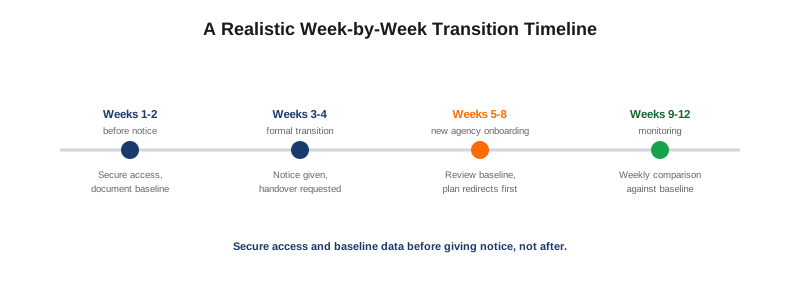
Weeks one and two, before any notice is given: Confirm and secure owner-level access to Search Console, GA4, Google Business Profile, and your domain registrar. Export a full baseline of current rankings, traffic, and technical health. Compile a list of every piece of content published and every technical change made during the outgoing engagement, since this becomes the reference document any new agency should review before recommending changes.
Weeks three and four, formal transition: Notify the outgoing agency according to your contract's notice terms. Request a formal handover document covering login credentials for any third-party tools used, an explanation of any ongoing technical work in progress, and confirmation that no scheduled content or campaigns will continue running unexpectedly after the relationship ends.
Weeks five through eight, new agency onboarding: A new agency should review the baseline and handover documentation before recommending any changes, precisely the discipline covered in what to expect in your first 90 days. Any URL or structural changes should be planned with a complete redirect map before implementation, not decided on the fly.
Weeks nine through twelve, monitoring: Compare current performance against your documented baseline weekly rather than monthly during this window specifically, since catching a redirect error or an unexpected ranking drop within days rather than a full month gives you time to correct it before real damage compounds.
What a Proper Handover Document Should Actually Contain
A genuine handover from an outgoing agency, whether offered willingly or requested directly, should include specific, checkable detail rather than a vague summary. This means a list of every page created or substantially edited with dates, a record of technical fixes implemented, any ongoing link-building or content partnerships that need a decision about continuation, and explicit confirmation of which third-party tools and subscriptions were used under whose account.
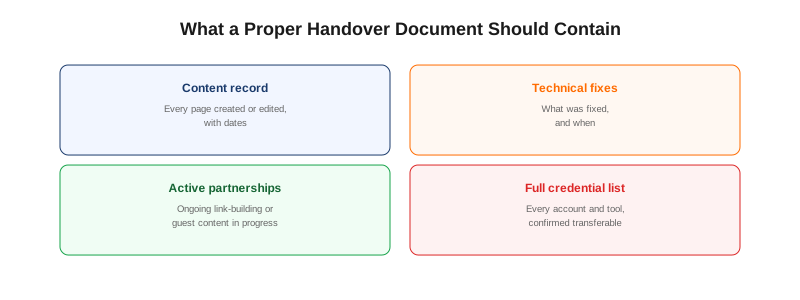
- Complete list of content created or edited, with dates and pages named
- Record of technical fixes and their implementation dates
- Any ongoing partnerships, guest content, or link-building relationships in progress
- Full account credential list, confirmed to be transferable or already in your name
- A statement of any known outstanding issues the agency has not yet resolved
Communicating the Transition Internally
If your team, sales staff, customer-facing employees, anyone managing your Google Business Profile day to day, has been interacting with the outgoing agency directly, a clear internal communication about the transition prevents confusion during the handover window. Name a single internal point of contact for the new agency to work through, and brief that person on the baseline data and handover documentation directly, rather than leaving institutional knowledge scattered across whoever happened to interact with the previous agency.
Content Ownership: A Question Worth Settling Before You Leave
Confirm in writing who owns the content an outgoing agency created on your behalf, published blog posts, service page copy, any custom graphics or schema implementations. Most reputable agency contracts assign ownership of deliverables to the paying client once invoices are settled, but this is worth confirming explicitly rather than assuming, particularly for any content published under a byline or authorship structure the agency controls rather than your own. A dispute over content ownership mid-transition can delay a clean handover and, in a worst case, result in content being altered or removed from your site by a party that still believes it retains rights to it.
Review your existing contract's notice period and any early-termination clauses before initiating a transition conversation. Some agency contracts specify a required notice window, often 30 to 60 days, and understanding this in advance lets you plan your technical baseline and access-transfer work to complete comfortably within that window rather than rushing at the last moment.
Should You Run Both Agencies Briefly, or Make a Clean Cutover
A short, deliberate overlap period, where the outgoing agency completes agreed final work while the new agency begins its own audit and baseline review without yet making live changes, often produces a smoother transition than an abrupt same-day cutover. This is not always practical or affordable, and a clean cutover with a well-prepared handover document can work just as well, provided the baseline and access work described above has been completed beforehand. What matters more than the specific approach is that no period exists where nobody is actively monitoring your site's technical health and rankings at all.
Multi-Location Businesses Face Additional Transition Complexity
A business with multiple locations, similar to how OneCity itself operates across Bengaluru, Mangaluru, and Mysuru, faces a more complex transition than a single-location business, since each location typically has its own Google Business Profile, potentially its own location-specific landing pages, and sometimes separate local citation profiles. Confirm access to every individual Business Profile listing, not just a primary one, and confirm your baseline audit and handover documentation cover each location specifically rather than treating the business as a single undifferentiated entity.
A transition that successfully secures access and baseline data for a headquarters location while overlooking a secondary location's Business Profile or location page risks leaving that location unmanaged during the handover window, an easy oversight to make when attention naturally gravitates toward the primary property.
Redirects Are the Single Most Common Way Transitions Lose Rankings
If a new agency changes any URL structure, every single changed URL needs a proper 301 redirect to its new location, verified individually, not assumed to work by default. A missed redirect on even a handful of previously ranking pages can erase months of earned visibility, turning a strategic improvement into a real, measurable loss.
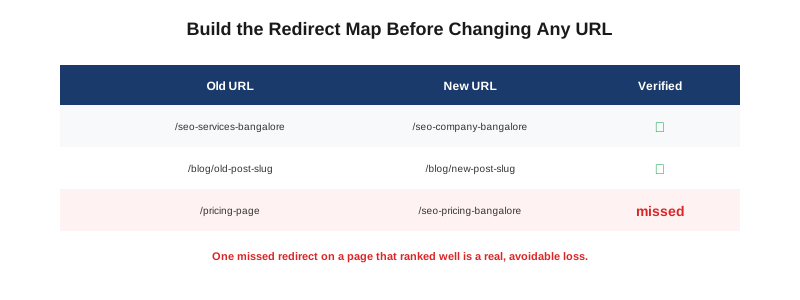
Build the redirect map before any URL changes go live, not after, listing every old URL alongside its exact new destination. Once changes are live, verify each redirect individually by visiting the old URL directly and confirming it lands correctly, rather than assuming a bulk redirect rule caught every case. A single missed page in a redirect map, especially one that previously ranked well, is a avoidable loss that proper verification catches before it costs real visibility.
- A new agency proposing a full site relaunch before understanding what is currently working
- No documented plan for redirecting any URLs that will change
- No baseline audit of current performance before starting new work
- Reluctance to confirm you retain full account ownership throughout the transition
What to Ask a New Agency About the Transition Specifically
Ask directly how they plan to avoid disrupting currently ranking pages during onboarding, and ask for their specific process for auditing what is already working before recommending changes. A genuine SEO company in Bangalore experienced with transitions should have a clear, specific answer here, not a generic assurance that "we'll take care of it."
Evaluating What to Actually Keep From the Old Engagement
A common mistake during a transition is discarding everything the outgoing agency built simply because the relationship itself soured. Before a new agency proposes any changes, review the existing content and technical work objectively against real data: which existing pages rank and drive traffic, which technical fixes are demonstrably working, which content pieces show real engagement. A new agency's first job should be distinguishing between what is underperforming and needs replacing, and what is quietly working well and simply needs continued maintenance rather than a rebuild.
This distinction protects you from paying twice for work that did not need redoing, and it protects your rankings from the disruption of unnecessary changes to pages that were never actually the problem. An agency proposing a wholesale rebuild without first demonstrating they have reviewed what currently works is skipping a step that directly affects both your budget and your risk during the transition.
Choosing a New Agency With Genuine Transition Experience
Not every capable SEO agency has genuine experience specifically with client transitions, distinct from starting fresh with a business that has no prior agency history. Ask a prospective new agency directly how many transitions they have managed, what their specific process looks like for auditing an outgoing agency's work, and how they handle the redirect-mapping and baseline-comparison work covered throughout this guide. A genuine SEO company with real transition experience should answer these questions with specific process detail, not a generic reassurance that transitions "happen all the time and are no problem."
This matters because a transition carries more immediate risk than a fresh engagement with no prior history to protect. An agency without a clear, demonstrated process for this specific situation is more likely to make the kind of sweeping, undocumented changes that put existing rankings at risk, regardless of how strong their work would be starting from a blank slate.
What Genuinely Stays the Same
The same fundamentals from what to expect in your first 90 days apply here in reverse: a genuine audit and baseline first, measured changes, transparent reporting. The difference is that a transition carries the added risk of undoing real, already-earned progress if handled carelessly, which makes the same discipline even more important to insist on upfront.
A transition, handled with the discipline covered throughout this guide, secured access, documented baseline, a phased timeline, honest evaluation of what already works, is lower risk than most business owners fear going into the process. The rankings and traffic a business has already earned are real assets. Protecting them through a transition requires the same care that built them in the first place, not a different or lesser standard simply because the relationship with the agency that built them has ended.
Frequently Asked Questions
How do I know if my rankings are actually at risk during a transition?
Establish a documented baseline of current rankings, traffic, and technical health before any changes begin, then monitor closely for several weeks after the transition. A genuine drop tied to specific changes, rather than normal fluctuation, is identifiable if you have that baseline to compare against.
Should I tell my old agency I am leaving before securing account access?
No. Confirm and secure owner-level access to all your accounts first, then formalise the transition. This protects you from delayed or complicated access handovers during a potentially contentious departure.
Is it normal for a new agency to want to change my content or site structure?
Some change is often warranted, but it should follow a real audit of what is currently working, not arrive as an immediate, sweeping relaunch. Be cautious of any agency proposing major changes before demonstrating they understand your current performance.
What is the single biggest risk during an agency transition?
Missed or improperly implemented redirects when URLs change. This is the most common, most avoidable way a transition actively loses previously earned rankings rather than simply failing to improve them further.
How long should I monitor performance closely after a transition?
At least two to three months, since this covers a typical recrawl and reassessment cycle for any changes made. Comparing this window against your documented pre-transition baseline is the most reliable way to confirm the switch was handled safely.
Who owns the content my outgoing agency created?
This depends on your specific contract, but most reputable agreements assign ownership of paid-for deliverables to the client once invoiced. Confirm this explicitly in writing before the transition, rather than assuming, particularly for content published under the agency's own authorship structure.
Should I run my old and new agency simultaneously during the transition?
A short, deliberate overlap where the outgoing agency completes final agreed work while the new agency reviews baseline data without yet making live changes often produces the smoothest transition, though a clean cutover with thorough preparation beforehand can work just as well.
What is different about transitioning a multi-location business?
Each location typically has its own Google Business Profile and sometimes its own location-specific content, meaning access, baseline documentation, and handover materials need to cover every location individually, not just a primary headquarters property.
Related Reading
SEO Company in Bangalore
Our flagship Bangalore SEO service.
SEO Agency in Bangalore
ROI-focused SEO for Bangalore businesses across industries.
What to Expect in Your First 90 Days
The onboarding process a new agency should follow.
Signs Your SEO Is Working
How to know if it's time to switch.
How to Choose an SEO Company in India
The full hiring checklist for your next agency.
Our Story
How OneCity started in 2006 and what changed along the way.
OneCity Technologies Pvt Ltd (CIN: U72100KA2009PTC048911, incorporated 2009) has run SEO campaigns since 2006. Every recommendation in this guide reflects how we handle client transitions ourselves. Written by L.K. Monu Borkala, Founder & CEO. Verify our registration at the MCA21 portal. | Updated:
Considering a Switch and Want a Safe Transition Plan?
Tell us about your current setup and we will outline exactly how a safe transition would work, no obligation to work with us afterward.
Rajajinagar, Bengaluru · Kankanady, Mangaluru · Kuvempu Nagara, Mysuru