
If you’re wondering how to increase traffic to your website and why your competitors seem to get more inquiries or sales online, the answer usually lies in SEO, content, and user experience. Today, website traffic is directly linked to business growth,without consistent visitors, you lose visibility, leads, and opportunities.
As a leading SEO agency, OneCity helps business owners access sustainable organic growth using proven, data-driven strategies that work in real markets and real competition.
Written by L.K. Monu Borkala, Founder, OneCity Technologies (CIN: U72100KA2009PTC048911), Bangalore. 20 years in business. +91 99023 30233.
Below is a complete, practical guide that shows exactly how to grow your traffic fast and sustainably.
Why Increasing Website Traffic Matters for Your Business
More website traffic means more visibility, more customers, and more conversions. But it’s not just about numbers it’s about attracting the right audience, the people who actually want your product or service.
Higher traffic helps your business:
-
Build brand authority
-
Increase lead generation
-
Improve conversions
-
Strengthen customer trust
-
Become more competitive online
If you’re thinking how to increase visitors on website, you need a complete approach that mixes SEO, content, UX, and brand optimization. Let’s break down what truly works.
Best Ways to Increase Website Traffic – A Quick Overview
Before diving deep, here’s a quick snapshot of the best way to increase website traffic in 2025:
-
Optimize your website for SEO (technical + on-page + off-page)
-
Publish high-quality content regularly
-
Improve user experience and page speed
-
Use schema markup for AEO and SERP visibility
-
Build high-authority backlinks
-
Update old blogs for freshness
-
Optimize your Google Business Profile
-
Run targeted ads for faster boost
Now let’s explore the most powerful strategy,SEO.
How to Increase Traffic on Your Website Through SEO
If you want long-term, high-quality traffic, SEO is the foundation. Search engines reward websites that load fast, solve user problems, and demonstrate topical authority.
Here’s a breakdown of what works:
1. Technical SEO Essentials
Technical SEO makes sure search engines can access, crawl, and rank your pages efficiently.
Focus on:
-
Fast page load speed
-
Mobile responsiveness
-
Core Web Vitals optimization
-
Secured HTTPS
-
Fixing broken links
-
Optimizing XML sitemaps and robots.txt
-
Clean URL structure
A fast, error-free site directly boosts rankings and increases traffic.
2. On-Page SEO Techniques
This is where you optimize elements on your website to increase visibility.
Key optimizations include:
-
Writing keyword-rich title tags and meta descriptions
-
Using primary and secondary keywords naturally
-
Adding relevant internal links
-
Publishing informative, original content
-
Adding schema markup (FAQ, Product, Local Business, etc.)
Good on-page SEO increases your chances of ranking in featured snippets, Google Answers, and People Also Ask,boosting organic clicks instantly.
3. Off-Page SEO Strategies
Off-page SEO builds trust and credibility for your site.
Strong ranking signals include:
-
High-authority backlinks
-
Guest articles on trusted sites
-
Business listings and citations
-
Social media mentions
-
Digital PR and brand signals
A consistent off-page strategy increases domain authority, helping you outrank competition.
This entire SEO environment is at the heart of how to increase traffic on website through SEO.
Content Marketing Strategies That Drive Consistent Traffic
SEO works best when powered by strong content. A well-written, optimized content plan brings continuous visitors, improves session time, and builds expertise.
Here’s what works best:
✔ Publish Topic Clusters & Pillar Pages
Example: A main article like “How to Increase Traffic to Your Website” with supporting blogs such as:
-
“How to Improve Website Speed”
-
“Best SEO Tools for Beginners”
-
“How to Rank Without Backlinks”
This boosts topical authority.
✔ Update Old Blogs
Google rewards freshness. Updating older content is one of the fastest ways to revive rankings.
✔ Cover Search Intent Properly
Match the content with what users genuinely want,informational, commercial, or transactional.
✔ Use Visuals & Infographics
Rich media increases user engagement and dwell time,key SEO ranking factors.
Advanced SEO Tips to Increase Website Traffic
To truly outperform competitors, you must adapt to modern SEO: GEO, AEO, SXO, and entity building.
Here are advanced SEO tips to increase website traffic:
✔ AEO (Answer Engine Optimization)
Optimize your content for voice search, featured snippets, and AI summaries.
✔ Add E-E-A-T Signals
Boost expertise and trust with:
-
Author bios
-
Credentials
-
Case studies
-
External citations
✔ Optimize for UX (SXO)
Improve readability, layout, and on-page engagement.
✔ Use Schema Markup
Boosts impressions and click-through rates.
✔ Improve CTR
Use emotional titles, questions, and power words to increase organic clicks.
These advanced SEO practices make sure Google sees your website as trustworthy, authoritative, and user-friendly.
Local SEO Strategies for Business Owners
If your business serves a region or city, local SEO dramatically increases traffic.
What to optimize:
-
Google Business Profile (posts, photos, categories, keywords)
-
Local keywords (e.g, “SEO agency in Bangalore”)
-
Citations & directory listings
-
Customer reviews & reputation management
-
Service-area pages
Local SEO can drive high-intent customers to your website without big ad spends.
How OneCity Helps You Increase Website Traffic Fast
As a results-driven SEO agency, OneCity specializes in helping businesses outperform competitors using customized strategies. Here’s how we boost your organic traffic:
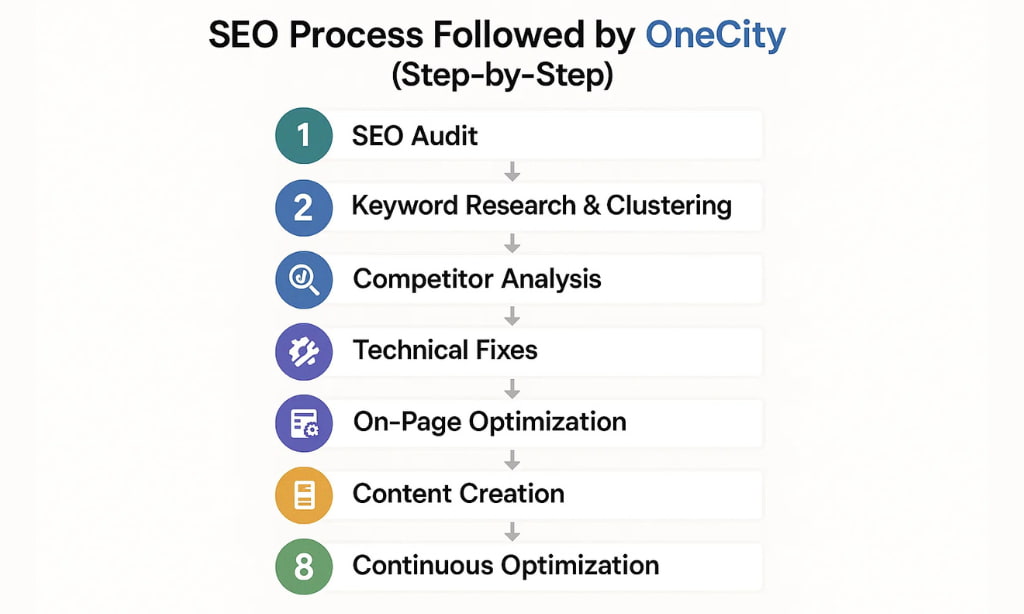
1. In-Depth SEO Audit
We identify issues in:
-
Technical structure
-
Content quality
-
Keyword gaps
-
User experience
-
Competitors’ SEO strategies


This forms the roadmap for sustainable growth.
2. Technical Fixes & UX Enhancements
Our team makes sure your site is fast, clean, and optimized for Core Web Vitals, making it easier for Google to trust and rank your pages.
3. Keyword Research & Content Strategy
We find keywords your customers are searching for and create content that ranks,blogs, service pages, landing pages, and more.
4. High-Authority Backlink Building
We secure quality backlinks that increase domain authority and accelerate rankings.
5. Monthly Monitoring & Optimization
We track rankings, improve underperforming pages, and continually strengthen your site.
With OneCity, you get a traffic-generation system,not a temporary solution.
FAQs
1. What is the fastest way to increase website traffic?
SEO + PPC + content updates give the fastest and most stable results.
2. How long does SEO take to show results?
Typically 2–4 months depending on competition and site quality.
3. Does blogging help increase website traffic?
Yes,blogs increase visibility, rankings, backlinks, and user engagement.
4. Can ads and SEO together grow traffic faster?
Yes, paid ads offer quick traffic while SEO builds long-term authority.
5. How do I track website visitors?
Use Google Analytics, Search Console, and heatmap tools like Hotjar.
Conclusion: Ready to Grow Your Website Traffic?
Boosting website traffic is not about hacks it’s a blend of SEO, content, UX, and consistent optimization. With the right strategy, your business can attract more customers and increase conversions faster than you think.
If you’re ready to grow, OneCity can help you accelerate traffic, outrank competitors, and strengthen your digital presence.
👉 Contact OneCity today for a free SEO audit and traffic growth plan.
Expert insight from L.K. Monu Borkala: Organic search drives 53.3% of all website traffic globally , more than paid search, social, email, and all other channels combined, according to BrightEdge’s 2023 Channel Share Report (BrightEdge Research). For Bangalore businesses specifically, ranking on the first page of Google for service-based keywords generates leads at 8-12x lower cost than Google Ads in most industries , a figure OneCity has validated across healthcare, real estate, and education clients in Karnataka. Choosing an SEO agency with verifiable local case studies and transparent reporting is the single most important selection criterion, as confirmed by Google’s own guidance on working with third-party SEO providers (Google Search Central).
Reference sources: Startup India portal.
Setting Realistic Traffic Growth Expectations
Before covering tactics, a necessary framing: “fast” means different things depending on your starting point, your competitive context, and which traffic channels you are willing to invest in. Google Ads can deliver traffic within 24 hours of campaign launch. SEO takes 3–6 months before meaningful organic traffic appears. Social media can drive traffic spikes that last 48 hours and then stop. Email marketing delivers predictable traffic to your existing audience at the click of send.
Most Bangalore business owners asking how to increase website traffic quickly are looking for sustainable growth, not a one-time spike. This guide covers both , the fast channels that produce immediate results and the compounding channels that produce the most cost-efficient traffic over 12–24 months. The right combination depends on your budget, your timeline, and whether you need leads this week or a traffic engine that grows without proportional ongoing spend.
At OneCity Technologies, we have managed traffic growth programmes for 650+ businesses across Karnataka. The tactics in this guide are drawn from what has consistently worked in the Bangalore market , not generic advice applicable to any business in any country.
Channel 1: Google Search Console Quick Wins (This Week)
If your site has been live for 6+ months and has any organic presence, Google Search Console contains your fastest traffic growth opportunity. Open the Performance report, set the date range to the last 90 days, and apply this filter: click the “+” button, select “Position,” and set it to “Greater than 5.” This shows every keyword where you appear in search results but below position 5 , meaning you are close to page one but not capturing clicks.
Sort this filtered list by Impressions descending. The keywords at the top , high impressions, positions 6–15 , are your immediate targets. For each one, identify which page Google is serving for that query. Then make three improvements to that page:
- Rewrite the title tag to more closely match the search query phrasing
- Add 300–500 words addressing the specific subtopics that question-format variants of the keyword suggest
- Add 2–3 internal links from higher-authority pages on your site to this page using the keyword as anchor text
These changes cost nothing except time and consistently produce ranking improvements within 2–4 weeks. For a site with 50+ indexed pages, this exercise typically reveals 8–15 near-miss keyword opportunities that can each be moved to page one with targeted improvements.
Channel 2: Google Ads (Traffic in 24 Hours)
Google Ads is the fastest way to put your website in front of people actively searching for your product or service in Bangalore. A campaign targeting high-intent keywords , “SEO company Bangalore,” “web design services Koramangala,” “digital marketing agency for restaurant Bangalore” , can be live and generating clicks within one business day of setup.
The critical success factors that determine whether the traffic converts to enquiries:
- Conversion tracking must be active before launch. Form submission events, phone click events, and WhatsApp click events must be firing correctly in GA4 and imported into Google Ads. Without conversion data, smart bidding optimises for clicks rather than business outcomes.
- Negative keywords prevent wasted spend. Add “free,” “jobs,” “course,” “how to,” “DIY,” and all competitor brand names to your negative keyword list before launch. In competitive Bangalore categories, 20–35% of spend goes to irrelevant queries on campaigns without comprehensive negative lists.
- Landing pages must match ad messaging. A visitor who clicked an ad promising “affordable SEO services” and lands on a generic homepage does not convert. The landing page must deliver exactly what the ad promised, with a clear call to action immediately visible without scrolling.
Expected cost ranges for Bangalore Google Ads: ₹25–80 per click for digital marketing keywords, ₹40–150 per click for legal and financial services, ₹30–120 for real estate, ₹15–50 for education. Budget ₹15,000–30,000/month minimum for meaningful data accumulation , smaller budgets produce too few clicks for statistical significance in optimisation decisions.
Channel 3: Content Refreshing (Fastest SEO Traffic Gain)
Publishing new content takes months to rank. Refreshing existing content that already has some ranking history produces results significantly faster , typically 3–6 weeks , because Google has already indexed and partially ranked the page. The authority is established; the content improvement is what pushes rankings higher.
Identify refresh candidates: pages with declining organic traffic over the past 6 months (GSC Performance report, compare last 90 days to previous period), pages ranking in positions 8–20 for valuable keywords, and pages with fewer than 1,500 words on topics where competing pages average 2,500+. For each candidate:
- Update all statistics and data points to current figures
- Add new sections covering subtopics that GSC shows users are searching for but your page does not address
- Improve the title tag and meta description if CTR is below 2% for your average position
- Add internal links from 2–3 recently published pages that are topically related
- Update the “last modified” date in your post editor and in the page's schema markup
Channel 4: Local SEO and Google Business Profile
For Bangalore businesses serving local customers, Google Business Profile drives more qualified traffic than most businesses realise , not just phone calls and direction requests, but also website clicks from the local pack. A GBP listing with the website URL correctly set generates direct website traffic from every user who clicks through from the Maps listing.
Actions that increase GBP-driven website traffic within 2–4 weeks: publish weekly GBP posts with a “Learn More” button linking to a specific page on your site, add your website URL to every GBP service listing, respond to all recent reviews (activity signals to Google that the listing is managed), and upload 5–10 new photos with descriptive file names and alt text.
For a Bangalore business not yet appearing in the local pack for its primary keywords, the fastest path to visibility: complete every field in GBP, generate 10+ new Google reviews within 30 days through a systematic outreach to recent clients, and build citations on Justdial, Sulekha, and 5–10 industry directories. Local pack rankings for low-competition local terms typically respond within 4–8 weeks of this activity.
Channel 5: Social Media Traffic Drives
Organic social media traffic to websites has declined significantly as platforms reduce organic reach in favour of paid distribution. However, specific tactics still produce meaningful website traffic from social without paid spend:
LinkedIn article and newsletter: LinkedIn's native article and newsletter features reach your existing connection base with above-average organic reach compared to external link posts. Publish long-form content natively, then include a “Read the full guide” link to your website. For B2B Bangalore businesses, LinkedIn consistently produces the highest quality social referral traffic of any platform.
Instagram bio link optimisation: Replace a generic homepage link with a link to your highest-converting landing page or to a Linktree-style page featuring your 3–5 most relevant pages. Instagram Stories with the link sticker (available to all accounts) drive direct website traffic from content that performs well organically.
Facebook Groups: Participating in relevant Bangalore business groups , sharing genuinely useful content rather than promotional posts , builds domain authority in the community and drives referral traffic from members who find your content valuable. Self-promotion in most groups is restricted; value-first participation earns profile views and website visits organically.
Channel 6: Email Marketing to Your Existing List
If you have an email list , even 200–300 subscribers , a well-crafted email to that list is the fastest way to drive qualified website traffic with zero acquisition cost. Your subscribers already know your brand and have opted in to hear from you. An email with a specific reason to visit your site (a new service announcement, a useful guide, a case study relevant to their industry) consistently produces 15–25% click-through rates on small engaged lists , far above typical paid channel CTRs.
Businesses without an email list should start building one immediately. Add an opt-in form with a specific lead magnet , a free SEO audit, a web design checklist, a digital marketing benchmark report , to your homepage, blog sidebar, and high-traffic pages. Email list growth compounds: 200 subscribers today becomes 2,000 in 18 months with consistent list-building activity, and the traffic value of that list grows proportionally.
Channel 7: Internal Link Optimisation
Internal links do not drive new visitors to your site, but they drive existing visitors deeper into it , improving pages-per-session, reducing bounce rate, and funnelling visitors from informational content toward conversion pages. For SEO, internal links distribute PageRank from high-authority pages to pages that need ranking support.
Audit your top 10 traffic pages in GA4. For each one, check how many internal links point to your primary service pages. If a blog post receiving 500 monthly organic visits does not link to your most important service page, you are losing conversion opportunities from qualified visitors who arrived via that post. Add 3–5 internal links to service pages from every high-traffic blog post. This audit typically takes 2–3 hours and produces measurable improvement in conversion rate and organic rankings within 4–6 weeks.
For a complete traffic growth programme covering SEO, Google Ads, content strategy, and conversion optimisation for your Bangalore business, contact OneCity Technologies at +91 99023 30233. Author: L.K. Monu Borkala, Founder & CEO, OneCity Technologies, 20 years in business.
Tracking Traffic Growth: Metrics That Matter
Organic sessions, direct sessions, referral sessions, and paid sessions are the four primary traffic streams in GA4. Track each separately , aggregate traffic numbers mask which channels are growing, stagnating, or declining. A total traffic increase could be entirely driven by one paid campaign; removing that spend would reveal flat or declining organic and referral performance underneath.
The metric that connects traffic to revenue is organic conversion rate by landing page. In GA4, create an exploration report segmenting sessions by landing page, filtered to organic traffic only, with conversion events as the goal metric. This shows which pages are efficiently converting their organic visitors and which are receiving traffic without producing leads. Invest content improvement effort in the high-traffic, low-conversion pages first , the revenue impact is immediate and requires no additional traffic spend.
Set up a monthly Looker Studio dashboard pulling from GA4, Google Ads, and Search Console simultaneously. The dashboard should show: total and channel-segmented sessions, keyword ranking movement for 15–20 target terms, cost-per-conversion by channel, and month-on-month trend lines for each metric. This single dashboard makes budget allocation decisions transparent and data-driven rather than intuition-based. OneCity provides this reporting setup as part of every SEO engagement.
Frequently Asked Questions
What is the fastest way to increase website traffic without paid ads?
The GSC quick-win process described above , identifying keywords ranking in positions 6–15 and improving those specific pages , is the fastest organic traffic improvement available for established sites. For a site with 3+ months of history and 20+ indexed pages, this process typically produces measurable ranking improvements within 2–4 weeks without any new content production or link building.
How much website traffic does a Bangalore small business need to generate leads?
With a 2% conversion rate (industry average for service business websites), 500 monthly visitors produces approximately 10 monthly enquiries. For most Bangalore SME service businesses, 10 qualified monthly enquiries is a healthy lead volume. The priority should be improving conversion rate alongside traffic volume , doubling conversion rate from 1% to 2% has the same revenue impact as doubling traffic, at no additional acquisition cost.
Does social media traffic help SEO?
Social media traffic does not directly improve search rankings , Google has confirmed that social signals are not ranking factors. Indirectly, content that receives significant social engagement is more likely to earn backlinks from other sites that discover it, which does improve rankings. Social media is better thought of as a traffic and awareness channel rather than an SEO channel.
How long before SEO produces significant traffic?
New content on an established domain (1+ years old with some existing authority) typically begins ranking and receiving traffic within 4–12 weeks. Competitive keywords take 6–12 months to reach page one. New domains with no history require 6–12 months before significant organic traffic appears regardless of content quality. This is why running Google Ads alongside SEO during the early phase , to generate leads while organic rankings develop , is the practical approach for most Bangalore businesses.